

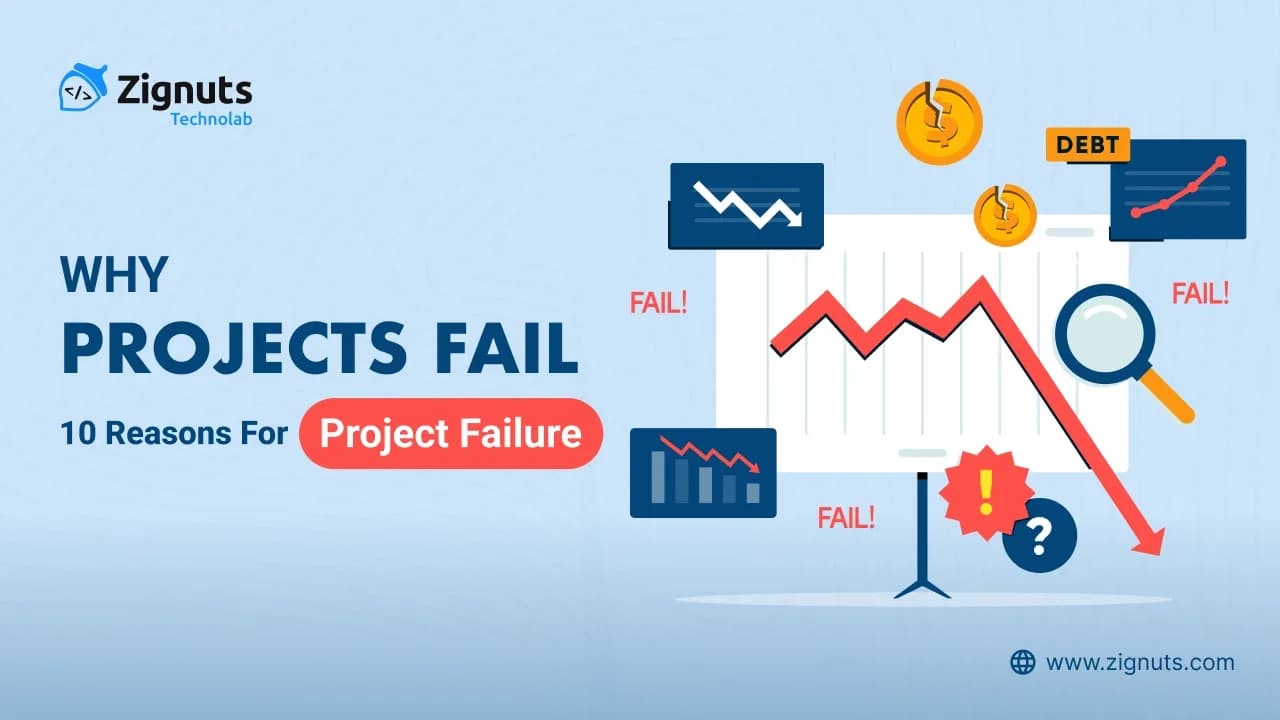
Projects, whether small-scale personal endeavours or large-scale corporate initiatives, often face numerous challenges. In 2026, the complexity of project management has been fundamentally rewired. We are now operating in an era where the integration of Autonomous AI Agents, decentralised remote-first global teams, and stringent ESG (Environmental, Social, and Governance) regulations is no longer optional; it is the baseline.
The traditional "Iron Triangle" of cost, time, and scope has expanded into a multidimensional "Resilience Matrix." Today, a project can be on time and under budget, yet still be considered a failure if it lacks ethical data transparency or fails to meet carbon-neutral computing standards. Recent 2026 industry data suggests that while AI has increased productivity by 40%, it has also introduced new failure points, such as "algorithmic bias" and "technical debt acceleration."
Understanding why projects fail in this hyper-connected, AI-driven landscape is crucial to mitigate risks and ensure long-term viability. This article delves into ten common reasons for project failures, enriched with real-life examples from the 2026 market and strategic insights from the front lines of digital transformation.
Why Projects Fail: How Poor Planning Leads to Disaster
1. Poor Planning and Lack of Clear Goals
Poor Planning Consequences:
One of the primary reasons projects fail is inadequate planning. In 2026, this often manifests as "AI-First" thinking, implementing complex technology without a strategic roadmap. According to 2026 industry reports, 37% of projects still fail due to a lack of defined milestones, but the impact is deeper than just missed dates. Without a robust plan, projects succumb to "Technical Gravity," where the weight of uncoordinated features pulls the entire initiative toward a collapse.
In the modern landscape, planning must account for Hyper-Agility and Human-AI Synergy. Failing to plan for data governance, model training timelines, and API scalability at the onset creates a "Planning Debt" that becomes impossible to repay mid-cycle.
- Directionless Development:
Teams become reactive rather than proactive, chasing "fire-fighting" tasks instead of high-value features.
- Resource Wastage:
Significant capital is burned on "vanity features" or expensive AI tokens that do not solve the core user problem.
- Misalignment:
A "Vision Gap" emerges where stakeholders expect immediate AI-driven ROI while developers are still struggling with fundamental infrastructure integration.
- Sustainability Blindness:
In 2026, failing to plan for Green Compute costs and energy efficiency leads to budget blowouts that were entirely predictable.
Example: A prominent fintech startup launched a new wealth management app in early 2026, leaning heavily on generative AI for personalised advice. Because they bypassed thorough market research and feasibility studies during the planning phase, they failed to account for the skyrocketing costs of real-time data processing. The technical glitches and high overhead costs led to the project's demise before it could reach a sustainable user base.
Personal Experience: In a previous role, I observed a project where the team skipped the planning phase to save time. The project was riddled with delays and budget overruns, ultimately leading to its cancellation.

Project Failure Reasons: Why Projects Fail Due to Inadequate Risk Management
2. Inadequate Risk Management
Importance of Risk Management:-
In 2026, risk management is no longer a static "check-the-box" activity; it is a dynamic, real-time necessity. With the rapid evolution of Agentic AI and decentralised cloud networks, projects that fail to identify and mitigate modern risks are doomed before they launch. According to 2026 executive surveys, cybersecurity and third-party AI risks have overtaken financial volatility as the #1 threat to project success.
Effective risk management now involves:
- AI-Assisted Risk Assessments:
Using predictive algorithms and Monte Carlo simulations to find hidden bottlenecks and "Black Swan" events. These tools analyse historical data to forecast where vulnerabilities such as vendor instability or technical debt might emerge weeks before they impact the timeline.
- Continuous Monitoring:
Tracking external market shifts, geopolitical data, and rapidly changing ESG (Environmental, Social, and Governance) regulations in real-time. By 2026, systems will be integrated with global news feeds and regulatory APIs to alert project managers of compliance shifts the moment they are announced.
- Automated Contingency:
Implementing "Agentic Guardrails" or automated response plans to contain risks instantly. This includes resource reallocation strategies that automatically shift workloads if a team member becomes unavailable or budget rebalancing recommendations if cloud compute costs spike unexpectedly.
- Addressing AI Model Drift:
Proactively managing the risk where an AI’s performance degrades over time due to shifting data patterns. Projects in 2026 require a "Model Hygiene" plan to ensure that, as real-world conditions change (like shifting consumer habits), the AI remains accurate and reliable.
Example: A large-scale construction project in 2026 ignored the combined risk of supply chain volatility and extreme climate shifts predicted by regional data models. Because they lacked a real-time risk dashboard, unexpected hardware shortages and new carbon-emission regulatory stops caused a 40% budget overrun and massive legal delays.
Personal Opinion: Incorporating a comprehensive risk assessment that includes "what if" scenarios for technological shifts early in the project lifecycle is essential. In today’s landscape, where a single AI update or regulatory change can pivot an entire industry overnight, it’s better to be over-prepared for a digital disruption than to face an avoidable crisis.
Hire Dedicated Developers Today!

Why Projects Fail Due to Insufficient Resources and Budget Constraints
3. Insufficient Resources
Resource Allocation Challenges:
Projects often fail due to inadequate financial, human, or computational resources. In 2026, the high cost of GPU power and specialised AI talent has become a primary bottleneck for digital transformation. According to 2026 supply chain reports, the global "GPU Crunch" has driven hardware costs up by 15–25% for mid-range configurations, making infrastructure budgeting more volatile than ever. Proper resource allocation now requires balancing traditional overhead with the high-bandwidth memory (HBM) and specialised compute power necessary to maintain AI-driven systems.
- Burnout:
In 2026, 73% of developers report experiencing burnout due to the "Productivity Paradox," the expectation that AI tools should make them faster, when in reality, managing AI-generated code often increases cognitive load. Over-allocating tasks to a small team leads to a 30% drop in overall output quality and a spike in attrition.
- Technical Debt:
Cutting corners on infrastructure, such as choosing lower-tier server instances or skipping robust data pipelines, leads to massive "rework" costs later. By 2026, 75% of technology leaders face severe technical debt caused by "quick-fix" AI integrations that lack long-term architectural integrity.
- Skill Gaps:
The demand for AI architects and cybersecurity experts in 2026 vastly exceeds supply. Using non-certified managers for high-stakes AI integrations often results in "Project Amnesia," where a lack of institutional knowledge leads to the same expensive mistakes being repeated across different departments.
- Computational Overrun:
Many 2026 projects fail because they budget for "initial training" but ignore the "inference tax," the ongoing cost of running AI models at scale. Without a dedicated budget for high-bandwidth memory and GPU cooling, operational costs can spiral out of control within months of launch.
Example: A global marketing campaign in early 2026 was launched with a limited budget that didn't account for the surging costs of GDDR7 memory and real-time data processing. The lack of computational resources led to severe system latency, resulting in poor execution and minimal consumer impact.
Personal Experience: I once worked on a project where we underestimated the required cloud infrastructure for a real-time analytics platform. The system crashed under peak load because we hadn't budgeted for auto-scaling GPU clusters. This proved that a thorough resource needs assessment, including a "Compute Stress Test," must happen before the first line of code is written.
How Poor Communication Contributes to Why Projects Fail
4. Poor Communication
Communication Breakdown:
Effective communication remains the backbone of successful project management. In 2026, the primary challenge is no longer just "misunderstanding," but "Digital Fatigue", a state of cognitive overload caused by an endless stream of automated notifications, AI pings, and fragmented messages. Recent studies show that project managers now spend up to 90% of their time communicating, yet 57% of project failures are still linked to communication breakdowns. When teams are hyper-connected but under-informed, critical information becomes "background noise."
- Siloed Information:
In 2026, developers, business analysts, and stakeholders often operate in "tool-isolated bubbles." Even with integrated suites, critical data frequently gets trapped in non-indexed Slack huddles, private VR meeting rooms, or unlinked specialised AI platforms, leading to a fragmented "source of truth."
- Loss of Nuance:
Relying solely on AI-generated summaries is a major 2026 failure point. While these tools excel at condensing data, they often strip away emotional intelligence and human nuance in the tone of a client’s hesitation or the subtle sarcasm of a developer flagging a "simple" fix. This "Context Collapse" leads to teams executing tasks without understanding the underlying priority or urgency.
- Ineffective Meetings:
Using valuable synchronous time for "status updates" that an AI could have emailed is a drain on 2026 productivity. High-performing teams now reserve live meetings strictly for complex problem-solving and conflict resolution, while using asynchronous video messaging (like Loom or Vouch) for routine updates.
- Asynchronous Disconnect:
With remote-first global teams spanning every time zone, a lack of structured "handover documentation" in 2026 can stall a project for 12–24 hours every time a simple question goes unanswered.
Example: In a major 2026 software development project, the engineering team misinterpreted a client's "high priority" request because the AI summary they received prioritised the technical keywords over the client's repeated verbal concerns about user accessibility. The resulting product was technically perfect but functionally useless for the target demographic, leading to an expensive 3-month pivot.
Personal Opinion: Regular human-led check-ins and clear, manual documentation can prevent many issues. Encouraging an environment where team members feel comfortable flagging "AI errors" or logic gaps is crucial for building trust. In 2026, the most successful projects are those that balance machine efficiency with human empathy, ensuring that the "why" behind a task is never lost in the "how."
Managing Scope Creep: A Key Factor in Why Projects Fail
5. Managing Scope Creep
Managing Scope Creep:-
Scope creep in 2026 often happens when stakeholders ask for "just one more AI feature" without evaluating the technical impact. In this high-speed era, what starts as a minor adjustment can quickly spiral into a "Feature Death Spiral." Recent data indicates that 55% of projects experience scope creep, often leading to a total failure to deliver. In 2026, the complexity of AI integrations means that even a "simple" data tweak can require massive re-training of models or significant shifts in cloud infrastructure costs.
- The "Yes" Trap:
Project Managers often agree to small, seemingly harmless changes to maintain stakeholder harmony without recalibrating timelines, budgets, or resource loads. In 2026, every "yes" to a new feature is a "no" to the project’s original stability. Without an Automated Impact Analysis, PMs often fail to see that a small UI change might require a complete backend API refactor.
- Lack of Documentation:
Without a definitive Scope Statement or a "Definition of Ready" (DoR) from the start, there is no baseline to refer to when new requests emerge. This leads to "Requirements Drift," where the project’s finish line is constantly moving because the core objectives were never anchored in a signed-off digital contract.
- Gold Plating:
This occurs when the development team adds extra functionalities they think the client will like, such as unrequested AI personalisation or "fancy" UI animations without approval. While well-intentioned, this consumes vital "buffer" time, introduces untested code, and sets a dangerous precedent for "free" work that isn't sustainable.
- Feature Inflation:
Stakeholders in 2026 are often influenced by rapid competitor updates, leading to a desire to pack every new market trend into a single release cycle. This "FOMO-driven development" results in a bloated product that attempts to do everything but master nothing, significantly increasing the Change Velocity to a point where the team can no longer maintain control.
Example: A website redesign project kept expanding as the client requested continuous AI integrations, such as real-time predictive search and voice-automated navigation. This led to significant delays and a bloated interface that confused users rather than helping them, ultimately doubling the original launch timeline and increasing the budget by 60% due to unplanned GPU costs.
Personal Experience: I witnessed a project where stakeholders changed requirements mid-way to match a competitor's sudden update in generative AI capabilities. We learned that setting clear boundaries and managing expectations via a "Dynamic Backlog" where every new request must displace an existing one of equal effort is essential to prevent total project derailment.
Stakeholder Engagement: Why Projects Fail Without Proper Alignment
6. Lack of Stakeholder Engagement
Engaging Stakeholders:-
Engaging stakeholders, including end-users, executive sponsors, and compliance officers, is the glue that holds a project's vision together. In 2026, the stakes are higher; projects often fail not due to technical glitches, but because they ignore the ethical, privacy, or regulatory expectations of the public. Without consistent engagement, an "Expectation Gap" develops where the technical team builds what they think is needed, while the stakeholders are left waiting for a solution that no longer fits the market reality.
- Feedback Loops:
Failing to show progress until the final delivery is a fatal mistake in a 2026 Agile environment. Research shows that projects using Continuous Feedback Pipelines, where stakeholders "test-drive" features every two weeks, see a 25% jump in customer happiness. Without these loops, teams risk spending months building a solution that is technically sound but commercially obsolete by the time it launches.
- Disengaged Sponsors:
Projects without an active high-level champion often lose funding or priority during organisational shifts. In 2026, a "Silent Sponsor" is a major risk factor; according to 2026 digital transformation studies, 70% of initiatives fail when executives stay hands-off. Success requires leaders who don't just approve budgets but actively remove roadblocks and communicate the "why" across the company.
- The Compliance Vacuum:
In 2026, the compliance function has shifted from "gatekeeper" to "strategic enabler." Failing to engage Legal and GRC (Governance, Risk, and Compliance) stakeholders early leads to massive "Compliance Debt." Many 2026 projects are legally suspended mid-way because they failed to audit AI models for demographic bias or didn't align with the latest sovereign data residency laws.
- End-User Alienation:
Stakeholders aren't just the people paying the bills; they are the people using the product. Ignoring the "boots on the ground" perspective leads to a high User Rejection Rate. In 2026, involving users in the design process, such as through Co-Creation workshops or Beta testing groups, reduces onboarding time by up to 40% and ensures the tool solves actual pain points rather than imaginary ones.
Example: A major government IT project failed in early 2026 because the end-users (citizens and administrative staff) were not consulted during the UI/UX and workflow design phases. While the system featured cutting-edge AI automation, the final product was too complex and unintuitive for the target demographic, leading to a total rejection by the public and a complete loss of the $15M investment.
Personal Opinion: Regular stakeholder meetings and updates using interactive dashboards can help align the project with their expectations and ensure their continuous support. Involving stakeholders from the beginning and maintaining open lines of communication can prevent many issues and ensure the project stays on track.
Setting Realistic Deadlines to Avoid Why Projects Fail
7. Unrealistic Deadlines
Setting Realistic Deadlines:-
Setting aggressive deadlines in 2026 is a primary driver of project failure, as the speed of the market often clashes with the complexity of modern integrations. According to 2026 industry data, only 35% of projects worldwide successfully meet all their goals and timelines. When deadlines are set based on "market optimism" rather than data-driven capacity, teams are forced into a cycle of reactive firefighting.
- Rushed Quality:
To hit an arbitrary date, teams often skip essential security audits, load testing, and AI model validation. This results in "Testing Debt," where undiscovered defects enter the final product, compromising its reliability and making it 10x more expensive to fix post-launch.
- Technical Debt Accumulation:
Rushed development leads to "spaghetti code" and poorly structured architecture. By 2026, teams with high technical debt spend up to 40% more time on maintenance versus new development, effectively grinding future innovation to a halt as they struggle to "pay back the interest" on past shortcuts.
- Low Morale and Attrition:
Constant overtime leads to massive talent attrition. In 2026, replacing a single skilled team member can cost up to four times their annual salary when factoring in recruitment, onboarding, and the loss of institutional knowledge. Burnout is now a measurable financial risk, costing businesses nearly 3x more than health insurance.
- The Productivity Paradox:
Ironically, attempting to speed up development by imposing unrealistic deadlines often results in paradoxical delays. Rushed work creates more errors, which require more rework, ultimately pushing the launch date further back than a realistic schedule would have in the first place.

Example: A major product launch in early 2026 was set with an aggressive 6-month deadline to beat a rival to the market. To meet the date, the team bypassed a critical third-party security audit. The rushed development led to critical vulnerabilities discovered just two weeks post-launch, resulting in a data breach that cost the company $5M in legal fees and irreparable harm to its reputation.
Personal Opinion: In 2026, a realistic timeline is not a sign of slow work; it is a sign of strategic maturity. Using Predictive Analytics to forecast delays and setting deadlines based on actual team velocity ensures a superior, stable product. It is always better to launch a week late with a perfect system than to launch on time with a broken one.
Inadequate Tools and Their Role in Why Projects Fail
8. Inadequate Project Management Tools
Importance of Project Management Tools:-
In 2026, the technological gap between high-performing teams and failing ones is defined by their choice of infrastructure. Teams that still rely on manual tracking or outdated software are 28% less likely to deliver on time and 40% more likely to go over budget. Modern project management is no longer just about task lists; it is about real-time data synthesis. Without AI-integrated PM tools, leaders are essentially flying blind in a hyper-speed market.
- Manual Reporting Overload:
In 2026, time is the most expensive resource. Project Managers (PMs) using legacy systems spend over 20% of their week (roughly 1+ days) just compiling status updates and manual reports. This administrative burden prevents them from focusing on high-level strategy and team mentorship.
- Lack of Real-Time Visibility:
Relying on fragmented tools leads to "Data Lag." Without a centralised, real-time dashboard, it is impossible to verify if a task is truly "Done" or just "In Progress." This lack of transparency causes a "Sync Gap" where different departments work on outdated versions of a project, leading to massive friction.
- Predictive Failure:
Legacy tools can only show you what has already happened. 2026-standard tools use Predictive Analytics to flag potential delays before they occur. Without these features, teams cannot anticipate resource shortages or timeline slippage until it is too often too late to course-correct.
- Fragile Integration:
In a remote-first world, tools that don't offer seamless integration with VR collaboration spaces, automated Git repositories, and ESG tracking software create "Information Silos." This results in team members spending more time looking for information than actually executing tasks.
Example: A mid-sized engineering firm relied on basic spreadsheets and disconnected email threads for a complex, multi-national infrastructure project in 2026. The result was a catastrophic failure in version control; the construction team in one region used an outdated blueprint while the procurement team ordered materials for the new one. The resulting disorganised information and lack of a "Single Source of Truth" led to a $1.2M loss in wasted materials alone.
Personal Opinion: Investing in robust software like Asana, Jira, or Microsoft Project and training the team to use their predictive features effectively is non-negotiable in 2026. Transitioning from "tracking tools" to "intelligent platforms" allows a project to breathe and adapt. In my experience, the cost of a premium tool is always lower than the cost of a failed project caused by a spreadsheet error.
Hire Dedicated Developers Today!
Navigating Project Changes: Why Projects Fail Due to Lack of Flexibility
9. Lack of Flexibility
Being Flexible, Projects in 2026 must operate within an "Agile-Hybrid" framework to survive. The era of rigid, five-year "Waterfall" plans is over; in today's landscape, rigidity in the face of a market shift is not just a hurdle, it is fatal. According to 2026 industry benchmarks, organisations that embrace Adaptive Planning are 3x more likely to pivot successfully when faced with external disruptions. Flexibility is no longer an optional "soft skill"; it is a strategic requirement for project resilience.
- Pivot or Perish:
In 2026, the regulatory landscape is in constant flux. The ability to change direction, whether due to a new update to the 2026 AI Ethics Act or a sudden shift in global data privacy laws, is the difference between a successful launch and a legal shutdown. Teams must be prepared to refactor entire modules to maintain compliance without collapsing the project timeline.
- Adaptive Governance:
Moving away from "one-size-fits-all" methodologies is essential. In 2026, high-performing teams use Value-Driven Execution, where success is measured by strategic impact rather than just sticking to a predefined checklist. This allows for "Micro-Pivots", small, data-driven course corrections that prevent large-scale failure later on.
- Iterative Funding and Capacity:
Rigid annual budgets are being replaced by Quarterly Adaptive Funding. In 2026, projects that lack the flexibility to reallocate resources mid-cycle often find themselves stuck with "Zombie Features" functionalities that are fully funded but no longer provide value to the shifting market.
- Resilience to "Black Swan" Events:
Whether it's a sudden GPU supply chain shortage or a breakthrough in a competitor's AI model, a flexible project structure allows for rapid scenario planning. Flexible teams build "Buffer Zones" into their architecture, allowing them to swap out third-party APIs or cloud providers with minimal downtime.
Example: A major retail project in 2026 stuck to its original two-year development plan despite a sudden, mid-year shift in consumer privacy laws regarding biometric data. Because the leadership refused to deviate from the initial "Locked Scope," the team continued building features that became illegal by the time of launch. The failure to adapt resulted in a product that was legally non-compliant, leading to a total loss of investment and a significant regulatory fine.
Personal Opinion: At Zignuts, we have found that "Rigidity is the enemy of Innovation." In 2026, the most successful projects are those that view the initial plan as a compass, not a set of tracks. By fostering a culture where "Pivoting" is seen as a strength rather than a failure, you empower your team to chase value instead of just checking boxes.
Incompetent Management: The Human Element in Why Projects Fail
10. Incompetent Project Management
Skilled Project Managers:-
In 2026, the role of the Project Manager (PM) has undergone a fundamental transformation. A successful PM must now act as a "Tech-Translator", a hybrid leader capable of bridging the gap between complex algorithmic logic and human strategic goals. Incompetent management in this era isn't just about poor scheduling; it’s a failure to synchronise human intuition with machine precision. Without a manager who understands the "language" of 2026 technology, projects quickly succumb to a lack of technical vision and a leadership vacuum.
- Inexperience and Lack of Certification:
Data from 2026 indicates that 53% of projects are still managed by "accidental project managers" professionals without formal certification or specialised training in AI-driven workflows. This leads to a 60% higher failure rate compared to projects led by certified PMP or AI-Agile practitioners who understand how to manage non-linear development cycles.
- Failing the "Human-AI" Synergy:
A major 2026 failure point is the inability to balance a hybrid workforce. Incompetent managers often lean too heavily on AI automation, alienating human talent, or conversely, ignore AI efficiencies entirely. Managing this synergy requires high Emotional Intelligence (EQ) to maintain morale while integrating automated agents into the team's daily pulse.
- Technical Literacy Gap:
Many 2026 projects fail because the manager lacks a foundational understanding of modern stacks like Cloud-Native Architecture, LLMOps, or Edge Computing. When a PM cannot grasp the technical constraints of the project, they make promises to stakeholders that the engineering team simply cannot keep, leading to a permanent breakdown in trust.
- Decision Paralysis in the Face of Data:
With 2026 tools providing an overwhelming amount of predictive data, incompetent managers often suffer from "Analysis Paralysis." Skilled managers, however, know how to filter AI insights to make decisive, timely moves that keep the project’s momentum alive.

Example: A large-scale IT modernisation project for a global logistics firm failed in early 2026 because the appointed manager lacked a basic understanding of cloud-native architecture. By treating the project like a traditional legacy migration, they made poor architectural decisions that resulted in a system that was unable to scale during peak demand. The total project mismanagement led to a $3M deficit and a complete system rollback.
Personal Opinion: Investing in hiring or training skilled project managers who stay updated with 2026 industry standards is the single most important insurance policy for your project. A manager who can navigate high-tech challenges while keeping the "human element" front and centre is the difference between a project that just survives and one that truly disrupts the market.
For those embarking on a new project, starting with a well-developed Minimum Viable Product (MVP) can prevent many common failures. At Zignuts, our MVP Development Services are designed to help you validate your ideas and set a solid foundation for success. Learn more about how we can support your project at MVP Development Services.
The Future Frontier: Why Projects Fail Without Ethical Compliance
11. Neglecting Sustainability and Ethical AI Governance
The Impact of ESG and Compliance:-
In 2026, sustainability and ethical governance are no longer "optional extras"; they are core project requirements. Failure to align with Environmental, Social, and Governance (ESG) standards can lead to immediate funding withdrawals, public boycotts, or severe legal penalties. As the EU AI Act reaches full applicability in August 2026, projects that bypass ethical audits risk being classified as "unacceptable risk," leading to permanent service shutdowns.
- Energy Inefficiency:
AI workloads in 2026 consume massive amounts of power. Projects that fail to use Energy-Efficient Computing, such as model quantisation, pruning, or renewable-aware scheduling, face soaring operational costs and "Carbon Taxes." According to 2026 reports, data centre power demand has increased by 17% annually, making energy optimisation a financial necessity.
- Algorithmic Bias:
Deploying AI that unintentionally discriminates based on race, gender, or age is a primary failure point. In 2026, "Bias Audits" are mandatory for high-risk systems (like those in hiring or lending). Failure to implement Explainable AI (XAI) to justify automated decisions can lead to "Model Prohibitions" under new global ethics frameworks.
- Data Sovereignty and Privacy:
Mismanaging user data in the age of strict 2026 sovereign data laws (like the updated GDPR and the India Digital Personal Data Protection Act) is fatal. Projects must now account for Data Residency, ensuring that sensitive data stays within national borders and under local jurisdiction, or face fines that can reach 7% of global turnover.
- The "Water Thirst" Factor:
In 2026, social license to operate depends on resource stewardship. Large-scale AI projects are now being scrutinised for their water footprint (used for cooling servers). Neglecting this can lead to community protests and regulatory stops in drought-prone regions.
Example: A major financial services firm developed an AI-driven lending tool in early 2026, but failed to perform a third-party audit for demographic bias. The tool was found to be disproportionately rejecting applicants from specific zip codes. Under the 2026 AI Ethics Act, the project was legally suspended after only three months of operation, resulting in a $10M loss and a massive blow to the firm’s "Trust Score."
Personal Opinion: In the 2026 landscape, a project’s "Return on Ethics" is just as important as its Return on Investment. By integrating Responsible AI (RAI) frameworks from day one, you don't just avoid fines; you build a brand that consumers can actually trust. Sustainability is the ultimate insurance policy for long-term project viability.
Hire Dedicated Developers Today!
Data and Culture: Why Projects Fail in the Modern Era
12. Poor Data Hygiene and "Garbage In, Garbage Out" (GIGO)
The Foundation of AI Failure:-
In 2026, data is the fuel for every major corporate initiative. However, many projects fail because they underestimate the state of their "Data Health." If the underlying data is fragmented, outdated, or poorly labelled, even the most expensive AI agent will fail to deliver value. According to 2026 data engineering benchmarks, 45% of AI projects stall because teams spend more time cleaning "dirty data" than actually building features. In a world of autonomous decision-making, the cost of an error is no longer just a typo in a report it is a systemic failure of the project's logic.
- Legacy Data Silos:
Projects often fail when they attempt to integrate modern AI with legacy databases that weren't designed for real-time access. This results in "Data Latency," where the AI provides insights based on information that is already 24 hours old. In the high-speed 2026 market, making decisions on day-old data is equivalent to driving a car while looking only at the rearview mirror.
- Synthetic Data Poisoning:
A new risk in 2026 involves the use of synthetic data. If a project relies on data generated by other AI models without strict human oversight, it can lead to "Model Collapse," where the system begins to output nonsensical or repetitive results. This "recursive pollution" can degrade a project's intelligence until it becomes entirely unusable.
- Labelling Inaccuracy:
Inconsistent data labelling across decentralised global teams leads to conflicting AI logic. Without a Unified Data Dictionary, different parts of the project will interpret the same metrics, such as "customer churn" or "delivery completion" in different ways, causing the AI to hallucinate contradictory strategies.
- Data Bias and Skew:
Even "clean" data can be dangerous if it is unrepresentative. In 2026, projects fail when their datasets lack diversity or contain historical prejudices, leading to biased outputs that trigger regulatory intervention and public backlash.
- Lack of Data Lineage:
Many teams fail because they cannot trace where their data came from or how it was transformed. In 2026, Auditability is key; if a project manager cannot explain why an AI made a specific decision due to a lack of data tracking, the project risks being shut down during a compliance review.
Example: A 2026 logistics giant attempted to automate its entire global supply chain using a neural network. However, because their regional offices used different data formats for "arrival times" and failed to account for localised time-zone shifts in their data entry, the AI produced conflicting schedules. This caused a massive bottleneck at European ports, leading to significant delays in global shipping and a major loss in contractual trust with their primary vendors.
Personal Opinion: Data hygiene should be treated as a high-priority architectural phase, not a cleanup task for the end of the project. I have seen countless initiatives fail because they prioritised "fancy algorithms" over "factual data." In 2026, your AI is only as smart as the records you give it; investing in a robust Data Governance Framework at the start is the only way to ensure the project doesn't collapse under the weight of its own misinformation.
13. Culture Shock and "Shadow AI" Resistance
The Human Element of Transformation Project's failure in 2026 is often a sociological issue rather than a technical one. When organisations implement massive technological shifts without addressing organisational culture, they encounter "Passive Resistance." This manifests as Shadow AI, where employees use unauthorised, unvetted AI tools because the official project is too complex, slow, or restrictive. According to 2026 executive surveys, over 60% of professionals admit to using unsanctioned AI tools to meet productivity pressures, creating a massive "Governance Gap" that leaves the official project as an expensive, empty shell.
- The Trust Gap and "Superagency":
If employees fear that a project is designed to replace them rather than augment their "Superagency," they will subconsciously sabotage the rollout. In 2026, projects that lack a "Human-in-the-Loop" (HITL) philosophy see a 50% lower adoption rate. Success requires shifting the narrative from "Automation" (replacing humans) to "Augmentation" (empowering humans).
- Shadow AI Proliferation:
When official project tools are too rigid or gated by slow IT approvals, teams bypass protocols to use personal AI agents. This creates massive security vulnerabilities and fragments the project's data, leading to "Inference Leaks" where sensitive company logic is absorbed into public AI training sets, often triggering severe regulatory fines.
- Inadequate AI Literacy:
Many projects fail because they assume staff already know how to prompt and interact with 2026-grade agentic interfaces. Skipping the "AI Literacy" phase leads to user error, "hallucination" acceptance, and a surge in support tickets that drain the project’s remaining resources.
- The "Junior PM" Vacuum:
In 2026, AI has automated most entry-level administrative tasks. Projects often fail because they lack a "Junior-to-Senior" talent pipeline; without experienced human mentors to oversee AI-generated plans, the project lacks the nuanced judgment required for complex problem-solving.
- Algorithmic Anxiety:
Constant monitoring by AI "productivity trackers" can lead to a culture of fear. Projects that prioritise machine metrics over employee well-being face high turnover rates, with 73% of developers in 2026 reporting burnout due to the increased cognitive load of managing AI-generated code.
Example: A major healthcare provider implemented a state-of-the-art AI diagnostic assistant in 2026. However, because they failed to involve senior medical staff in the design phase, the doctors viewed the tool as a threat to their clinical judgment. Instead of using the secure, sanctioned platform, staff began using unauthorised personal AI tools to summarise patient notes for speed. This led to a catastrophic "Data Leak" when sensitive patient information was used to train a public model. The official system was mothballed within six months due to "zero utilisation," resulting in a total loss of the project investment.
Personal Opinion: In 2026, the "Safe Path" must also be the "Fast Path." If your official project tools are more cumbersome than a rogue AI chatbot, you have already lost the battle for your employees' focus. At Zignuts, we believe that transparency is the antidote to Shadow AI; by fostering a culture of curiosity and providing safe "AI Sandboxes," you turn rogue innovators into your project’s strongest advocates.
Conclusion: Navigating the Landscape of Why Projects Fail
In 2026, project success is no longer a binary of "on time" or "under budget," but a complex equilibrium within the Resilience Matrix. Organisations that navigate these thirteen pitfalls realise that modern project management has evolved into a high-stakes integration of technical precision, ethical foresight, and psychological safety. From the foundational necessity of Data Hygiene to the critical avoidance of "AI Hype," every factor underscores a shift toward Adaptive Intelligence. This means the most successful initiatives are those built on a "Human-in-the-Loop" philosophy, ensuring that as AI scales operational speed, human intuition remains the ultimate guardrail for strategic direction and ethical governance.
Furthermore, the 2026 landscape demands that leaders treat Cultural Alignment and Sustainability as core technical requirements. To execute these complex integrations without falling into the traps mentioned above, many industry leaders choose to Hire Dedicated Developers who specialise in AI-Agile frameworks and ESG-compliant architecture. Neglecting the human element leads to the rise of "Shadow AI," while ignoring ESG mandates can result in immediate regulatory shutdowns.
As we move forward, the projects that thrive will be those that view change not as a disruption to the plan, but as the plan itself. By fostering a culture of continuous upskilling and predictive risk management, organisations can transform potential points of failure into a sustainable competitive advantage. If you are looking for a partner to help navigate these complexities, explore our expertise and Contact Zignuts to start your journey toward project resilience today.

Zignuts Technolab
Zignuts Technolab delivers future-ready tech solutions and keeps you updated with the latest innovations through our blogs. Read, learn, and share!