


.svg)

.svg)


.svg)

.svg)


.webp)
.webp)
The arrival of React 19 in December 2024 ignited passionate discussions throughout developer communities. With the debut of Actions, Server Actions, and robust new hooks including useActionState and useFormStatus, a compelling question emerged: has Redux finally faced its successor? Having worked extensively with React since its formative years, I contend that this inquiry warrants thoughtful analysis rather than a simple binary response.
React 19 Actions: A Comprehensive Overview
React 19, stable since late 2024, represents a pivotal transformation in managing form submissions and state. While 2026 sees the community anticipating React 20, version 19.2 remains the production standard. Its Actions capability isn't just a feature; it's an integrated ecosystem reconceptualizing data mutations. Fundamentally, Actions empower developers to process form submissions with markedly reduced boilerplate compared to legacy methodologies.
Conventional form handling in React demanded manual administration of state variables. Developers relied on useState for tracking loading indicators, error conditions, and success notifications collectively. React 19 Actions mitigate this by delivering native support for asynchronous operations embedded directly within form elements via the action property, standardizing patterns that were previously fragmented.
The useActionState Hook Explained
Among React 19's additions, useActionState stands out for governing asynchronous action states. This hook furnishes a standardized mechanism for monitoring an action's lifecycle. Prior to React 19, practitioners commonly orchestrated these states through multiple useState invocations, generating repetitive patterns.
Examining the conventional methodology reveals complexity. Separate state declarations were necessary for isLoading, error, and success. Every submission mandated manual state modifications at distinct phases. useActionState accomplishes equivalent functionality with substantially reduced code. The hook yields the present state, a form action function, and a pending indicator. This encapsulation eliminates manual tracking, autonomously managing transitions based on promises returned by action functions.
The useFormStatus Hook in Practice
The useFormStatus hook delivers instantaneous information regarding form submission status, crucial for constructing responsive interfaces with immediate user feedback. The hook produces an object containing pending status, submitted data, method details, and action references.
A notable limitation is that useFormStatus must be used in a child component of the <form>. It cannot access status for a form rendered in the same component. This promotes creating reusable submit buttons:
This pattern eliminates the need to pass isLoading props down through component trees.
Understanding Server Actions
Server Actions constitute React 19's most revolutionary mutation handling capability. By applying the "use server" directive, developers authorize server-side logic that integrates fluidly with client components, removing the need for distinct API routes.
This architecture operates by establishing references to server functions that React automatically serializes. Upon invocation, React dispatches requests for execution and returns results transparently. Regarding form processing, Server Actions dramatically streamline workflows. Rather than constructing API routes, addressing CORS, and manually parsing data, developers compose async functions executing directly on servers. Form actions accept these functions natively, establishing clean boundaries between client presentation and server logic.
Ready to bring your web application vision to life? Start your journey with Zignuts expert React.js developers.
**Hire now**Hire Now**Hire Now**Hire now**Hire now

Redux in 2026: Persistent Strengths
React 19 hasn't de-throned Redux as a formidable state management instrument. In 2026, Modern Redux Toolkit (RTK 2.0+) remains a staple for complex applications, having resolved historical boilerplate issues while optimizing the developer experience.
While emerging patterns like Signals (for fine-grained reactivity) and Atomic State (via libraries like Jotai) have gained traction for specific use cases, Redux continues to excel in scenarios requiring intricate state logic, time-travel debugging, and predictable modifications. Its single source of truth pattern is indispensable for large applications needing synchronized access across numerous components. For enterprise-scale business rules, Redux supplies architectural clarity that native capabilities struggle to replicate. The segregation of actions, reducers, and selectors ensures maintainability, while middleware handles complex asynchronous workflows beyond simple form submissions.
Scenarios Where Actions Excel
React 19 Actions distinguish themselves where Redux previously seemed excessive. Applications heavily dependent on forms benefit tremendously. When state management centers on submissions, loading, and errors, Actions deliver native solutions eliminating dependencies.
Server-state management now possesses superior alternatives. Server Actions combined with libraries like TanStack Query address server-state scenarios more gracefully than Redux. Automatic caching, background refetching, and optimistic updates available through these tools exceed Redux's offerings.
Small and medium applications with uncomplicated requirements no longer necessitate Redux. The combination of useActionState, useFormStatus, and Server Actions handles mutations elegantly.
For immediate UI updates, React 19's useOptimistic hook pairs perfectly with Actions:
This handles optimistic UI updates natively, a feature that previously required complex Redux middleware setups.
Situations Favoring Redux
Despite React 19's advancements, Redux retains advantages. Sophisticated client-side state spanning multiple features and requiring complex update logic remains Redux's specialty. Applications incorporating real-time data sync, collaborative editing, or complex undo-redo functionality benefit from its predictable state machine.
High-frequency state updates, like data visualization dashboards, perform optimally with Redux's selector-based subscription architecture, preventing unnecessary re-renders common with Context. Development teams on substantial codebases appreciate Redux's explicit patterns and robust typing. The mandated structure simplifies code review and onboarding. When consistency across large teams is a priority, Redux's opinions transform from constraints into advantages.
Insights from Production Experience
Transitioning to React 19, I have witnessed remarkable reductions in boilerplate. A recent e-commerce checkout workflow that previously demanded hundreds of lines of Redux logic now operates with substantially less code using Server Actions and useActionState. The development velocity improvement is unquestionable.
Conversely, the application incorporates real-time collaboration and undo-redo functionality. Attempting to substitute Redux with React 19 features would generate complications. Explicit state management and middleware prove essential here.
My observation indicates the ecosystem is advancing toward specialization. React 19 Actions excel at form handling and server mutations. Redux dominates complex client-state scenarios. Successful teams will master appropriate tool selection rather than seeking a universal replacement.
Code Comparison: Before and After React 19
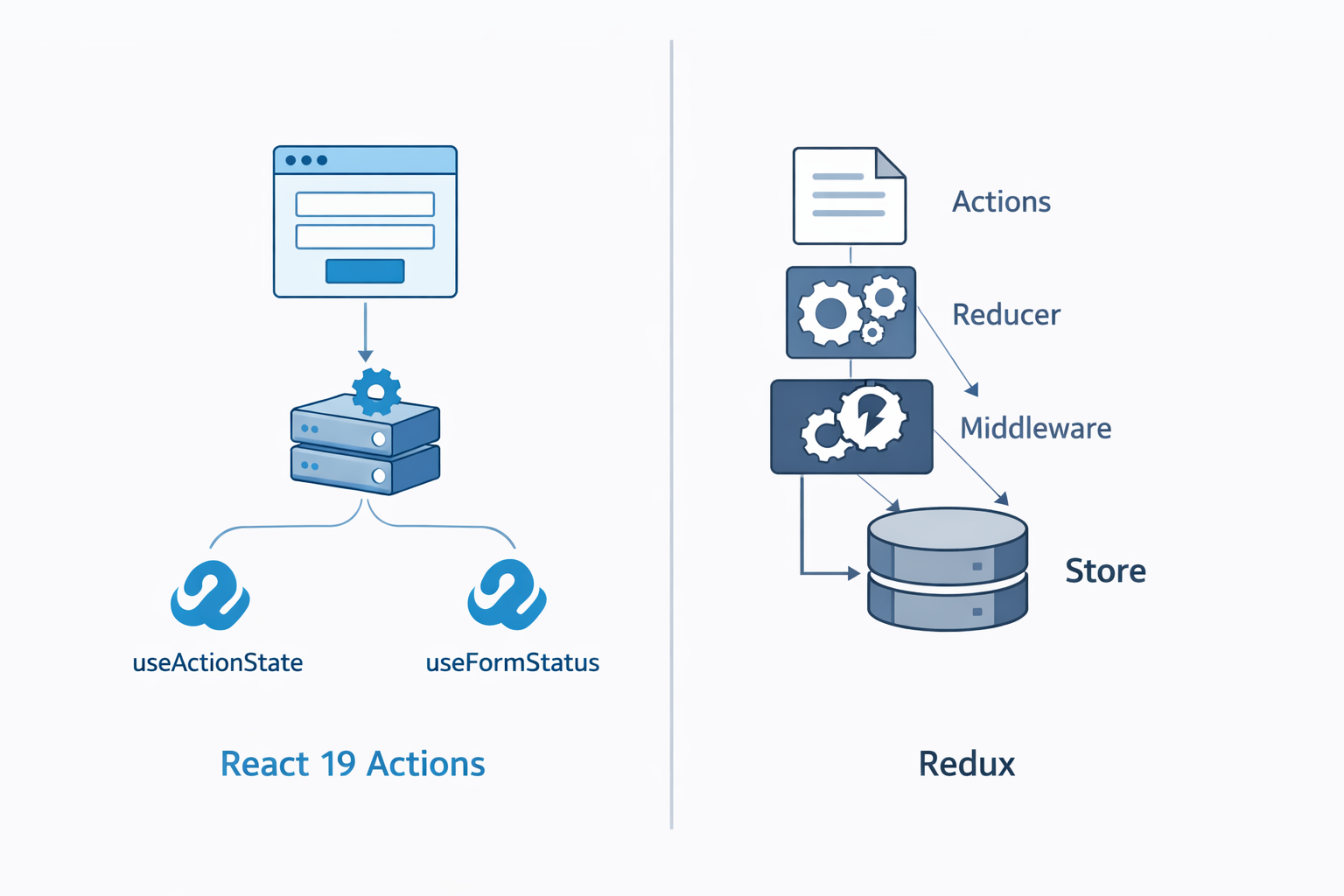
Examining concrete examples illuminates the differences. Consider a registration form handling loading, errors, and success.
The Redux approach requires substantial boilerplate. You need action types, creators, a reducer, and a component connection:
This pattern, while predictable, demands defining action creators, reducers, and selectors for a single form interaction.
React 19 simplifies this dramatically. Using useActionState, the same form requires only the hook and an async function. The hook manages transitions automatically. Server Actions eliminates separate API code, cutting lines of code often by fifty percent.
Here is a practical React 19 example:
This implementation demonstrates how useActionState encapsulates loading states, error handling, and success feedback without external libraries.
Migration Considerations
For existing Redux applications, a complete migration is rarely necessary. Strategic incremental adoption often yields better results.
New features offer ideal entry points for React 19 Actions. New forms can leverage useActionState without disturbing existing Redux infrastructure, allowing teams to evaluate patterns in production. However, for apps deeply invested in Redux with extensive middleware or sagas, maintaining the status quo is often pragmatic. The migration cost frequently exceeds benefits; in these cases, React 19 Actions should complement rather than replace the established architecture.
Summary
React 19 Actions embody progress for form handling and server mutations, though they haven't rendered Redux obsolete. They eliminate Redux for form-intensive apps and simple server-state management. Nevertheless, Redux is complemented by modern reactive patterns like Signals, which appropriately preserve its standing for complex client-state scenarios and enterprise applications.
The most productive approach in 2026 involves comprehending each tool's strengths. Employ React 19 Actions for forms and uncomplicated async operations. Select Redux for complex apps with intricate state requirements. The objective involves applying appropriate solutions to specific challenges, not choosing exclusively between alternatives.





.webp)
.webp)
.webp)

.webp)
.webp)
.webp)
.webp)
.webp)
.webp)


