

Jotai vs Zustand: Quick Comparison Summary
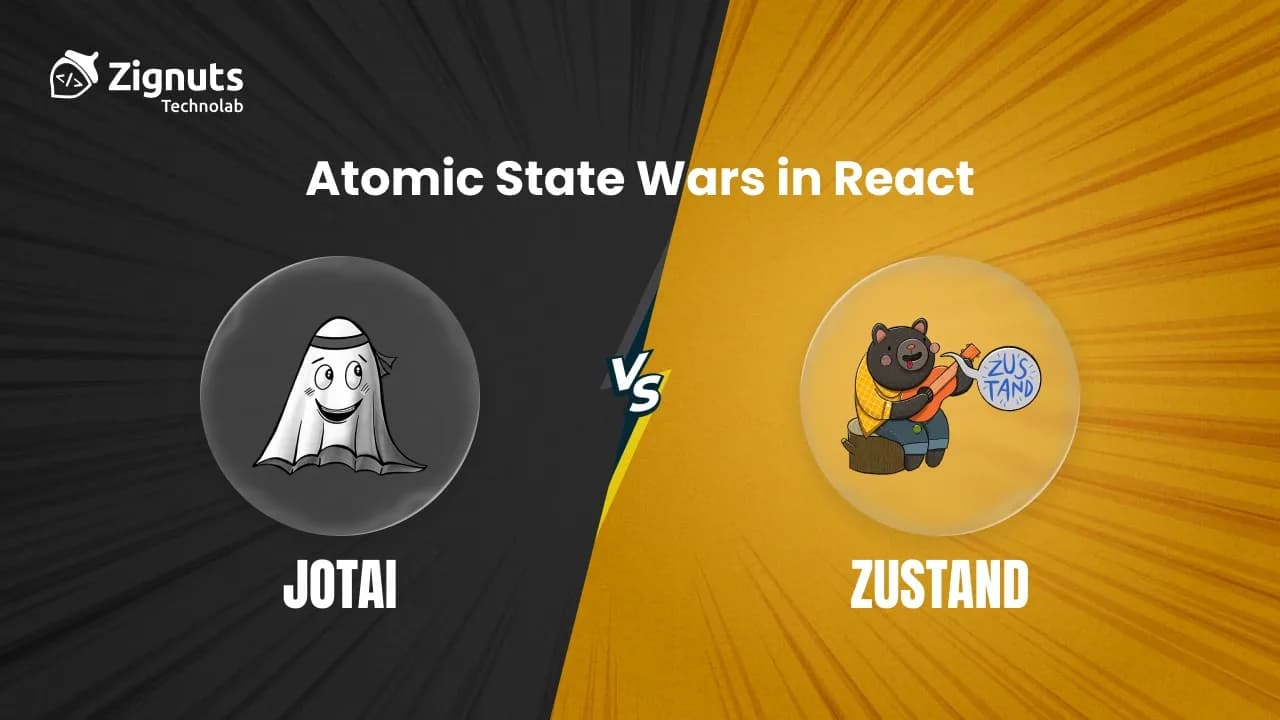
Choosing between Jotai vs Zustand depends on your application’s architecture. At Zignuts, our development teams prioritize Jotai for fine-grained reactivity in complex UIs and Zustand for scalable, centralized global state management.
- Jotai (Atomic): Best for micro-updates and modular features. It breaks the state into independent "atoms," ensuring only the specific component using that atom re-renders.
- Zustand (Centralized): Best for app-wide data like Auth and Themes. It uses a single store with a hooks-based API, offering a simpler, more predictable boilerplate than Redux.
The Verdict:
If you want ultimate performance and modularity → choose Jotai.
If you want clarity and centralized control → choose Zustand.
Why Choosing Between Jotai vs Zustand Matters for React Performance
State management has always been a core challenge in React applications. As apps grow, managing state becomes complex, leading to performance issues, unnecessary re-renders, and hard-to-maintain code.
Traditional solutions like Redux introduced centralized stores, while modern libraries like Jotai and Zustand offer simpler and more efficient approaches.
This is where Atomic State Management in React comes into play.
In this blog, we’ll explore:
- What atomic state management means
- How Jotai and Zustand work
- Real-world examples
- Performance Comparison
- When to use each library
Hire React.js Developers Today!

Understanding the Atomic Approach in Jotai vs Zustand
Atomic state management means breaking state into small independent units (atoms) instead of storing everything in a single global store.
Each piece of state is isolated, components subscribe only to the data they need, and updates affect only minimal parts of the UI.
As a result, React applications achieve better performance , improved scalability 📈, and cleaner, more maintainable code .
Why is it called “Atomic”?
Just like atoms in physics:
- Atoms are the smallest units
- They are independent
- They can be combined to form complex structures
In state management:
- Each atom holds a small piece of the state
- Components subscribe only to the atoms they need
- Updates affect only relevant components
Jotai is a pure atomic state library, while Zustand blends atomic ideas with centralized stores.
What is Jotai?
Jotai is a lightweight state management library based on the concept of atoms.
Unlike traditional centralized state management solutions, Jotai allows you to manage state in a decentralized and fine-grained way.
Each atom represents a single piece of state.
Core Concept
- Atom = the smallest unit of state
- Components subscribe directly to atoms
- Derived atoms can depend on other atoms
Deep Dive into Jotai: Fine-Grained Atomic State
Let’s build a simple counter app.
Step 1: Create an Atom
This atom holds a single piece of state: count.
Using Atoms in React Components
Step 2: Use Atom in a Component
What’s happening here?
- The component subscribes only to countAtom.
- When countAtom changes, only this component re-renders.
No global store or reducers are required.
Atomic State Management in React: Jotai Advantages
1. Fine-Grained Reactivity
Each atom updates independently, reducing unnecessary renders.
2. Minimal Boilerplate
No reducers, actions, or complex configuration.
3. Derived State Support
Atoms can depend on other atoms.
Example:
const doubleCountAtom = atom((get) => get(countAtom) * 2);
4. Perfect for Component-Level State
Ideal for apps with modular UI and micro-features.
Atomic State Management in React with Zustand
What is Zustand?
Zustand is a simple and powerful state management library that uses a centralized store but avoids Redux complexity.
Unlike traditional state managers, Zustand combines centralized state with fine-grained reactivity, allowing components to react only to relevant state changes instead of the entire store.
Core Concept
- Single store or multiple stores
- Direct state mutation via functions
- Hooks-based API
Atomic State Management in React: Zustand Example
Step 1: Create a Store
Step 2: Use Store in a Component
What’s Happening?
- The state is centralized in one store.
- Components subscribe to the selected state.
- Updates trigger re-renders based on selectors.
Atomic State Management in React: Zustand Advantages
1. Centralized Store Architecture
All states are organized in one place, making it easier to manage large apps.
2. Simple API
No reducers, actions, or middleware required.
3. Selective Subscriptions
Components can subscribe to specific state slices.
Example:
const count = useCounterStore((state) => state.count);
4. Better for Global State
Ideal for authentication, themes, dashboards, and shared data.
Real-World Example Jotai: User Authentication State
Step 1: Define Atoms
Step 2: Use in Components
Why this is powerful?
- Authentication state is isolated.
- UI updates only where needed.
- No complex global store logic.
Real-World Example Zustand: User Authentication State
Step 1: In Zustand, you define a centralized store.
Step 2: Use in Components
Why is this powerful?
- Authentication state is centralized but lightweight.
- UI updates are optimized through selective subscriptions.
- Simple store logic without Redux-like boilerplate.
Performance Comparison in Atomic State Management in React
Jotai Performance
Pros:
- Minimal re-renders
- High efficiency in large component trees
- Best for micro-updates
Cons:
- Harder to track the global state
- Can become fragmented if not organized well
Zustand Performance
Pros:
- Predictable state updates
- Easy debugging
- Good performance with selectors
Cons:
- Slightly more re-renders than atomic models
- Large stores can become complex
When to Use Jotai vs Zustand
Use Jotai when:
- State is UI-focused (modals, tabs, forms, filters)
- You need fine-grained reactivity
- State is local to a feature or component
- Derived state matters (computed values)
Jotai works best when the state is small, independent, and tightly coupled to UI.
Use Zustand when:
- State is global (auth, cart, app settings)
- Many components need the same data
- You want a clear structure & debugging
- Persistence or middleware is required
Zustand is ideal for shared, application-level state.
Conclusion
Atomic State Management in React is not just a trend—it’s a shift in how developers think about state.
- Jotai empowers developers with fine-grained reactivity and modular state.
- Zustand simplifies global state with a clean and scalable architecture.
Understanding both tools will make you a better React developer and help you design scalable applications.

Pruthvi Darji
A problem solver with a passion for building robust, scalable web solutions that push the boundaries of technology and deliver impactful results

Janvi Kalavadiya
Focused on ensuring product quality, refining user experiences, and delivering reliable, well-tested solutions across platforms.