


The rapid evolution of LLM-powered chatbots has transformed the way modern software systems are built and validated. Traditional applications operate within deterministic logic, where QA engineers can trace execution paths through code and predictable rules. AI systems, however, behave very differently. They reason probabilistically, generate adaptive outputs, and rely on layered architectures involving prompt pipelines, vector retrieval systems, and fine-tuned models. This shift has forced quality engineering to evolve from simple output verification toward behavioral, contextual, and risk-aware evaluation.
My first real encounter with this shift happened while testing an LLM + RAG–based support chatbot. A simple pricing-related query produced three different answers across three attempts. Each response was grammatically correct and well-structured, but only one reflected the actual pricing table. The issue didn’t lie in business logic, or UIit originated from a retrieval mismatch and insufficient grounding. That moment clearly demonstrated that AI systems demand new testing paradigms built around context stability, factual grounding, and architectural awareness.
This guide provides a comprehensive, descriptive, and technically grounded framework for testing modern AI chatbots, focusing on architecture layers, behavioral evaluation, data validation, safety checks, and continuous monitoring.
Why AI Chatbot Testing Requires a New Engineering Paradigm
LLM-driven systems introduce complexities that are absent in traditional software. Their outputs can legitimately vary, even when the input is identical. This non-determinism is influenced by sampling temperature, context windows, or subtle changes in phrasing. Furthermore, LLMs operate as black boxes: their internal decision-making is buried inside high-dimensional vector transformations learned from massive training corpora.
Context also plays a significant role. A model’s response depends not only on the immediate prompt but also on the conversational history, the system instructions shaping behavior, the nature of retrieved documents, and biases introduced during fine-tuning. Compounding this complexity is the fact that AI systems evolve over time. A model update, a slight prompt adjustment, or a change in retrieval indexing can meaningfully shift the chatbot’s behaviorwithout a single line of application code being touched.
For QA engineers, this means the objective is no longer verifying exact strings. Instead, testing must define an acceptable behavioral envelope: responses must be correct, grounded, safe, aligned with domain constraints, and consistent in tone and trustworthiness.
Understanding LLM Architecture from a QA Engineering Viewpoint
A deep understanding of AI system architecture is essential for reliable testing. Each layer introduces its own failure modes and must be validated individually.
User Query
↓
Prompt Layer ──► Prompt Injection / Rule Override
↓
RAG Retriever ──► Wrong Docs / Outdated Data
↓
LLM Model ──► Hallucination / Bias / Overconfidence
↓
Orchestrator ──► Context Loss / Tool Failure
↓
Final Response ──► Compliance / Trust Issues
1. Base Model Layer
This includes the general-purpose pre-trained LLM (such as GPT-4/5, Claude, or LLaMA). QA must verify the model’s ability to comprehend instructions, follow constraints, maintain reasoning stability, and resist prompt injection attempts. This layer forms the foundation of all downstream behavior.
2. Fine-Tuning Layer
Fine-tuning introduces domain-specific behavior, but it also brings risks: overfitting to narrow examples, loss of general capability, or even memorization of sensitive training data. Comparing responses from the fine-tuned model to the base model is an effective way to detect regressions or unwanted behavior drift.
3. Prompt Engineering Layer
Prompts define system behavior much like code. They determine tone, rules, boundaries, and specialty instructions. Poorly designed prompts can lead to inconsistent responses or vulnerabilities to instruction overrides. Prompts must be version-controlled, stress-tested, and validated across a variety of linguistic variations.
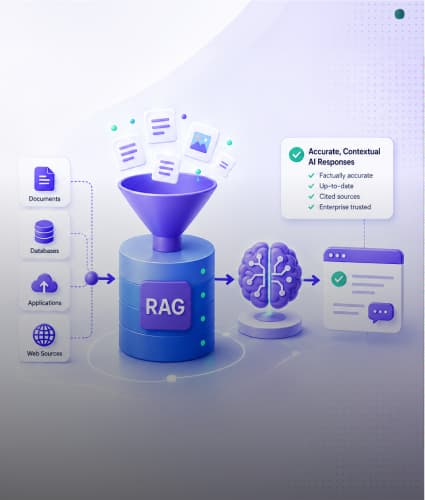
4. RAG (Retrieval-Augmented Generation) Layer
In systems using RAG, the retriever provides context documents to ground the model’s responses. Failures here lead directly to hallucinations, outdated answers, or unauthorized content exposure. QA must evaluate retrieval relevance, ranking quality, grounding accuracy, and citation correctness.
5. Orchestration Layer
The orchestrator manages tools, multi-turn memory, and middleware logic. It stitches together prompts, retrieved data, and conversation state. Testing this layer closely resembles integration testingbut with added complexity due to dynamic context flows.
Different Chatbot Domains Demand Tailored Testing Approaches
Not all AI chatbots serve the same purpose, and testing must reflect domain-specific risks. Customer support bots require factual consistency, sentiment management, and correct escalation logic. Healthcare-focused bots must emphasize safety, disclaimers, and uncertainty communication. Financial and legal bots require strict grounding and zero-tolerance for hallucinations because incorrect advice may violate regulations. HR and recruiting bots demand fairness and bias neutrality, while enterprise knowledge bots must adhere to permission boundaries and operate on fresh, accurate internal information.
Each domain shapes the test datasets, guardrails, risk thresholds, and evaluation metrics that QA engineers must use.
Technical Challenges Unique to AI Chatbot Testing
AI testing introduces a new set of engineering challenges. Models hallucinate facts, lose track of context, or interpret queries differently depending on subtle phrasing changes. Retrieval systems may surface irrelevant information because of embedding drift. LLMs often provide incorrect answers with unwarranted confidence. Bias patterns can emerge from fine-tuning data or from retrieved documents. And adversarial users can exploit prompt injection vulnerabilities to bypass system rules.
These behaviors are not bugs in the classical sense; they are emergent patterns requiring specialized adversarial, statistical, and contextual testing techniques.
Hire AI Engineers Today!

Real-World Failure Case: When Correct-Looking Answers Were Wrong
During a production rollout of an LLM-powered customer support bot, users began receiving confident but incorrect refund timelines. The system consistently stated that refunds took “3–5 days,” while the official policy clearly stated 7 business days.
UI tests passed. API tests passed. There was no bug in the backend.
The root cause was subtle: the RAG retriever was pulling an outdated PDF indexed six months earlier. The model did exactly what it was told; it confidently summarized an incorrect context.
QA introduced three changes:
- Grounding tests validating that the answers quoted are retrieved from documents
- Freshness checks during document ingestion
- Fallback enforcement requiring “I don’t know” when confidence was low
Within one release cycle, hallucination incidents dropped by 92%, customer complaints disappeared, and the support team regained trust in the AI.
The lesson was clear:
“AI failures often look like intelligence problemsbut they are usually testing gaps.”
Engineering a Robust AI Testing Strategy
A strong testing strategy blends deterministic validation with statistical evaluation. High-risk domains require more comprehensive safety and grounding checks than low-risk ones. Test assertions must evaluate semantic correctness rather than word-level matches. Human-in-the-loop evaluation becomes indispensable, particularly for correctness, tone, and safety assessments.
Finally, continuous validation is essential. AI systems drift over time due to evolving user behavior, model updates, or shifting document indexes. Testing cannot cease after deployment.
Functional Testing Reimagined for AI
Functional testing expands significantly in AI systems. QA must validate intent recognition under noise, slang, or incomplete phrasing. Models integrating with external tools must generate correct parameters and handle API failures gracefully. Fallback logic becomes important when user input is ambiguous. Above all, the model must enforce constraints, such as avoiding disclosure of personal data.
Real-world testing has shown how easily natural language can trigger unintended actions for example, misinterpreting “restart my system” as a remote wipe. Functional AI testing helps prevent such failures.
Testing Multi-Turn Conversations and Contextual Memory
LLMs power conversational interfaces, but conversation memory is prone to degradation across long contexts. QA must test how well the system retains context, handles topic switches, recovers from misunderstandings, and maintains consistent tone across multiple turns. The objective is conversational reliability, not just individual response correctness.
Training Data and Knowledge Source Validation
For RAG-based systems, the indexed documents serve as the system’s knowledge base. QA must validate embedding quality, retrieval accuracy, content freshness, and permission-sensitive document boundaries. Misconfigured ingestion pipelines can leak confidential informationsomething that has occurred in real systems and was only caught through rigorous data validation.
Prompt Engineering QA
Because prompts govern behavior, they must be treated like software artifacts. This involves version control, regression testing, adversarial testing for instruction overrides, and stress testing across varied phrasing structures. Prompt weaknesses can easily cause compliance failures or rule bypassing.
The following example demonstrates how QA teams can detect behavioral drift when prompts change across releases.
What this validates :
- Prompt changes don’t break refusal logic
- Safety rules remain enforced
- Behavioral drift is detected early
Accuracy, Hallucination, and Groundedness Evaluation
Models must be evaluated using benchmark datasets scored by SMEs, grounding checks against retrieved content, automatic validation of citations, and clear handling of unknown or unanswerable questions. High-risk applications require extremely low hallucination rates.
The most effective way to prevent hallucinations is to programmatically verify that answers are grounded in retrieved knowledge.
What this validates:
- LLM answers are grounded in retrieved content
- RAG failures are caught before production
- Prevents confident but incorrect answers
Bias, Fairness, and Ethical Testing
Bias testing involves generating controlled inputs that evaluate demographic neutrality, sentiment consistency, and stereotype avoidance. Bias is not merely an ethical issue; it directly affects reliability and fairness in decision-making workflows.
Security, Privacy, and Compliance Testing
LLMs introduce novel security challenges, including prompt injection, context-window leakage, and training data extraction attacks. QA must also verify compliance with privacy standards like GDPR, ensure models do not memorize PII, and confirm that retrieval systems do not expose unauthorized documents.
Performance, Load, and Cost Testing
AI systems have unique performance characteristics. QA must measure latency, token usage patterns, retrieval speed, batch versus streaming performance, and cost per conversation. Token-based cost inflation under load is a real issue that can escalate operational expenses if not tested.
Automation Frameworks for AI Testing
Modern AI QA blends multiple testing tools and frameworks. Automated evaluators score model outputs, prompt regression tools compare responses across versions, trace inspection tools expose model reasoning paths, and UI automation tools test end-to-end conversational flows. Automation accelerates evaluation but does not eliminate the need for human oversight.
| Tool | Primary Focus | Key Strengths | Limitations |
|---|---|---|---|
| LangSmith | Tracing & evaluation | Prompt diffing, RAG tracing, eval pipelines | Vendor lock-in |
| Promptfoo | Prompt testing | Fast regression testing, CLI-friendly | Limited RAG depth |
| OpenAI Evals | Model benchmarking | Standardized, reproducible evals | Engineering-heavy |
| TruLens | RAG evaluation | Groundedness & faithfulness metrics | Setup complexity |
| HumanLoop | Human-in-the-loop QA | Human feedback workflows | Cost at scale |
Testing Fine-Tuned Models
Fine-tuned models require differential testing to identify overfitting, catastrophic forgetting, sample memorization, and domain-specific hallucinations. Each new fine-tuned version demands a comprehensive regression cycle.
Using AI to Test AI
AI-based test agents can automatically generate adversarial inputs, fuzzed prompts, long-context simulations, or bias-heavy scenarios. These synthetic tests vastly expand coverage and reveal failure patterns that manual testing would never uncover.
Production Monitoring and Continuous Evaluation
After deployment, monitoring becomes the ongoing test harness. Systems must track retrieval drift, hallucination rates, safety violations, context overflow, sentiment patterns, and cost anomalies. Without continuous monitoring, LLM systems degrade over time.
Once deployed, hallucination detection must shift from test-time checks to continuous production monitoring.
Why is this important
- AI systems degrade silently
- Hallucinations must be treated like production defects
- Enables continuous AI quality tracking
Metrics and KPIs for AI Quality
Effective quality evaluation includes grounded accuracy, hallucination probability, retrieval precision/recall, fallback rate, compliance violations, behavioral consistency, and cost per successful task. These metrics form the basis of AI governance.
Future of AI Testing: QA Becomes AI Reliability Engineering
As AI becomes a core component of enterprise infrastructure, QA engineers must expand their skill sets into data validation, prompt engineering, ML behavior analysis, safety testing, performance profiling, and model governance. Traditional QA focuses on correctness, but AI QA focuses on ensuring trust, an essential requirement in a world where AI influences business decisions and user experiences.
Core AI QA Checklist
- Prompt injection resistance
- Grounded answer verification
- “I don’t know” fallback behavior
- Multi-turn context retention
- Retrieval relevance scoring
- Bias & fairness checks
- PII leakage prevention
- Tool-call accuracy
- Cost & token usage limits
- Drift detection post-release
GitHub Repository Structure
Let’s Build AI You Can Trust. Turning unpredictable prototypes into reliable production systems is what we do best. If you are wrestling with hallucinations or need a second pair of eyes on your RAG architecture, reach out. Let’s talk about how to apply these testing strategies to make your AI robust and ready for the real world.

Nirav Chaudhari
A results-driven professional with a passion for transforming ideas into impactful, user-focused solutions. Known for a sharp eye for detail, strategic thinking, and a collaborative approach that drives product success from concept to launch.

Naveen Kumar Suthar
A quality-driven QA specialist passionate about delivering reliable, user-friendly software through thorough testing and precision.