

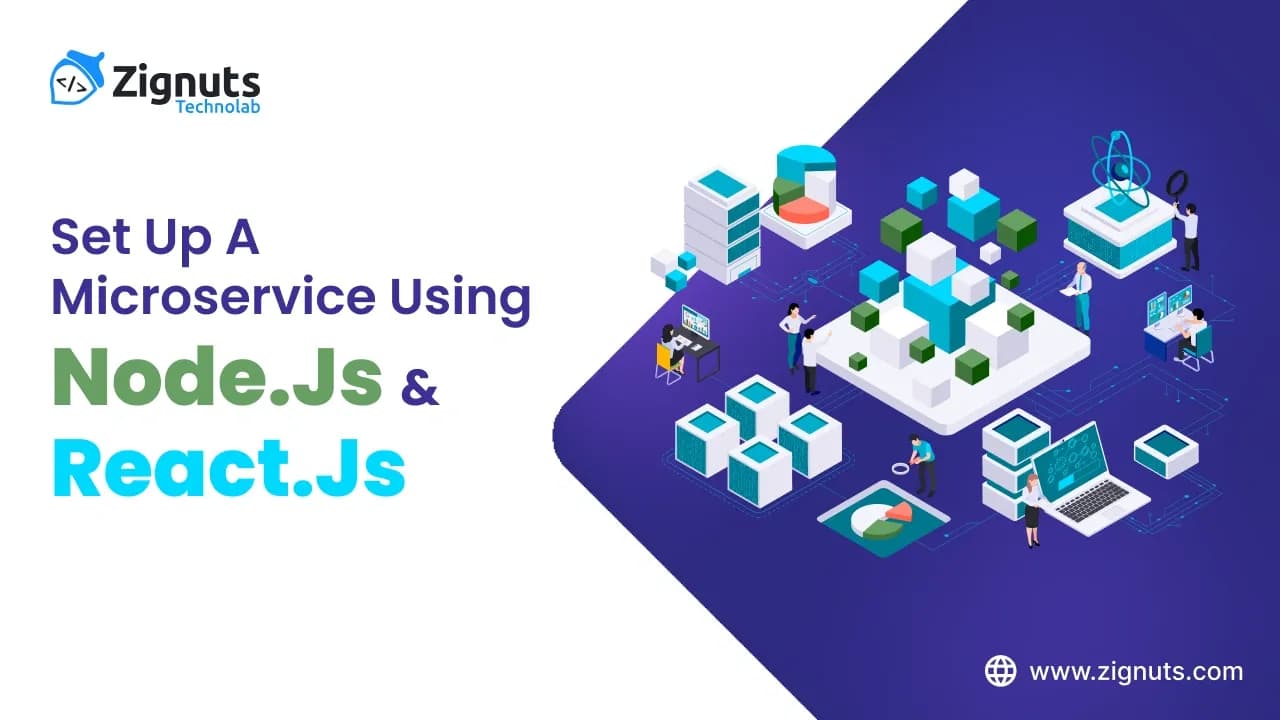
The landscape of software development has shifted dramatically. In 2026, the demand for high-speed delivery and hyper-scalability has made the monolithic approach feel like a relic of the past. Modern engineering teams now favor a modular strategy where applications are broken down into small, autonomous units. This guide explores how to build and orchestrate Microservices with Node.js and React to create resilient, future-proof applications.
In this current era of distributed systems, the "one size fits all" codebase is no longer viable for enterprises that need to pivot at the speed of the market. By decoupling your business logic into specialized Node.js instances, you eliminate the single point of failure that haunts traditional apps. This approach allows your team to deploy updates to the "Billing" service without ever touching the "User Dashboard," ensuring 99.99% uptime even during heavy maintenance cycles.
Furthermore, the synergy between these technologies has reached a new peak in 2026. With the maturity of Serverless functions and Edge computing, your React frontend can now intelligently route requests to the closest geographic Node.js microservice, drastically reducing latency. Whether you are managing a global e-commerce platform or a high-frequency data tool, mastering the deployment of Microservices with Node.js and React is the definitive path to achieving technical agility and long-term maintainability.
Understanding the Architecture of Microservices with Node.js and React
At its core, this architectural style is about the separation of concerns. Instead of one massive codebase, you develop a suite of services that communicate over lightweight protocols. Node.js remains the premier choice for the backend due to its non-blocking I/O and vast ecosystem, while React continues to dominate the frontend with its component-based efficiency.
In 2026, this architecture has evolved beyond simple REST calls. Modern systems now utilize a mix of synchronous APIs (gRPC, GraphQL) for immediate data needs and asynchronous event-driven patterns (Kafka, RabbitMQ) for background tasks. This ensures that the user interface remains snappy even when complex backend processing is happening.
Why This Duo Works in 2026
- Independent Scaling: If your payment service is under heavy load during a flash sale but your profile service is idle, you only scale the payment container. This optimizes cloud costs and maintains performance where it matters most.
- Technology Agility: You aren't locked into one stack. While Node.js is the backbone, a specialized service could use Python for AI tasks or Go for high-speed networking, all while feeding into a unified React UI.
- Resilience and Fault Isolation: A bug in a "Recommendations" service won't crash the "Checkout" process. In 2026, we will use Circuit Breakers to gracefully degrade features, so if one service fails, the rest of the app stays alive.
- Micro Frontends Integration: React’s component model now extends to "Micro Frontends." Large teams can own specific parts of the screen (e.g., the Search Bar vs. the Product Grid) as independent React apps that are stitched together at runtime using Module Federation.
- Unified JavaScript/TypeScript Stack: Using TypeScript across both Node.js and React allows for Shared Type Definitions. If you change a data model in the backend, the frontend is immediately aware of the change, reducing "contract" bugs between teams.
Modern Communication Protocols
| Protocol | Best Use Case in 2026 | Benefit |
|---|---|---|
| gRPC | Internal service-to-service calls | High speed, low overhead using binary data. |
| GraphQL | React-to-Backend data fetching | Frontend asks for exactly what it needs, preventing over-fetching. |
| WebSockets | Real-time dashboards and chats | Bi-directional communication with zero-latency updates. |
| Event Bus | Asynchronous workflows (e.g., Email alerts) | Decouples services so they don't have to wait for each other. |
The Role of the API Gateway
In a 2026 Microservices with Node.js and React setup, the API Gateway acts as the "Traffic Controller." It handles:
- Authentication: Validating JWT tokens before they reach your internal services.
- Rate Limiting: Protecting your Node.js microservices from being overwhelmed by too many requests.
- Request Aggregation: Combining data from three different services into one single response for the React frontend, reducing the number of network hops.
Building the Backend Microservices with Node.js and React
In a 2026 workflow, the way we architect backends has shifted toward efficiency and modularity. We utilize Fastify or Express with modern ESM (ECMAScript Modules) to ensure high performance and clean syntax. Let's set up a basic user service that follows the latest industry standards for decoupled systems.
1. Initialize the Service
First, create a dedicated space for your microservice. In 2026, we emphasize a "shared-nothing" architecture, where each service maintains its own dependencies and environment to avoid version conflicts.
Project Setup: Create a directory named user-service and initialize it.
2. Crafting the Logic
Create an index.js file. Notice the use of clean, modern JavaScript syntax. In this 2026 approach, we move away from require and fully embrace ES Modules, which allows for better tree-shaking and performance optimization in production.
3. Implementing Environment Management
For Microservices with Node.js and React, security is paramount. In 2026, we will never hardcode port numbers or API keys. We use a .env file to manage configuration across different environments (Development, Staging, Production).
Create a .env file in your root:
4. Middleware and Security Headers
Modern microservices must be defensive. Beyond standard CORS, we now integrate middleware like Helmet to set secure HTTP headers automatically. This prevents common vulnerabilities like Cross-Site Scripting (XSS) and clickjacking, which remain threats even in 2026.
5. Health Check Endpoints
Every microservice should expose a /health route. This is essential for orchestration tools like Kubernetes to monitor whether your service is alive and ready to accept traffic. If the health check fails, the orchestrator automatically restarts the container, ensuring self-healing capabilities for your application.
Hire Dedicated Developers Today!

Crafting the Frontend Microservices with Node.js and React
In 2026, the frontend has evolved far beyond a simple "view" layer. In a Microservices with Node.js and React ecosystem, the React application serves as a sophisticated orchestrator. It doesn't just display data; it manages multiple streams of information from various independent services, stitches them together, and handles complex state transitions without refreshing the page.
This shift toward "Frontend Orchestration" means your React app is responsible for service fallback logic, intelligent caching, and even partial UI updates if a specific microservice (like "Recommendations") is temporarily down while others (like "Product Details") are active.
1. Setup with Vite
By 2026, Vite will have completely replaced legacy tools like Create React App. Its Lightning-fast Hot Module Replacement (HMR) and native ES modules support make it the gold standard for developing modular interfaces.
Project Setup Execute these commands to spin up a performance-optimized React environment:
2. Connecting to the Backend
In your App.jsx, fetch data from your specific microservice. In a production 2026 environment, you would typically use an API Gateway URL, but for this setup, we connect directly to our user service.
3. Handling Service Boundaries with React Suspense
Modern Microservices with Node.js and React development leverages React Suspense and Error Boundaries. In 2026, we treat every microservice call as a "pluggable" part of the UI. If the "User Service" fails, we can catch that specific error and show a "Login Temporarily Unavailable" message while still allowing the user to browse the rest of the app.
4. Optimized Data Fetching with TanStack Query
While Axios handles the request, most 2026 teams use TanStack Query (React Query) for state management. This allows for:
- Automatic Retries: If a Node.js microservice blips, the frontend automatically retries the request.
- Stale-While-Revalidate: Users see cached data instantly while the app fetches fresh data from the microservice in the background.
- Polling: Keeps your React UI in sync with high-frequency backend services like stock tickers or notification feeds.
5. Micro Frontends and Module Federation
For massive projects, you might split the React app itself into "Micro Frontends." Using Webpack 5 or Rspack Module Federation, different teams can deploy their own parts of the React UI (like the 'Checkout' component) completely independently of the main 'Shell' app. This mirrors the backend microservice philosophy on the frontend.
Advanced Communication in Microservices with Node.js and React
As your system expands, direct HTTP calls between services can become messy and create "dependency hell." In 2026, we avoid tight coupling by implementing sophisticated communication layers that separate the Request/Response logic from the Event/Action logic. This ensures your Microservices with Node.js and React stay fast and reliable even under heavy load.
API Gateways and Service Mesh
Instead of the React app talking to twenty different URLs, it talks to one API Gateway. This acts as the single point of entry, providing a unified interface for your frontend while masking the complexity of the backend.
- API Composition: The gateway can call three different Node.js services (e.g., User, Orders, and Shipping) and combine their data into one single JSON response for React. This significantly reduces the "Network Waterfall" effect on mobile devices.
- Protocol Translation: In 2026, your React app might speak GraphQL to the Gateway, while the Gateway translates those requests into high-speed gRPC calls for internal Node.js service-to-service communication.
- The Service Mesh Layer: While the Gateway handles "North-South" traffic (Client to Server), a Service Mesh (like Istio or Linkerd) manages "East-West" traffic (Service to Service). It automatically handles retries, mTLS encryption, and "Circuit Breaking," stopping a service from trying to call a failing microservice and potentially crashing itself.
The Backend-for-Frontend (BFF) Pattern
A specialized trend in 2026 for Microservices with Node.js and React is the BFF pattern. Instead of one generic API Gateway, you create a dedicated Node.js "shim" specifically for your React web app and another for your mobile app.
This allows the React team to tailor the data exactly to their UI components' needs, aggregating multiple microservice responses into a single, optimized payload. It moves the complexity of data joining away from the browser and into a high-speed Node.js environment.
Event-Driven Messaging
For complex tasks that don't need to happen instantly, like generating a PDF invoice or sending a "Welcome" email, services shouldn't wait for each other. Using a message broker like RabbitMQ or Apache Kafka allows services to emit events and move on, ensuring the system remains responsive.
- Choreography Pattern: Instead of a central "boss" service telling everyone what to do, each microservice "listens" for events. For example, when the Order-Service emits an OrderPlaced event, the Email-Service and Inventory-Service react to it independently.
- Dead Letter Queues (DLQ): In 2026, we built for failure. If the Email service is down, the message stays in the broker or moves to a DLQ. Once the service is back online, it "replays" the missed events, ensuring no data is ever lost.
- The "Saga" Pattern: When a transaction spans multiple microservices (like booking a flight, hotel, and car), we use Sagas to manage consistency. If the hotel booking fails, the Saga triggers "compensating transactions" to cancel the flight booking automatically, keeping your data synchronized.
- CQRS (Command Query Responsibility Segregation): In 2026, we often split the logic that writes data from the logic that reads it. A Node.js service might handle a "Place Order" command by writing to a database and emitting an event, while a separate "Read" service consumes that event to update a high-speed search index (like Elasticsearch) for the React frontend to query.
Containerization and Deployment of Microservices with Node.js and React
To ensure "it works on my machine" translates to "it works in the cloud," we use Docker. In 2026, containerization had matured from a luxury to a baseline requirement for any distributed system. By bundling your code, runtime, and system libraries together, you eliminate environmental friction and create a standard "unit of software" that can move from a developer's laptop to a global edge network in seconds.
Pro Tip: In 2026, serverless containers (like AWS Fargate, Google Cloud Run, or AWS App Runner) are the preferred way to host these services. They offer the "best of both worlds": the control of Docker with the simplicity of serverless, allowing for automatic scaling to zero when not in use to save costs.
A Simple Dockerfile Example
This Dockerfile uses an optimized Alpine base image to keep your footprint small and secure.
Multi-Stage Builds for Production
A major trend in 2026 for Microservices with Node.js and React is the use of Multi-Stage Builds. This technique allows you to use a heavy image with all development tools to build your app, and then "copy" only the final production-ready files into a much smaller, hardened runtime image.
Why this matters in 2026:
- Security: Smaller images have a reduced "attack surface" (fewer libraries for hackers to exploit).
- Speed: Faster deployment times because your cloud provider can pull a 50MB image much quicker than a 500MB one.
- Cost: Lower storage costs in your container registry.
Infrastructure as Code (IaC) with Terraform
In 2026, we no longer manually click buttons in a cloud console to deploy our Microservices with Node.js and React. Instead, we use Terraform or OpenTofu. This allows you to define your entire infrastructure, including databases, load balancers, and container clusters as code.
- Version Control: Your infrastructure is stored in Git just like your code.
- Repeatability: You can spin up an identical "Staging" environment in minutes.
- Safety: Running terraform plan lets you see exactly what will change before you deploy, preventing accidental deletions.
The Rise of WebAssembly (Wasm)
While Docker remains the king, 2026 has seen the rise of Wasm-based serverless runtimes (like Fermyon Spin). For ultra-lightweight microservices, developers are now compiling Node. js-compatible logic into WebAssembly. These "containers" start in sub-milliseconds, far faster than traditional Docker containers, making them perfect for "Cold Start" sensitive applications.
Security and Observability for Microservices with Node.js and React
In a distributed system, you cannot fix what you cannot see, nor can you protect what you haven't identified. As we move through 2026, the complexity of Microservices with Node.js and React demands a "Security-First, Visibility-Always" mindset. We have moved beyond simple firewalls into the world of Zero Trust Architecture, where every request is treated as potentially hostile until proven otherwise.
Distributed Tracing with OpenTelemetry
In 2026, OpenTelemetry (OTel) has become the universal language for observability. When a React frontend makes a request that touches five different Node.js services, a single "Trace ID" follows that request through every hop.
- Context Propagation: By using OTel SDKs in Node.js, your services automatically pass trace headers. If the "Payment Service" is slow, you can see exactly which database query or external API call caused the bottleneck.
- Span Analysis: You can visualize the "span" of each operation in tools like Jaeger or Honeycomb, allowing you to identify "Long Tail Latency" that would be invisible in standard logs.
Zero Trust and JWT Authentication
Security in 2026 is based on the principle of Never Trust, Always Verify. We use JSON Web Tokens (JWT) not just for user logins, but for Service-to-Service identity.
- Short-Lived Tokens: In this era, access tokens expire in minutes, not days. We use Refresh Token Rotation in our Node.js backends to ensure that even if a token is intercepted, its window of use is negligible.
- mTLS (Mutual TLS): While JWTs handle application-level identity, mTLS ensures that Service A and Service B only talk to each other over an encrypted tunnel with verified certificates. This is often handled automatically by a Service Mesh like Istio.
- Claims-Based Authorization: Don't just check if a user is logged in; check their "claims." In 2026, we use Attribute-Based Access Control (ABAC) to decide if a specific React component should even be rendered based on the user's real-time security clearance.
Centralized Logging and AIOps
Logs are the "black box" of your aircraft. In 2026, we aggregate logs from all services into a single dashboard using the LGTM Stack (Loki, Grafana, Tempo, Mimir) or platforms like Datadog.
- Structured Logging: We no longer use plain text. Every Node.js log is emitted as a JSON object. This allows you to filter millions of logs by service_name, error_code, or correlation_id in milliseconds.
- Predictive Alerting (AIOps): Modern observability tools now use AI to spot "Anomalies." Instead of waiting for a server to crash, the system alerts you when the "Checkout" service's latency deviates by 15% from its Tuesday afternoon baseline.
- Real User Monitoring (RUM): We integrate telemetry directly into the React frontend. If a user in London experiences a slow UI, the React app sends a "Frontend Trace" back to our dashboard, correlating their browser performance with our Node.js backend performance.
Hire Dedicated Developers Today!
Automated Scaling Strategies for Microservices with Node.js and React
In 2026, scaling is no longer just about increasing CPU and RAM. It involves Predictive Scaling and Horizontal Pod Autoscaling (HPA). Modern Node.js services are designed to be stateless, allowing orchestrators like Kubernetes to spin up dozens of instances in response to real-time traffic spikes detected by your React frontend.
This evolution ensures that your Microservices with Node.js and React architecture remain cost-effective during quiet periods and hyper-responsive during peak demand. By leveraging real-time telemetry from the React client, the infrastructure can anticipate load rather than just reacting to it.
Predictive Scaling with AI
By analyzing historical traffic patterns, AI-driven orchestrators can predict a surge in "User Profile" requests before they actually happen. For Microservices with Node.js and React, this means the backend is already scaled up and ready by the time your marketing campaign goes live, eliminating latency for the end-user.
- Pattern Recognition: AI models analyze seasonal trends, such as Black Friday surges or weekend spikes, to pre-provision Node.js instances.
- Proactive Resource Allocation: Instead of waiting for CPU usage to hit 80%, the system scales up 15 minutes before the predicted peak, ensuring a smooth experience for React users.
- Sentiment-Based Scaling: In 2026, advanced systems even monitor social media trends to prepare microservices for viral traffic bursts.
Horizontal Pod Autoscaling (HPA) and Custom Metrics
Standard scaling often relies on basic metrics, but high-performance Microservices with Node.js and React utilize custom metrics to trigger expansion.
- Event Loop Latency: Since Node.js is single-threaded, scaling based on event loop delay is more accurate than just monitoring CPU.
- Request Queue Depth: If the number of pending requests from the React frontend grows, HPA triggers new pods immediately.
- Memory Fragmentation: Automated scaling can recycle pods that show signs of memory leaks before they impact the user experience.
Cost-Optimization and Scaling to Zero
Effective scaling in 2026 isn't just about growing; it's about shrinking to save budget.
- Scale-to-Zero: For internal or low-traffic services, serverless platforms like Knative allow your Node.js microservices to shut down completely when not in use.
- Spot Instance Orchestration: Using "Spot" or "Preemptible" instances for non-critical microservices can reduce hosting costs by up to 90% while the React app handles potential service swaps seamlessly.
- Cold Start Mitigation: To prevent the "first click" delay in a scaled-to-zero environment, 2026 architectures use Pre-warming techniques that keep a tiny footprint of the service active at the edge.
Future-Proofing Microservices with Node.js and React via Edge Computing
The next frontier in 2026 is Edge Orchestration. We are moving logic closer to the user to achieve sub-10ms latency. By shifting computation from a distant central data center to the "edge" of the network, often a node in the same city as the user, you eliminate the physical delay of data travel.
Deploying to the Edge
Using platforms like Cloudflare Workers, Vercel Edge Functions, or Fastly Compute, you can deploy "Nano-services" written in Node.js. Your React app can then fetch data from an Edge Node located in the same city as the user, while the heavy lifting remains in your centralized microservice cluster. This hybrid approach ensures that Microservices with Node.js and React deliver the fastest possible global performance.
Key Benefits of the Edge in 2026:
- Sub-10ms Personalization: Tailor the React UI instantly based on the user's local weather, time zone, or regional inventory without a round-trip to the main server.
- Improved Reliability: If the central cloud has a hiccup, the edge node can serve cached data or a "graceful fallback" UI, ensuring the user sees no disruption.
- Security at the Boundary: Move sensitive tasks like JWT validation and bot mitigation to the edge. This stops malicious traffic before it ever touches your core Node.js backend.
- Bandwidth Efficiency: Process and filter large data streams (like IoT sensor data) at the edge, sending only the critical summaries to your central microservices to save on cloud costs.
Edge-Native Data Handling
In 2026, Microservices with Node.js and React leverage "Edge-First" data strategies. Instead of just caching static images, we are now caching dynamic API responses.
- Stale-While-Revalidate at the Edge: The edge node serves the React app a cached response in 5ms while simultaneously updating its cache from the Node.js origin in the background.
- Geographic Routing: Automatically route a user's request to the specific Node.js microservice cluster hosted in their region (e.g., us-east-1 vs eu-central-1) based on their entry point at the edge.
- Local-First Syncing: For high-speed apps like collaborative editors, the React frontend syncs changes to the closest edge node first, which then propagates the update to the central database asynchronously.
Conclusion
The transition from monolithic builds to a decoupled architecture is the most significant step toward achieving true engineering excellence in 2026. By effectively implementing Microservices with Node.js and React, you aren't just building software; you are creating an adaptable ecosystem that scales with your business ambitions. From AI-driven predictive scaling to sub-10ms edge orchestration, these technologies empower you to deliver world-class user experiences without compromising on maintainability or security.
If you are looking to build a high-performance, distributed application but need expert guidance, you can Hire Dedicated Developers who specialize in modern JavaScript ecosystems. Choosing the right partner ensures your architecture is optimized for 2026 and beyond.
Ready to revolutionize your software architecture? Contact Zignuts today for top-tier development solutions.

Zignuts Technolab
Zignuts Technolab delivers future-ready tech solutions and keeps you updated with the latest innovations through our blogs. Read, learn, and share!