


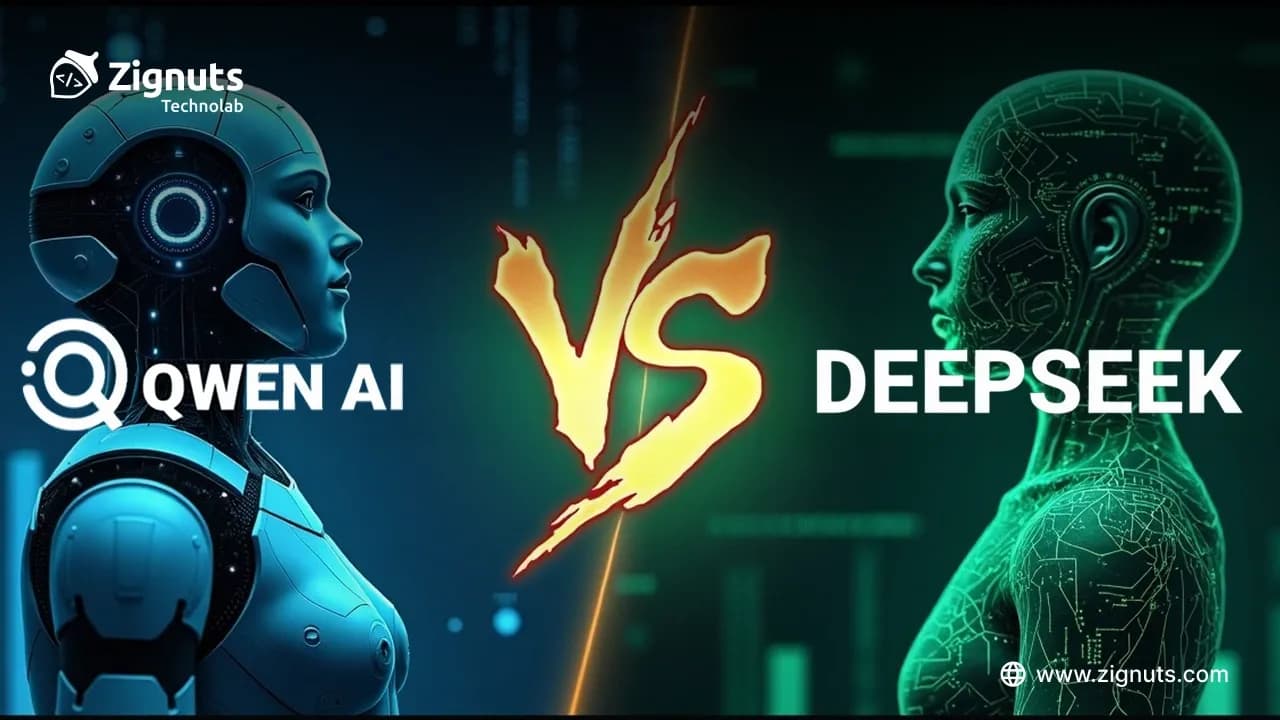
The artificial intelligence landscape in 2026 has shifted from simple chatbots to specialized reasoning "thinking" models. As businesses look to integrate these powerhouses, two names dominate the conversation: Alibaba’s Qwen AI and the efficiency-focused DeepSeek. Both have evolved significantly, moving beyond general text generation into the realms of agentic workflows and complex mathematical reasoning.
In this era of Test-Time Compute and Mixture-of-Experts (MoE) architectures, the competition has entered a new phase. Qwen3-235B now leads the charge for enterprises requiring a "global communication hub" with its 119+ language support and seamless dual-mode reasoning. Meanwhile, DeepSeek V4 and the R1 series have disrupted the market by delivering PhD-level logic at a fraction of the cost, making high-end intelligence accessible to everyone from indie developers to global supply chain giants. This guide breaks down how they compare in the current market to help you decide which one aligns with your strategic goals.
Exploring the New Era of Qwen AI
In 2026, Qwen has matured into a massive ecosystem of specialized models. No longer just a single engine, the Qwen3 family includes flagship Mixture-of-Experts (MoE) models like the Qwen3-235B, which utilizes a unique "Thinking Mode" for deep logic. This architecture is designed to optimize compute by activating only a fraction of its total parameters, specifically 22 billion active parameters, allowing it to rival the world's most powerful dense models while maintaining significantly higher throughput.
Core Strengths of Qwen AI:
- Dual-Mode Reasoning: This feature represents a fundamental shift in user-AI interaction, allowing you to toggle between "Instant Mode" for routine tasks like email drafting or data summarization and "Thinking Mode" for PhD-level problem-solving. In Thinking Mode, the model utilizes a long-chain-of-thought (CoT) process to verify its own logic before responding, which has pushed its accuracy in complex STEM and legal reasoning to record-breaking levels.
- Agentic Coding: The specialized Qwen3-Coder handles repository-scale tasks, shifting the paradigm from simple code generation to autonomous software engineering. Unlike traditional assistants that work with isolated snippets, Qwen3-Coder can map out an entire project’s architecture, understand cross-file dependencies, and execute multi-step migrations across a full codebase.
- Multilingual Mastery: Supporting over 119 languages and dialects, Qwen remains the industry leader for global enterprises requiring high-fidelity localization. This version specifically addresses "intelligence drops" in non-English languages, ensuring that the model's reasoning capabilities remain consistent whether you are querying in Arabic, German, or Cantonese.
- Massive Context: With native support for up to 1 million tokens, it can process massive legal contracts, entire technical manuals, or several hours of meeting transcripts in a single window. This ultra-long context is supported by advanced "sparse attention" mechanisms, which prevent the performance degradation typically seen as input lengths increase.
Advanced 2026 Capabilities:
Beyond its core reasoning, Qwen has expanded into a fully multimodal and agentic powerhouse that integrates directly into physical and digital workflows:
- Omni-Modal Integration: The Qwen3-Omni series has redefined human-AI communication by facilitating real-time, low-latency voice chatting and video understanding. This enables "Hear You, See You, Follow Smarter" interactions where users can share a live camera feed for the AI to troubleshoot physical hardware, analyze complex architectural diagrams in real-time, or even interpret human emotion and environmental cues during a conversation.
- Next-Gen Efficiency: The introduction of the Qwen3-Next architecture features a "highly sparse" MoE design that pushes the boundaries of cost-effectiveness. For instance, the 80B-A3B model activates only 3 billion parameters during inference, achieving speeds nearly 10x faster than previous generations for long-context tasks while matching the performance of much larger, more expensive models.
- Autonomous Agentic Workflows: With the release of Qwen3-Coder-Next, the AI has been "agentically trained" using reinforcement learning within executable environments. This means it doesn't just suggest code; it can independently navigate terminals, utilize file system tools, and autonomously perform complex debugging cycles. It can even recover from its own execution failures by reflecting on error logs and adjusting its strategy without human intervention.
- Specialized Creative Suite: The 2026 ecosystem now includes specialized tools like Qwen-Image-Edit and Qwen3-TTS. These tools bring high-fidelity text rendering to image generation and natural-sounding speech cloning across 10 global languages. The TTS system is particularly advanced, intelligently adjusting prosody, pacing, and intonation to mimic human speech patterns, making it ideal for automated customer service or narrative content creation.
- Real-Time Safety Guardrails: Security is now native to the stream. Every interaction is monitored by Qwen3Guard, a series of multilingual safety models that classify prompts and responses in real-time. Unlike older binary "safe/unsafe" filters, Qwen3Guard uses a three-tier severity system (Safe, Controversial, Unsafe) to provide nuanced moderation that allows for creative freedom while strictly blocking malicious activity like prompt injections or malware generation.
Understanding the DeepSeek Advantage
DeepSeek has carved out a reputation as the "efficiency king." In 2026, DeepSeek V4 and the R1 series focus on delivering high-end reasoning at a fraction of the traditional computational cost. By moving away from "brute-force" parameter scaling, DeepSeek has optimized the relationship between algorithmic logic and hardware, proving that frontier-level intelligence can be achieved without the massive "compute bubble" typically associated with Silicon Valley giants.
Core Strengths of DeepSeek:
- Superior Logic and Math: The DeepSeek-R1 model has become a benchmark leader, consistently rivaling the world’s most expensive proprietary models in mathematical proofs and logical deductions. Its success is rooted in a multi-stage Reinforcement Learning (RL) framework that incentivizes "emergent reasoning." This allows the model to naturally develop self-reflection and dynamic strategy adaptation, meaning it can catch its own mistakes and rethink a problem mid-stream, similar to a human mathematician.
- Architectural Efficiency: Using DeepSeek Sparse Attention (DSA) and the innovative MODEL1 architecture, the platform reduces inference costs by over 50%. A key breakthrough in 2026 is its Tiered KV Cache storage, which offloads up to 80% of data from expensive GPU VRAM to more affordable CPU RAM. This hardware-aware design allows DeepSeek to maintain a stable 1-million-token context window while requiring significantly less high-end hardware than its competitors.
- Developer-First Open Source: With a permissive MIT license on many of its flagship versions, DeepSeek is the gold standard for developers who want to run high-performance models on their own hardware. This "Open-Source Magic" eliminates vendor lock-in and allows technical teams to inspect every line of code, ensuring full transparency and auditability. It has particularly empowered startups to build specialized, on-premise solutions that would otherwise be cost-prohibitive.
- Deep Data Automation: It excels at "process-oriented" AI, automating complex workflows like multi-file debugging and supply chain analysis. Beyond simple text, DeepSeek’s Code Agent and Search Agent can navigate entire project directories to identify import/export conflicts, track type definitions across modules, and propose fixes for bugs that span multiple files. This makes it a powerful tool for enterprise-level refactoring and long-range dependency mapping.
Key Technical Innovations in 2026:
The 2026 iteration of DeepSeek introduces several modular technologies that separate "static recall" from "active reasoning," creating a more balanced and faster AI experience:
Engram Conditional Memory: This technology allows the model to selectively retain and recall information based on the specific task context. By using a "U-shaped scaling law," the Engram module handles static knowledge recall like looking up a specific API syntax, while the main reasoning engine handles the logic. This "don’t calculate blindly" approach prevents the model from wasting compute power on simple facts.
Sparse FP8 Decoding: DeepSeek V4 utilizes Mixed Precision Intelligence, where critical tokens are computed in high-precision (FP16) while non-critical ones use lower-precision (FP8). This results in a 1.8x inference speedup with less than a 0.5% loss in accuracy. For businesses, this translates to nearly double the throughput for the same hardware investment, making real-time autonomous agents economically viable for the first time.
Manifold-Constrained Hyper-Connections (mHC): These are architectural shortcuts that link non-adjacent layers of the transformer network. They help the model maintain a "global structure" during long-range tasks. For instance, when analyzing a 500-page legal document, mHC ensures that the AI remembers the definitions on page one while interpreting a clause on page 499, reducing "hallucinations" in long-context processing.
Self-Evolution and Reflection: In its latest update, the R1 series has shown emergent reflective language usage. During complex problem-solving, you will often see the model use specific internal tags to verify its steps. This self-correction cycle has dramatically increased its win rate in coding competitions (LiveCodeBench) and competitive math (AIME), where it now frequently surpasses human benchmarks.
Performance Comparison: Qwen AI vs DeepSeek
When we look at raw benchmarks in 2026, the gap between these two is narrow but defined by their "personality." While both utilize Mixture-of-Experts (MoE) architectures to maximize efficiency, their performance profiles cater to different professional demands.
The Qwen AI Performance Profile: The Enterprise Workhorse
Qwen AI (specifically the Qwen3-235B) excels in versatility and massive-scale processing. Its performance is characterized by high reliability across a vast array of disciplines, making it the preferred choice for multifaceted enterprise environments.
- Multilingual Leadership: Qwen remains the dominant force in linguistic flexibility. In 2026 benchmarks, it maintains superior accuracy in over 119 languages, ensuring that complex nuances in legal or medical documents are preserved across global markets.
- Agentic Frameworks: Where Qwen truly pulls ahead is in Repository-Scale Coding. While other models might struggle with context drift, Qwen3-Coder can manage and reason across tens of thousands of lines of code, understanding the "why" behind an architecture rather than just the "how" of a single function.
- Dual-Inference Modes: Qwen offers a unique performance toggle. Its "Instant Mode" provides lightning-fast responses for routine data entry and chat, while its "Thinking Mode" allocates massive compute to solve PhD-level logic puzzles, giving users control over their own "time-to-accuracy" ratio.
- Data Throughput: Optimized for high-volume environments, Qwen is capable of processing up to 2.5 Terabytes of data daily, maintaining a 95% accuracy rate in predictive analytics for sectors like fintech and e-commerce.
The DeepSeek Performance Profile: The Logic Specialist
DeepSeek (led by the V4 and R1 series) has optimized its performance for raw intellectual depth and cost-efficiency. It is frequently described as the "surgical instrument" of the AI world, precision-engineered for specific, high-intensity cognitive tasks.
- Mathematical and Logical Dominance: DeepSeek-R1 consistently sets the gold standard for STEM reasoning. In 2026, competitive math benchmarks (like AIME and IMO-level problems) often edge out Qwen by a slim margin due to its native "Self-Reflecting" reasoning loop that catches logical fallacies before they reach the user.
- Inference Speed and Efficiency: Thanks to DeepSeek Sparse Attention (DSA), the platform delivers frontier-level intelligence with incredible speed. It is specifically tuned to be "token-efficient," meaning it arrives at the correct answer using fewer computational steps, which results in nearly 45% faster data processing for logic-heavy queries.
- Optimized Code Snippets: While Qwen handles the "big picture" of a codebase, DeepSeek is the king of the optimized snippet. It is the favorite for developers who need the most algorithmically efficient solution to a specific problem, often outperforming Qwen in generating "lean" code with minimal memory overhead.
- Niche Specialization: DeepSeek’s performance is tailored toward process automation. It is significantly more adept at identifying bottlenecks in supply chains or automating inventory management, areas where specialized "business logic" outweighs the need for general creative writing.
Hire AI Developers Today!

Security and Enterprise Vulnerability: Qwen AI vs DeepSeek
In the high-stakes environment of 2026, enterprise security is the top priority. Recent independent audits by security firms like PointGuard AI and Wiz Research have revealed distinct risk profiles for each platform regarding how they handle sensitive data and adversarial attacks.
Key Security Findings:
- Prompt Injection Resilience: Qwen AI has shown superior resilience here, with a failure rate of only 1.2%. This makes it one of the most stable choices for public-facing applications where users might try to "hijack" the AI's instructions. In contrast, DeepSeek has struggled with a significantly higher vulnerability rate in its V4 iterations, reaching failure rates as high as 57.1% in some adversarial tests.
- Jailbreaking Protection: DeepSeek-R1 holds a slight edge in safety alignment, using a stricter "reward-based" reinforcement learning to prevent harmful outputs. Research shows it has a 37.6% failure rate against advanced jailbreaking, which, while not perfect, is considerably better than Qwen’s alarming 82% failure rate in resisting adversarial persona-play bypasses.
- Data Privacy and Sovereignty: For companies handling sensitive intellectual property, Qwen AI offers dedicated VPC (Virtual Private Cloud) deployments via Alibaba Cloud, ensuring data stays within a managed enterprise perimeter. Conversely, DeepSeek’s primarily open-source weights allow for complete air-gapped local hosting, which is the gold standard for high-security sectors like defense or core R&D that cannot risk any external data transmission.
Critical Vulnerability Insights for 2026:
As AI agents become more autonomous, the security conversation has shifted from "bad words" to "bad actions." Here is how the two platforms compare in deep-level enterprise risks:
Training Data Leakage: One of the most surprising findings in 2026 audits was the disparity in training data privacy. Qwen AI demonstrated an industry-leading 0.7% leakage rate, meaning it is highly unlikely to inadvertently reveal its training data. DeepSeek, however, flagged a 32.7% risk in this category, raising red flags for organizations that worry about the model potentially echoing sensitive information it was exposed to during its massive-scale training phases.
Malware and Exploitation Risk: Both models remain a concern for cybersecurity teams due to their high proficiency in coding. DeepSeek-R1 recorded a 96.7% failure rate in blocking attempts to generate harmful scripts or infostealer malware, essentially acting as an unrestricted tool for bad actors. Qwen AI fared slightly better but still failed 75.4% of the time, highlighting that neither model has yet perfected the "kill-switch" for malicious software development.
Agent Hijacking Susceptibility: As businesses deploy these models as autonomous agents, the risk of "Agent Hijacking" has emerged. In simulated environments, DeepSeek models were found to be 12 times more likely to follow malicious instructions that derail them from their original task compared to Western counterparts. Qwen, while more resilient to initial prompt injections, showed "system instability" in 85.6% of glitch-token tests, which could lead to unpredictable and potentially unsafe behavior in production environments.
Geopolitical and Compliance Factors: Organizations must also navigate the regulatory landscape. DeepSeek has faced scrutiny from European data protection authorities regarding direct data transfers to servers in China. While local deployment of its open-source weights eliminates this specific flow, the "embedded censorship" patterns where the model may refuse certain sensitive political topics remain hard-coded into the weights themselves, potentially impacting the neutrality of the AI in a global corporate setting.
Agentic Workflows and Automation: Qwen AI vs DeepSeek
The true battle in 2026 is no longer about who can write the best essay, but who can execute the most complex tasks autonomously. The shift toward Agentic AI models that can plan, use tools, and self-correct has created a clear divide in how Qwen and DeepSeek approach automation.
Qwen's Agentic Ecosystem: The "Predictive Architect"
Alibaba's Qwen3-Next has moved beyond sequential processing to a "parallel planning" mindset. By integrating a native Multi-Token Prediction (MTP) mechanism, the model doesn't just predict the next word; it anticipates the next several steps in a logical chain. This architectural shift allows Qwen to be 7x faster during the "pre-fill" stage of agentic tasks, effectively mapping out an entire workflow before it even begins to output the first instruction.
- Long-Horizon Planning: Qwen3 utilizes a Hybrid Attention mechanism (mixing Gated DeltaNet and standard attention), which allows it to maintain a 1-million-token context without the typical "memory fog." For agents, this means the AI can remember initial user constraints and environmental feedback across thousands of interaction steps.
- Tool-Use Reliability: In 2026, Qwen became the gold standard for Function Calling. It is specifically optimized to pick the correct API or tool on the first try, significantly reducing the "loop drift" where agents get stuck in repetitive, incorrect cycles.
- Omni-Agent Integration: Through the Qwen-Agent framework, the model can now act as a central orchestrator for multimodal tasks, such as watching a live video feed to identify a hardware fault and then autonomously searching a service manual to generate a Python script that recalibrates the device.
DeepSeek's Self-Correction: The "Reflective Debugger"
If Qwen is the architect who plans the build, DeepSeek V4 is the elite engineer who refuses to let a single bug pass. It's 2026. "R1-inside" logic is built on a Self-Reflecting loop during inference, a feature known as System 2 Debugging. Unlike standard models that rush to an answer, DeepSeek-V4 can internally pause, simulate the outcome of its logic, and restart its reasoning chain if it detects a potential failure, all before the user sees a single line of text.
- The Engram Advantage: DeepSeek’s revolutionary Engram Architecture separates "static memory" (syntax, API facts) from "dynamic reasoning" (logic, planning). By offloading 100-billion-parameter embedding tables to host RAM, the model frees up GPU power to focus entirely on autonomous debugging. This allows DeepSeek to handle repository-level refactoring where it must trace execution paths across dozens of files simultaneously.
- Cross-File Traceability: DeepSeek V4 is designed for Repository-Level Comprehension. It doesn’t just see a snippet; it understands import/export relationships and type definitions across a whole project. If a change in main.py breaks a dependency in utils/auth.ts, the model identifies the conflict in three files upstream and proposes a unified fix.
- Emergent Self-Verification: During complex mathematical or coding tasks, DeepSeek-V4 utilizes long Chain-of-Thought (CoT) reasoning. It has been trained via Reinforcement Learning to use internal "reflection tags" to verify its own steps, leading to an industry-leading 90% score on HumanEval, specifically in scenarios requiring multi-step logical persistence.
Global Market Adoption and Ecosystem Growth: Qwen AI vs DeepSeek
The "open-weights" movement has seen massive traction in 2026, but the scale of adoption differs by industry and geography. The competition between these two platforms has fundamentally shifted the global AI balance, with Chinese models now capturing approximately 15% of the total global market share, a staggering jump from near-zero just two years ago.
The Qwen Ecosystem: The Open-Source Giant
Qwen has established itself as the world's most widely used open-source AI system, leveraging Alibaba's massive infrastructure to dominate the developer landscape. By early 2026, the Qwen model family surpassed 700 million downloads, a milestone that placed it ahead of Meta's Llama series for the first time.
- Developer Dominance: On platforms like Hugging Face, Qwen has become the ultimate foundation for innovation. With over 113,000 derivative models built on its architecture, it boasts a community "remix" rate that nearly doubles that of its closest Western competitors. Developers favor Qwen for its "prolific" nature, as Alibaba has open-sourced nearly 400 specialized variants to suit everything from edge devices to orbital satellites.
- Enterprise Integration: Through deep integration with DingTalk, Qwen has secured a stronghold in the corporate world, serving over 2 million active corporate users. Major Western enterprises, including Airbnb and Nvidia, have reportedly integrated Qwen models into their workflows, citing its superior balance of speed, cost, and high-fidelity multilingual support.
- Market Aggression: Alibaba has committed to a "total war" for user acquisition, recently announcing a $431 million (3 billion yuan) marketing push. This campaign aims to transform Qwen from a back-end tool into a "super entrance" for daily services, mirroring the aggressive land-grab tactics seen during the digital payment wars of the previous decade.
The DeepSeek Momentum: The Efficiency Disruptor
DeepSeek has achieved what many thought impossible: matching the performance of trillion-parameter models with a fraction of the budget. In 2026, DeepSeek alone holds 4% of the global chatbot market, driven by its reputation for delivering "frontier logic" at disruptive prices.
- The Startup "Darling": DeepSeek is currently the preferred choice for the Silicon Valley "vibe-coding" scene. Because its API is 100% OpenAI-compatible and costs as little as $0.28 per million input tokens, roughly 94% cheaper than proprietary alternatives, it has become the default engine for cash-conscious startups building autonomous agents.
- High-Level Corporate Adoption: DeepSeek’s efficiency has caught the attention of major global players. Pinterest now runs significant portions of its recommendation engine on DeepSeek models, while Japan’s National Institute of Informatics has integrated DeepSeek into its national LLM initiatives.
- Geographic Spread: While its roots are in Hangzhou, DeepSeek’s user base is surprisingly global. As of early 2026, only 32% of its downloads come from China, with significant traction in India (7%), Russia (8%), and the United States (5%). Its status as the "most followed organization" on Hugging Face underscores its appeal to a borderless community of AI researchers who value its reinforcement-learning-first philosophy.
User Experience and Accessibility: Qwen AI vs DeepSeek
The choice between these two powerhouses often comes down to your technical "flight path," whether you are looking for a quick, friction-free launch or a long-term, custom-built enterprise hangar. In 2026, the Qwen AI vs DeepSeek debate has evolved to focus heavily on how developers and business leads interact with the underlying intelligence.
DeepSeek: The Developer’s "Fast Lane"
DeepSeek is widely considered the most accessible platform for rapid deployment. Its design philosophy centers on removing the "cognitive load" for developers, allowing them to focus on building features rather than wrestling with complex configurations.
- OpenAI Compatibility: DeepSeek’s API is 100% OpenAI-compatible. This means companies can switch their existing infrastructure, including SDKs and third-party integrations like LangChain to DeepSeek in minutes by simply changing the base_url. This makes it the ultimate "drop-in" replacement for startups looking to slash costs without rewriting their entire backend.
- Minimalist Interface: The DeepSeek user experience is stripped-back and efficient. It lacks the heavy "enterprise bloat" of larger platforms, offering a clean, high-performance dashboard that prioritizes speed and raw token throughput.
- Low Barrier to Entry: Because it offers free web/mobile access and an API that is roughly 1/10th the cost of legacy competitors, it has become the "go-to" for individual developers and small teams who need frontier-level reasoning without the "enterprise tax."
Qwen AI: The "Batteries-Included" Enterprise Hub
In the Qwen AI vs DeepSeek accessibility battle, Qwen takes a "heavyweight" approach. While it has a steeper learning curve, it offers a robust, all-in-one ecosystem for companies that require deeply integrated AI services within a managed cloud environment.
- Native Multimodal Ecosystem: Unlike DeepSeek, which primarily focuses on text-based reasoning, Qwen provides a "batteries-included" experience with specialized Vision-Language (VL) and Audio-Speech (ASR) capabilities. For an enterprise, this means they can handle image recognition, voice-to-text, and complex document parsing within a single unified API.
- Alibaba Cloud Synergy: For organizations already operating on Alibaba Cloud, Qwen offers seamless integration. It provides "one-click" deployment for fine-tuning models on proprietary data, complete with enterprise-grade security layers and compliance certifications that smaller providers may lack.
- Customization Depth: Qwen is highly suited for developers who need to "get under the hood." It offers extensive documentation for fine-tuning and supports a wider range of machine learning frameworks (like TensorFlow and PyTorch), making it the preferred choice for massive-scale projects that require bespoke, fine-tuned models rather than general-purpose agents.
Hire AI Developers Today!
Pricing and Value Strategy: Qwen AI vs DeepSeek
Pricing in 2026 has become a race to the bottom, but the structures differ significantly based on whether you use proprietary cloud versions or open-source "distilled" variants.
DeepSeek (V4/R1):
Remains the "disruptive" leader in pure economics. Input costs can be as low as $0.14 - $0.27, while output costs hover around $0.40 - $1.12. This represents a staggering 90% saving over Western proprietary models, making it the top choice for high-volume "vibe-coding" and mass-automation startups.
Qwen-Max (Proprietary):
Positioned for high-end stability, the flagship Qwen3-Max costs approximately $1.20 for input and $6.00 for output. While higher than DeepSeek, this includes specialized support for "Thinking Mode" and context caching that can drop repeated input costs down to a mere $0.02 - $0.05 per 1M tokens.
Open-Source Distillations:
For those self-hosting, both platforms offer "distilled" versions (like the Qwen3-Next-80B or DeepSeek-R1-Llama-70B). These models can run on local machine learning infrastructure for as little as $0.07 per 1M tokens via providers like DeepInfra, offering nearly identical logic to the flagship models at a fraction of the hardware overhead.
Tiered Scaling for Context:
Qwen has introduced a Tiered Pricing Model for its 1M-token window. While the first 32K tokens follow the standard rate, costs scale to $2.40 (input) and $12.00 (output) for windows between 32K and 128K tokens. This ensures that businesses only pay for the "extreme memory" they actually use, preventing the over-billing common in fixed-rate models.
Batch Inference Discounts:
Both providers now offer 50% off for non-real-time batch processing. By scheduling heavy data-scraping or code-refactoring tasks for "off-peak" compute hours, enterprises can effectively lower DeepSeek input costs to $0.07 and Qwen-Max to $0.60, making massive data synthesis economically viable.
Free-Tier "Red Envelopes":
In a bid for market share, Alibaba recently launched a $430 million (3 billion yuan) "red envelope" campaign, providing millions of free tokens to new Qwen developers. This aggressive subsidy strategy aims to lower the "barrier of entry" compared to DeepSeek’s already low-margin baseline.
Regional Arbitrage:
Pricing varies by geography; for instance, Qwen3-Max in mainland China is priced as low as $0.359 (input) and $1.434 (output), nearly matching DeepSeek's global rates. Global firms are increasingly utilizing "regional routing" to take advantage of these local price drops for non-sensitive data processing.
Use Cases: Which Platform is Better for Your Business?
The decision between Qwen AI vs DeepSeek largely depends on your operational "DNA." While both are top-tier performers in 2026, their specialization paths have created distinct advantages for different industry sectors.
Example Use Case for Qwen AI: The Global Enterprise
A multinational logistics firm uses Qwen3-Max to manage cross-border customs documentation. Because Qwen supports 119+ languages with high-fidelity accuracy, the AI can parse complex legal shipping manifests in Arabic, Mandarin, and French simultaneously. By utilizing Agentic Coding, the system autonomously updates the firm’s central database whenever tax laws change, resulting in a 35% reduction in compliance errors.
- Manufacturing and IoT: Large-scale manufacturers use Qwen3-VL (Vision-Language) to monitor assembly lines. The AI analyzes real-time video feeds to detect microscopic structural defects that escape human eyes, immediately triggering an agentic workflow to halt the line and notify maintenance.
- Medical Document Parsing: Healthcare providers leverage Qwen's 94.2% accuracy in medical OCR to digitize legacy patient records and parse complex laboratory reports. Its ability to maintain structural integrity across diverse document types makes it the gold standard for clinical data integration.
- Creative Marketing at Scale: Unlike logic-heavy models, Qwen retains a "cinematic" creative edge. Global brands use it to generate culturally nuanced marketing copy that adapts tone and imagery to fit local demographics while maintaining brand consistency across continents.
Example Use Case for DeepSeek: The Lean Startup
A fintech startup uses DeepSeek-V4 to power their automated trading bot. They prioritize DeepSeek’s 45% faster processing speed and superior mathematical reasoning to analyze market shifts in real-time. By leveraging the OpenAI-compatible API, they switched from more expensive providers in under an hour, cutting their monthly operational AI spend from $12,000 down to $1,200 while maintaining elite-level logical performance.
- SaaS Cyber-Threat Modeling: Cybersecurity firms integrate DeepSeek-R1 into their backend for deep-reasoning threat analysis. The model excels at breaking down zero-day exploits and generating step-by-step mitigation scripts, providing a 94.3% success rate in simulated adversarial testing.
- Academic and Scientific Research: DeepSeek has become the primary tool for research labs requiring high-precision math and logic. Its "Self-Reflecting" loop allows researchers to verify complex chemical formulas or architectural physics without the "hallucination" risks associated with more creative models.
- E-commerce Inventory Optimization: Retail startups use DeepSeek's Deep Data Automation to forecast demand. By processing 1.5 Terabytes of transactional data daily, the model reduces stockouts by 25%, providing specialized "niche" insights that general-purpose models often overlook.
Final Verdict: Which AI Platform Reigns Supreme?
Both platforms offer features that were unthinkable just two years ago, but they cater to distinct audiences in the 2026 market.
- Qwen AI is the "Premium Powerhouse." It is ideal for large enterprises or companies with specific needs for custom, multimodal models (vision/audio) and massive-scale repository management. If you need a global, "batteries-included" solution that can handle a million tokens of context without breaking a sweat, Qwen is your champion.
- DeepSeek is the "Efficiency Specialist." It is more suited for small to medium-sized businesses and developers looking for a cost-effective, high-logic platform. If your priority is raw mathematical reasoning, ultra-low latency, and the freedom of an MIT-licensed open-source framework, DeepSeek remains the undisputed "efficiency king."
Conclusion
The Qwen AI vs DeepSeek debate proves that the "one-size-fits-all" era of AI is over. To stay competitive in 2026, businesses must embrace specialized models that align with their specific data needs, operational complexity, and budget. Whether opting for the robust, multilingual ecosystem of Qwen to power a global enterprise or the surgical, cost-efficient logic of DeepSeek to fuel a lean startup, implementation success depends on the technical specialists who build and integrate these systems.
Modern AI integration goes beyond simple API calls; it requires a deep understanding of agentic workflows, dual-mode reasoning, and hardware-aware deployment. Navigating these technical nuances is essential to prevent system instability or security vulnerabilities. Transforming business operations to leverage the full potential of these "thinking" models is best achieved by choosing to Hire AI Developers who can bridge the gap between frontier research and real-world application.
Ready to transform your AI challenges into a digital reality? Contact Zignuts today to schedule a discovery workshop and explore how our expert developers can architect a high-performance, agentic future for your business.

Deep Mistry
Digital Marketing Enthusiast | Diving into the world of trends, tools, and strategies, sharing discoveries that help create impactful online experiences.