

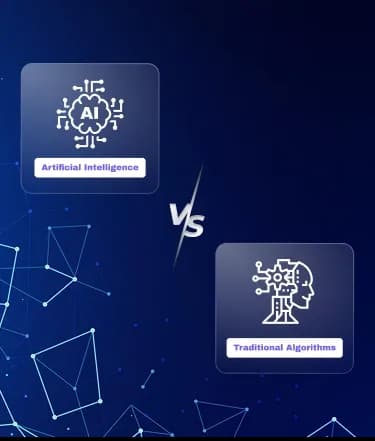
The long-standing dichotomy between artificial intelligence and classical programming has matured into a sophisticated Strategic Orchestration. In 2026, the technological landscape is no longer defined by a "winner-takes-all" mentality, but by how we balance the rigid reliability of deterministic code with the fluid reasoning of agentic AI. As we integrate these systems into every facet of global infrastructure, from autonomous power grids to personalized genomic medicine, understanding the boundary between calculating and reasoning has become the primary challenge for developers and architects alike.
An Intelligent System: AI vs Traditional Algorithms
In 2026, the definition of Artificial Intelligence has transitioned from simple pattern recognition to Agentic Intelligence. Unlike the "predictive" models of the past, modern AI acts as a digital partner capable of multi-step reasoning, goal-setting, and real-world execution. While AI mimics human-like cognition, it is the integration of these models with classical frameworks that creates the "Strategic Orchestration" seen in today’s enterprise environments.
The 2026 Architecture: AI vs Traditional Algorithms
The architecture of AI has matured beyond simple processing. It now rests on four expanded pillars that distinguish it from the fixed logic of Traditional Algorithms.
1. Input Data: The Shift to Multimodal & Synthetic Streams
In the context of AI vs Traditional Algorithms, data is no longer just a static table or text file.
Multimodal Perception: 2026 AI systems simultaneously ingest "World Data" live video, 3D spatial sensors, and environmental audio to build a holistic context.
Synthetic Data Generation: To overcome privacy constraints, AI now utilizes high-fidelity synthetic datasets to train its reasoning layers, whereas Traditional Algorithms remain dependent on manual, structured data entry with strict schemas.
2. Machine Learning & Reasoning Algorithms
The core "logic" has evolved from simple "Machine Learning" to Neuro-symbolic Reasoning.
Agentic Planning: Modern algorithms do not just produce an output; they plan a sequence of actions. For example, if a goal is "optimize supply chain," the AI creates a hierarchy of sub-tasks.
The Verification Layer: A major 2026 update is the inclusion of "Verifier Models." This is where AI vs. Traditional Algorithms find harmony; an AI generates a creative solution, but a traditional, rule-based algorithm checks it against safety laws and physical constraints to prevent "hallucinations."
3. Computational Power: Edge & Liquid Computing
The effectiveness of AI in 2026 is tied to where the power lives.
Neuromorphic & NPU Chips: Most AI computation has moved away from general CPUs to specialized Neural Processing Units (NPUs).
Edge Intelligence: Unlike Traditional Algorithms that often run on central servers, 2026 AI is decentralized. Intelligence lives "at the edge" on your glasses, in your car, or within industrial sensors, enabling real-time decisions with zero lag.
4. The 2026 Pillar: Ethical & Governance Guardrails
The most critical addition to AI architecture this year is the Built-in Governance Layer.
Constitutional AI: Safety is no longer an external patch but a core part of the code. This architectural component ensures the AI adheres to the "human-in-the-loop" principle, meaning that for high-stakes decisions, the AI provides the reasoning, but the Traditional Algorithm (or a human) provides the final "permission" to act.
Hire AI Developers Today!

A Look At Rule-Based Processing: AI vs Traditional Algorithms
In 2026, traditional systems have shifted from being "legacy" tools to becoming the Essential Guardrails of the digital world. While AI handles the creative and "fuzzy" tasks, traditional systems provide the rigid, mathematically certain foundations required for global infrastructure. In an era of autonomous agents, these rule-based systems act as the "Constitutional Layer," ensuring that even the most advanced AI remains within the boundaries of law, physics, and safety.
Traditional System Architecture: AI vs Traditional Algorithms
The architecture of a traditional system in 2026 is defined by its role as a Deterministic Core. It provides the "Ground Truth" that probabilistic AI models often lack.
1. Deterministic Execution: The "No-Hallucination" Zone
The predictable nature of a traditional system makes it deterministic, meaning that for a specific input, the output remains identical every single time.
Reliability for Mission-Critical Tasks: In 2026, while AI might suggest a "likely" flight path, a traditional algorithm is what physically calculates the fuel-to-weight ratio to 10 decimal places.
Fixed Schemas: Unlike AI, which can interpret unstructured data, traditional systems require structured, predefined data formats. This makes them the gold standard for high-stakes environments like tax processing, banking transactions, and medical dosage calculations, where "creativity" is a liability.
2. Manual Rule-Writing & Expert Verification
In the 2026 hybrid ecosystem, Manual Rule-Writing has evolved into Expert Governance.
Explicit Logic: Instead of learning from data patterns (like AI), these systems follow instructions explicitly defined by human experts. This includes detailed code for legal compliance, safety protocols, and financial regulations.
Auditability: Every decision made by a traditional algorithm can be traced back to a specific line of code. This is vital in 2026 for meeting global AI regulations (like the EU AI Act), which often require that an AI's decision be "checked" or "bounded" by a human-written rule.
3. Structured Logic: The Framework for Automation
Structured logic refers to the systematic, step-by-step procedures that govern the system's operation.
Linear Processing: Traditional systems excel at executing a "decision tree" with perfect accuracy.
Systematic Guardrails: In modern 2026 applications, this structured logic often serves as a "wrapper" around AI. For instance, an AI might generate a customer service response, but a traditional structured logic filter will automatically block that response if it contains sensitive data or violates company policy.
Our Personal Observation on AI vs Traditional Algorithms
The distinction between AI algorithms and traditional algorithms has evolved from a competition into a Strategic Orchestration. In our organizational experience, traditional algorithms remain the "Logical Skeleton," the unmoving rules that keep a system stable and compliant. Meanwhile, AI has become the "Cognitive Muscle," providing the fluidity needed to navigate the unstructured data and complex "agentic" workflows that define 2026.
The 2026 Hybrid Workflow: Precision Meets Autonomy
We have observed this balance firsthand through the integration of Neuro-symbolic AI, which combines the best of both worlds:
Agentic AI for Cognitive Labor:
When we generate complex research reports or cross-market strategies, we no longer use AI as a simple "tool," but as an Agentic Partner. In 2026, our AI systems don't just summarize text; they reason through goals. They can plan a report structure, cross-reference real-time 2026 global regulations, and adapt their tone based on the target audience. The system learns from our feedback loops, meaning the AI actually understands our corporate "style" and improves with every project.
Deterministic Systems for Precision Tasks:
Conversely, for mission-critical operations like a Payroll System, we maintain a strict reliance on traditional, rule-based algorithms. In 2026, when "Explainable AI" is a legal requirement (under the EU AI Act and similar global standards), payroll must be processed with zero margin for error. A traditional system excels here because it follows a linear, step-by-step logic that provides a perfect audit trail. If an employee queries a deduction, a traditional algorithm provides a mathematically certain "Why," whereas an AI's probabilistic guess would be a liability in a financial audit.
Challenges and Limitations: AI vs Traditional Algorithms
In 2026, the primary challenge for any system is no longer just "can it do the job," but Governance and Resource Efficiency. As we integrate these tools deeper into our societal fabric, the hurdles for both approaches have become more specialized and high-stakes.
The Agility Gap in Traditional Code: The main limitation of classical, rule-based systems is their inability to adapt to the speed of a post-AI economy. Because these systems are requirement-specific, updating them requires manually rewriting thousands of lines of code. This creates a massive bottleneck in a 2026 market where business conditions change weekly.
The "Black Box" Regulatory Crisis: While AI models are more powerful than ever, they face severe legal constraints. With the full enforcement of the EU AI Act and other global regulations in 2026, models that cannot provide a "Right to Explanation" are being restricted. If an AI cannot explain why it made a decision in high-risk sectors like healthcare or lending, it cannot be legally deployed.
Maintenance Hell and Logic Collisions: Scaling classical methods requires rigid scripting for every possible scenario. In 2026, as system complexity grows, the sheer volume of rules becomes too dense for human teams to audit. This often leads to "cascading errors," where a single update to a traditional algorithm breaks multiple other functions in the system.
Sustainability and "The Energy Score": AI's environmental footprint is a major 2026 roadblock. Training and running massive models consume vast amounts of electricity and water for cooling. Companies are now being measured by their AI Energy Score, forcing a shift toward smaller, more efficient models over the "larger-is-better" approaches of the past.
Post-Quantum Cybersecurity Risks: Traditional algorithms often rely on older encryption standards. In 2026, as Quantum Computing becomes more accessible, many legacy traditional systems require a complete and expensive architectural overhaul to remain secure against new types of "harvest now, decrypt later" cyber threats.
Synthetic Data Hallucinations & Model Collapse: As AI models increasingly train on data generated by other AIs (Synthetic Data), we are witnessing "Model Collapse." This occurs when AI starts to lose its grasp on reality and amplifies its own errors. In the 2026 landscape, this makes high-quality, human-verified data more expensive and difficult to source than ever before.
Future Prospects: AI vs Traditional Algorithms
The future of computation is defined by Neuro-symbolic Synergy. We are moving away from choosing one over the other and toward a unified architecture where AI handles "perception," and traditional algorithms handle "reasoning and safety."
Hyper-Automation & Robotics:
AI is now leveraging Physical AI, giving robots the human-like dexterity needed for complex surgeries and disaster response. Meanwhile, classical methods have evolved into Real-time Deterministic Layers for IoT. For instance, in 2026 supply chains, AI predicts global disruptions while traditional algorithms execute the precise, minute-by-minute logistical shifts in automated warehouses.
Sustainability-First Computing:
Future prospects include Liquid AI and Small Language Models (SLMs) that run on the edge. These allow for AI capabilities with a fraction of the carbon footprint, governed by traditional code to ensure they remain within the "Green Computing" limits set by international 2026 standards.
Why Use AI Models Over Classical Methods?
In 2026, the shift from traditional algorithms to AI is defined by Strategic Orchestration rather than simple replacement. While classical methods remain the gold standard for tasks requiring absolute mathematical certainty and auditability, such as payroll and legal compliance, AI has become the essential Cognitive Layer for modern enterprises. By leveraging Agentic Autonomy, AI models can now reason, plan, and adapt to real-time market shifts, handling the "fuzzy" logic of unstructured data like voice and video that traditional, static code simply cannot process.
The true competitive edge today lies in building Hybrid Systems that combine these two strengths. Organizations use AI to drive innovation and navigate complex, data-heavy environments, while keeping traditional algorithms as the "logical skeleton" to ensure safety and predictability. This fusion allows businesses to achieve high-velocity automation in areas like predictive healthcare and smart infrastructure without sacrificing the structural integrity and reliability that regulated industries demand.
Ultimately, choosing AI over classical methods is a matter of architectural necessity. By integrating the self-learning power of AI with the unwavering reliability of deterministic code, 2026 businesses ensure their digital transformation is both pioneering and fundamentally stable.
Conclusion: The Era of Strategic Orchestration
As we navigate the complexities of 2026, the debate is no longer about AI vs Traditional Algorithms, but rather how to master their Strategic Orchestration. The future of technology belongs to those who can successfully marry the fluid, reasoning capabilities of Agentic AI with the rigid, deterministic safety of classical code. While traditional algorithms remain the indispensable "logical skeleton" for high-stakes precision and legal compliance, AI provides the "cognitive muscle" necessary to thrive in a data-rich, rapidly shifting global market.
Building these hybrid architectures requires a deep understanding of both neuro-symbolic reasoning and mission-critical engineering. To bridge the gap between innovation and reliability, you need a team that understands how to implement these 2026-ready guardrails. When you Hire AI developers with expertise in both probabilistic models and deterministic systems, you ensure your business isn't just automating tasks, but is building a resilient, future-proof ecosystem.
Ready to start your next project? Explore our expertise and get in touch with our technical consultants to discuss your vision. Contact Zignuts Today to bridge the gap between intelligence and execution.

Zignuts Technolab
Zignuts Technolab delivers future-ready tech solutions and keeps you updated with the latest innovations through our blogs. Read, learn, and share!