

Artificial Intelligence and Natural Language Processing have fundamentally shifted how software interacts with the world. We have moved far beyond the era of static, rule-based logic. Today, developers utilize advanced reasoning engines to create systems that can plan, execute complex tasks, and retrieve specific knowledge in real-time. In 2026, the barrier between human intent and machine execution has dissolved, as Large Language Models now serve as the central nervous system for enterprise software.
At Zignuts, we harness the power of LangChain and modern agentic architectures to build context-aware solutions that drive business growth. This framework has matured into the industry standard for bridging the gap between raw probabilistic models and deterministic business logic. By treating language models not just as text generators, but as reasoning kernels, we enable applications to navigate messy, real-world data with unprecedented precision. In this guide, we dive deep into the 2026 landscape of this framework, exploring its core architecture, modern components, and how to implement it effectively.
What is LangChain?
LangChain is a comprehensive open-source framework designed to orchestrate applications powered by Large Language Models (LLMs) like GPT-5 or Claude 4. In 2026, the framework has evolved from a simple chaining tool into a robust ecosystem for building "Deep Agents," autonomous entities capable of long-horizon reasoning. It serves as a specialized abstraction layer that allows developers to swap models, vector stores, and APIs without rewriting the entire core logic.
Rather than just sending a prompt to an LLM, this framework allows your application to:
- Connect securely to enterprise data via the Model Context Protocol (MCP), ensuring that the AI can access proprietary databases while maintaining strict security compliance. This connectivity extends to legacy SQL systems, NoSQL clouds, and real-time internal APIs, allowing the model to act as a bridge between structured corporate data and natural language queries without exposing sensitive credentials directly to the model.
- Maintain persistent state and "episodic memory" across weeks of user interaction, moving beyond simple session history to create a truly personalized user experience. By utilizing advanced vector stores and "summary buffers," the framework can recall specific user preferences or project details discussed months ago, effectively allowing the AI to "grow" with the user and provide contextually relevant advice based on a shared historical background.
- Execute sandboxed code to perform complex mathematical calculations or data analysis, which prevents the model from making logical errors or "hallucinating" numbers. This is achieved through secure runtime environments where the model writes and runs Python or JavaScript to verify its own logic, ensuring that output such as financial forecasting or scientific modeling is grounded in deterministic calculation rather than probabilistic guesswork.
- Navigate complex, non-linear workflows using graph-based logic, allowing the system to backtrack, verify its own work, and correct errors before delivering a final answer. By using directed acyclic graphs (DAGs), developers can build "self-healing" chains where an agent checks its own output against a set of constraints and, if it finds a discrepancy, re-runs the logic using a different strategy.
- Streamline model orchestration through unified interfaces, which means a single application can utilize a high-reasoning model for planning and a smaller, faster model for execution to save on costs. This tiered approach optimizes token usage and latency, automatically routing high-stakes reasoning tasks to "frontier" models while delegating routine formatting or summarization to lightweight, specialized edge models.
Why LangChain?
While modern LLMs are incredibly capable, they still face operational hurdles when used in isolation. Direct integration often leads to "context fatigue" or "hallucination loops," where the model loses its way in long conversations or invents data. LangChain addresses these challenges through a modular, agentic approach that prioritizes reliability and control.
1. State Management and LangGraph
Traditional LLMs are stateless, meaning they treat every prompt as a brand-new interaction with no memory of what came before. This framework introduces LangGraph, which transforms linear chains into stateful workflows. By modeling applications as state machines, agents can now "remember" exactly where they are in a multi-step task, even if the process is interrupted or requires human approval. This persistence is vital for long-running enterprise tasks that may span hours or days, allowing the system to "resume" rather than "restart."
2. Sophisticated Tool Orchestration
Models cannot naturally browse your SQL database, read local files, or call a specific shipping API. This framework provides the essential "glue" to let models use these tools safely. In 2026, this has evolved into Deep Agent capabilities, where an orchestrator doesn't just call a tool but plans the most efficient sequence of tool usage, validates the output, and retries the action if the first attempt fails. It essentially grants the LLM a "utility belt" for the digital world.
3. Dynamic Cost and Latency Control
Running frontier models like GPT-5 can be expensive and slow. This framework optimizes this through:
- Semantic Caching: Storing previous model responses for similar queries to avoid redundant and costly API calls.
- Model Routing: Automatically sending simple tasks to smaller, faster models (like Llama 3 or Gemini Nano) while reserving high-reasoning tasks for the heavy hitters.
- Token Pruning: Intelligently trimming context windows to ensure only the most relevant information is sent, keeping latency low and costs predictable.
- Parallel Execution: Running independent reasoning steps simultaneously rather than sequentially to slash total response time.
4. Enterprise-Grade Reliability and LangSmith
Moving past "black box" prompts, this framework offers a structured way to build and debug. With LangSmith, every decision an agent makes is traceable. Developers can see exactly which tool was called, what context was retrieved, and where a hallucination might have started. This visibility turns AI development from a "guess-and-check" process into a rigorous engineering discipline with clear audit trails, automated evaluations, and performance metrics for production deployment.
5. Multi-Agent Collaboration
One of the most significant advantages in 2026 is the ability to coordinate multiple specialized agents. Instead of one model trying to do everything, you can have a "Researcher Agent," a "Writer Agent," and a "Compliance Agent" all working together within the same framework. This division of labor leads to higher-quality outputs, reduces the "cognitive load" on a single model, and allows for complex, recursive workflows that a single model simply couldn't handle alone.
6. Human-in-the-Loop (HITL) Interventions
In mission-critical scenarios, full autonomy can be risky. Modern LangChain implementations utilize "Static and Dynamic Interrupts" to pause execution when an agent is uncertain or about to perform a high-stakes action (like executing a financial trade). This allows a human operator to review the state, provide guidance, or approve the next step before the agent continues, ensuring a collaborative partnership between human judgment and machine efficiency.
Hire AI Developers Today!

Core Components of LangChain
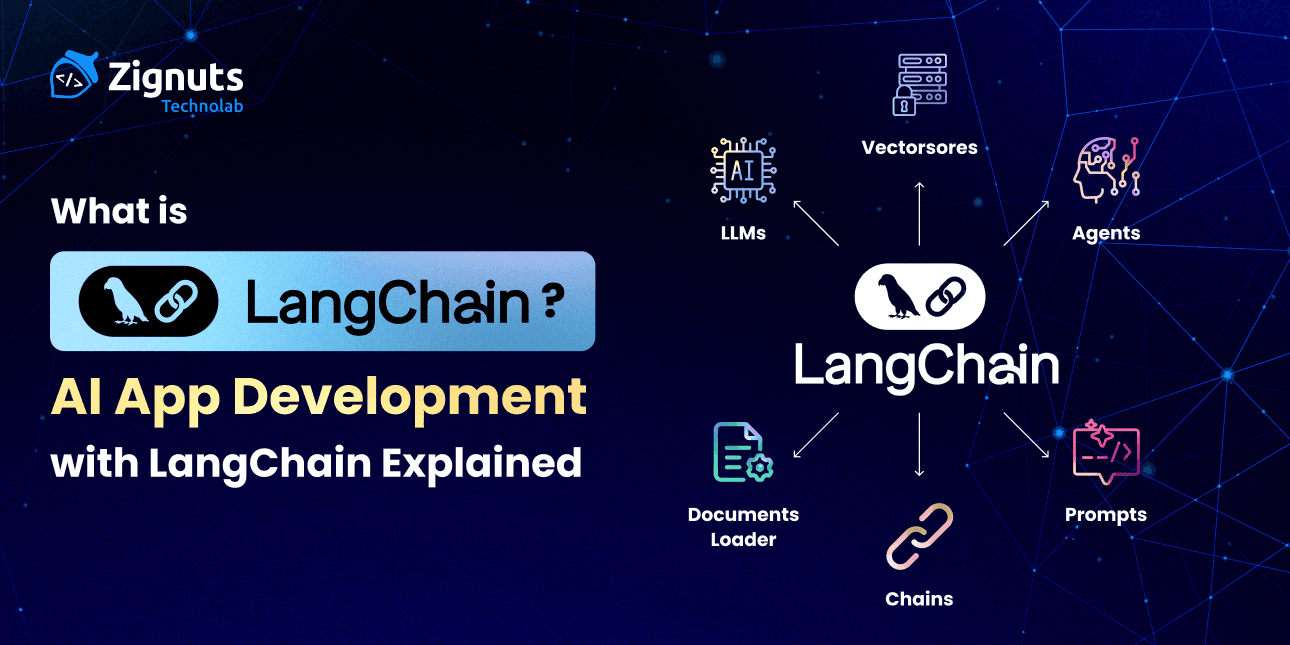
The architecture has shifted toward a more granular, "Lego-like" structure in 2026. This modularity allows developers to construct highly specialized AI systems by snapping together interoperable parts. Here are the essential building blocks:
1. LangGraph and Advanced Chains
While classic linear chains still exist for simple tasks, most modern apps use LangGraph. This evolution allows for cycles and loops, enabling an agent to try a task, observe the failure, and "loop back" to correct itself. Unlike the rigid sequences of the past, these graphs represent state machines where execution can branch or revisit earlier nodes based on real-time evaluation. In 2026, LangGraph has become the deterministic control system that prevents AI from getting stuck in "infinite loops" by enforcing retry caps and explicit state transitions.
2. Deep Memory and SummaryMiddleware
In 2026, memory is no longer just a text buffer. It acts as a tiered storage system that balances instant recall with long-term retention.
- VectorStoreRetrieverMemory: This component allows an application to recall specific facts or user preferences from months ago using high-dimensional semantic search across vectorized conversation history.
- SummaryMiddleware: This is a specialized orchestration layer that automatically condenses long histories when the model's context window is nearly full. It preserves the "gist" of the conversation while discarding redundant tokens, ensuring the agent remains cost-effective and responsive without losing the thread of the dialogue.
- Persistent Checkpointing: Every state change in a LangGraph workflow is saved to a persistent database (like SQLite or Postgres), allowing an agent to "time travel" back to any previous state if an error occurs.
3. Agentic Agents and Sub-Agent Delegation
Agents are the "brains" of the operation, but they are no longer solitary thinkers. In the latest update, Deep Agents can now spawn and manage "sub-agents" to handle specialized sub-tasks. For instance, a lead "Project Manager" agent might delegate a technical search to a "Research Agent" and a code audit to a "Security Agent," aggregating their results into a final, high-integrity response. This hierarchical structure reduces the cognitive load on any single model and minimizes reasoning errors.
4. Advanced Retrievers and Agentic RAG
Retrieval-Augmented Generation (RAG) has matured into Agentic RAG. This system utilizes retrievers that don't just find text but also critically evaluate if the found text is actually relevant before showing it to the LLM.
- Self-RAG: The agent acts as its own critic, checking if the retrieved information is sufficient; if not, it automatically refines the query and searches again.
- Contextual Compression: This strips away the "noise" in a document, feeding only the most essential sentences into the model to reduce latency and hallucination risks.
- Hybrid Search: Modern retrievers combine semantic vector search with traditional keyword search to ensure 100% accuracy for specific terms like product IDs or legal codes.
5. Unified Tool Interface and MCP Integration
The framework now features a standardized interface for interacting with the physical and digital world. Whether it is a SQL database, a real-time web search API, or a local filesystem, all Tools are now defined with strict Pydantic v2/v3 schemas.
- Model Context Protocol (MCP): Often called the "USB-C for AI," MCP allows LangChain agents to discover and connect to any external tool or data source instantly without custom code.
- Safe Sandboxing: Tools that execute code or modify files now run in secure, isolated environments, protecting your host system from unintended AI actions.
6. Observability with LangSmith
No modern component is complete without a way to watch it work. LangSmith is integrated into every block, providing a real-time "X-ray" of the agent's logic. In 2026, it offers automated unit testing for prompts, helping developers catch "regressions" where a model update might make an agent less helpful than it was before.
Use Cases of LangChain
The versatility of the framework has opened doors across every industry, shifting from simple text generation to autonomous, cross-functional systems. In 2026, the ecosystem supports high-stakes applications where accuracy and reliability are non-negotiable.
Autonomous Customer Success
Modern chatbots no longer just answer FAQs; they function as digital concierge agents. Using LangChain’s Action Transformers, these systems can process refunds, update shipping addresses, or verify warranty claims by securely interacting with backend ERP and CRM systems. They use multi-step reasoning to verify a user’s identity, check the return policy window, and execute the transaction, only escalating to a human agent when a high-emotion or "out-of-policy" exception is detected.
Context-Aware Document Analysis
Beyond simple search, these systems "read" and comprehend thousands of complex documents like insurance policies or technical manuals. By employing Agentic RAG (Retrieval-Augmented Generation), the system doesn't just find keywords; it understands the hierarchy of information.
It can cross-reference a specific clause in a 400-page manual against a user’s specific query, providing a cited answer based strictly on private data while ignoring irrelevant or outdated versions of the same document.
AI Software Engineers
Coding assistants have evolved into full-cycle developers. They utilize FilesystemMiddleware to read entire codebases, write new features, run tests in a secure sandbox, and debug errors autonomously. By using Self-Correction loops, the agent attempts to compile its own code; if it fails, it reads the error log, modifies the code, and tries again until the test suite passes, ensuring that a human developer only reviews functional, high-quality pull requests.
Hyper-Personalized Content Engines
Marketing tools now act as "Brand Guardians." They use Long-term Memory components to remember a brand's specific tone, past campaign performance metrics, and legal compliance rules. This allows them to generate fresh, cross-platform assets from TikTok scripts to LinkedIn articles that are automatically optimized for the specific audience segment while ensuring the brand's unique "voice" remains consistent across years of content.
Intelligent Financial Analysts
In the finance sector, agents are deployed to monitor global market feeds and internal transaction logs in real-time. Using LangGraph for complex state management, they can detect subtle fraud patterns or generate investment memos. These agents synthesize data from structured SQL databases and unstructured live news APIs simultaneously, providing a "holistic risk score" that accounts for both hard numbers and geopolitical sentiment.
Healthcare Operations & Diagnostics
Clinics utilize this technology to automate the heavy lifting of patient intake. This includes parsing medical histories from disparate formats (handwritten scans or PDFs) and validating insurance claims against complex regulatory notices. By using Output Parsers, the system transforms messy patient data into structured medical summaries, highlighting potential red flags in lab reports so doctors can focus on treatment rather than data entry.
Autonomous Supply Chain Logistics
By integrating with real-time IoT sensors and weather APIs, these agents predict maintenance needs and optimize delivery routes dynamically. If a disruption occurs, such as a port closure or a storm, the agent uses Dynamic Routing logic to re-calculate the most cost-effective path, autonomously re-route shipments, and notify stakeholders with a detailed "reasoning chain" explaining why the change was made.
Legal Compliance & Review
Law firms use hierarchical agent systems to scan massive contracts for high-risk clauses. A "Researcher Agent" identifies the text, while a "Legal Agent" compares it against a checklist of 2026 regulatory standards. This ensemble approach reduces "hallucinations" by having a third "Critic Agent" verify the findings, flagging only the truly non-compliant sections for human review, which slashes the time required for due diligence by up to 80%.
Hire AI Developers Today!
Example Workflow: YouTube Transcript Q&A System
To see the framework in action, we can look at a 2026-optimized workflow. This system doesn't just "read" a transcript; it uses a Contextual Compression Retriever to find the exact needle in the haystack. In the era of high-density video content, extracting precise insights requires more than simple keyword matching. By leveraging LangChain, we can build a pipeline that understands the semantic nuance of a video and compresses thousands of words into the specific context needed for your question.
This project demonstrates the power of Agentic RAG. Instead of feeding the entire transcript to the model, which is costly and prone to context fatigue, we use an intelligent compressor to distill the text. Below is the step-by-step implementation using the state-of-the-art Qwen3-Coder model, specifically optimized for reasoning and long-context processing in 2026.
Step 0: Utils
Before we can process a video, we need a robust utility to handle diverse YouTube URL formats. This helper function ensures that whether a user pastes a standard link, a mobile link, or an embed code, the system can reliably isolate the unique video ID.
Step 1: Install Dependencies
Building a modern AI app requires a specialized stack. We use langchain-huggingface for high-performance open-source model integration and langchain-chroma for efficient local vector storage.
Step 2: Import Libraries
We import the core modules required for document loading, text splitting, and vectorization. Notice the use of RecursiveCharacterTextSplitter, which intelligently maintains paragraph and sentence integrity during the chunking process.
Step 3: Define Response Schema
To ensure our AI application is production-ready, we use Pydantic to enforce a structured output. This guarantees that every AI response follows a consistent JSON format, making it easy to integrate with frontend dashboards.
Step 4: Create LLM & Embeddings
In 2026, we utilize the Qwen3-Coder-480B-A35B-Instruct, a Mixture-of-Experts (MoE) model that offers GPT-4 class reasoning with lower latency. Combined with all-MiniLM-L6-v2 embeddings, we create a powerful semantic search engine.
Step 5: Get YouTube Transcript
Using the youtube-transcript-api, we fetch the raw text data. In 2026, many videos contain multi-language tracks; here, we specifically target the English transcript to maintain data consistency.
Step 6: Split Text into Chunks
LLMs perform best when given small, contextually rich snippets. We split the transcript into 512-character blocks with a 64-character overlap to ensure no critical information is lost between chunks.
Step 7: Store in Vector Database
Chroma DB serves as our long-term memory. By storing the chunked text here, we can perform mathematical similarity searches to find the most relevant parts of the video in milliseconds.
Step 8: Create Retriever with Compression
Standard retrieval often returns too much "fluff." We implement a Contextual Compression Retriever, which uses the LLM to pre-read the retrieved chunks and filter out everything except the sentences that directly answer the user's query.
Step 9: Define Prompt & Parsers
The prompt template is the "instruction manual" for our AI. It tells the agent to stay strictly within the context of the transcript and follow the Pydantic formatting instructions we defined earlier.
Step 10:Manage Chat History
Finally, we wrap the execution in a loop. The system maintains a chat_history list, allowing the user to ask follow-up questions. This creates a true "Chat with Video" experience where the AI understands the continuity of the conversation.
Step 11: Ask Questions
Benefits of Using LangChain
Adopting this framework provides a significant head start in building production-grade AI. By 2026, it will have become the definitive backbone for enterprise AI, offering more than just simple connectivity; it provides the rigorous architecture needed to move from a "fun demo" to a "reliable business asset."
1. Infrastructure Neutrality and Future-Proofing
The AI landscape moves at a staggering pace. Today’s top model might be tomorrow’s legacy technology. LangChain’s Unified Interface allows you to switch from OpenAI to local models (like Llama 3) or Anthropic’s Claude 4 without changing your core logic. This "swap-and-play" capability ensures that your application is never locked into a single provider, protecting your investment as the industry evolves.
2. Enterprise-Grade Guardrails and Safety
Deploying AI in regulated industries requires strict safety protocols. This framework provides built-in support for:
- PII Redaction: Automatically detecting and masking Sensitive Personal Information before it ever reaches the LLM.
- Human-in-the-loop (HITL) Approvals: Integrated "gates" that pause an agent’s execution, requiring a human to verify high-stakes actions like financial transfers or legal filings.
- Deterministic Logic: Combining probabilistic AI with rule-based "if/else" logic to ensure the model stays within brand and compliance boundaries.
3. Radical Observability with LangSmith
One of the biggest hurdles in AI is the "Black Box" problem, not knowing why an agent made a specific mistake. LangChain integrates seamlessly with LangSmith, providing a real-time X-ray of every single decision, tool call, and retrieval step. This allows developers to:
- Trace execution paths to find exactly where a hallucination occurred.
- Run A/B tests on different prompt versions to see which performs better.
- Monitor token usage and latency in real-time to keep operational costs predictable.
4. Economic Optimization and Scaling
Scale brings costs, but LangChain helps manage the "token tax" through intelligent engineering:
- Semantic Caching: If a user asks a question that was answered recently, the system serves the cached response instead of making a new model call.
- Parallel Processing: Executing multiple reasoning steps at once rather than one after the other, which slashes the "time-to-first-token" for the end user.
- Smart Routing: Automatically sending simple queries to "cheap" models while reserving the "expensive" frontier models for complex reasoning.
5. Multi-Actor Collaboration (LangGraph)
Modern business problems are too complex for a single prompt. This framework enables LangGraph, allowing multiple specialized agents, each with their own tools and memory, to collaborate on a single goal. This "team-based" approach mimics human office workflows, leading to higher accuracy and the ability to handle non-linear, recursive tasks that standard chains simply cannot solve.
6. Automated Testing and "LLM-as-a-Judge"
In 2026, manual testing is a bottleneck. LangChain facilitates Automated Evaluations where a more powerful "Judge LLM" reviews the outputs of your production model against a set of quality benchmarks. This ensures that every update to your prompts or data retrieval methods actually improves the system rather than causing regressions.
7. Rapid Prototyping to Production Deployment
The framework accelerates the entire development lifecycle. With LangServe, you can turn any chain into a production-ready REST API with a single command. This seamless transition from a Jupyter notebook to a scalable cloud service allows startups and enterprises alike to iterate at the speed of thought, reducing the time-to-market for new AI features from months to days.
8. The "USB-C for AI": Model Context Protocol (MCP)
By 2026, LangChain will have fully embraced the Model Context Protocol (MCP). This standardization allows your agents to instantly "plug in" to any data source or tool that supports the protocol, from local filesystems to global CRM platforms, without writing custom integration code for every new API. This universal connectivity makes your AI ecosystem modular, interoperable, and incredibly easy to expand.
Challenges and Considerations
No framework is a silver bullet. While LangChain provides the scaffolding for sophisticated AI, developers in 2026 must navigate a landscape where "more features" often mean "more points of failure." To move from a prototype to a resilient enterprise application, you must actively manage these core challenges:
1. Execution Latency and Sequential Bottlenecks
Multi-agent reasoning and complex tool-calling chains take significant time. If an agent must call three different tools sequentially, the user could be left waiting for 10 seconds or more.
- Streaming as a Standard: Always use astream or StreamingStdOutCallbackHandler so users see the agent's "thought process" in real-time, which reduces perceived latency.
- Parallelization: Use asyncio.gather() to trigger independent tool calls (like searching a database and a web API simultaneously) instead of waiting for one to finish before starting the next.
2. Token Economics and "Context Bloat"
Every token sent to a frontier model costs money and adds latency. Complex chains that pass entire conversation histories back and forth quickly become prohibitively expensive.
- SummarizationMiddleware: Instead of passing the full transcript, use a specialized summarizer to condense older messages into a "memory gist."
- Model Cascading: Use a "frugal GPT" strategy. Route simple classification tasks to ultra-cheap models like Gemini Nano and reserve high-reasoning heavyweights only for the final synthesis.
3. Non-Deterministic Outputs and Validation
AI is inherently probabilistic, meaning it might format a date differently or skip a field even with a perfect prompt. This unpredictability can crash traditional backend code that expects strict JSON.
- Structured Output Parsers: Use Pydantic v2 schemas to force the LLM into a deterministic mold. If the model fails to return the required fields, LangChain’s OutputFixingParser can automatically catch the error and ask the model to fix its own formatting.
- Retry Logic: Implement "exponential backoff" for tool calls. If an API fails or the LLM hallucinates a parameter, the system should intelligently retry before throwing an error.
4. Over-Abstraction and "Opaque" Logic
LangChain is a high-level framework, which sometimes makes it hard to see what is happening "under the hood." Deeply nested chains can create massive stack traces that are difficult to debug.
- LangSmith for Debugging: Never deploy to production without LangSmith tracing enabled. It provides a visual timeline of every prompt sent and every raw response received, turning a "black box" into a transparent engineering log.
- Keep it Simple: Avoid "chaining for the sake of chaining." If a task can be done with a single prompt and a simple Python function, don't build a 5-step agentic graph for it.
5. The "Identity and Permissions" Risk
In 2026, the primary threat to AI agents isn't just a bad answer; it’s over-privileged access. An agent given a "Search & Edit" tool might accidentally delete a database table if its instructions are ambiguous or if it falls victim to a Prompt Injection attack.
- Least Privilege Principle: Tools should have the narrowest scope possible. A "Read-Only" tool is always safer than one with "Write" access.
- Guardian Agents: Deploy a separate, lightweight "Supervisor Agent" whose only job is to monitor the main agent's outputs for safety, bias, or sensitive data leaks (PII) before they reach the user.
Future of LangChain
The roadmap for the coming year is focused on Agentic Autonomy. In 2026, the transition from "copilots" to "autonomous teammates" is becoming a reality, as frameworks evolve to handle the full lifecycle of a task with minimal supervision. We expect to see LangChain cement its position not just as a library, but as a complete Operating System for AI Agents.
1. Universal Interoperability via MCP
The deeper integration with the Model Context Protocol (MCP) allows agents to act as universal adapters for any software tool. Instead of building custom connectors for every API, LangChain agents in 2026 can instantly "plug into" standard MCP servers. This means a single agent can switch between querying a specialized medical database, executing a trade on a financial terminal, or managing a cloud server, all using a standardized, secure communication layer that eliminates integration friction.
2. The Rise of "Self-Healing Chains"
"Self-Healing Chains" are becoming the new industry standard for reliability. These systems utilize Recursive Error Correction, where an agent doesn't just fail when it hits a bug; it analyzes the error log, identifies the root cause (such as a hallucinated tool parameter or a schema mismatch), and automatically "loops back" to fix its own logic. This capability is powered by meta-agents that monitor observability traces in real-time, optimizing system prompts on the fly to improve performance without human intervention.
3. Industrial-Scale Autonomy and Swarms
We are moving toward Industrial-Scale Autonomy, where a "Lead Architect" agent manages a swarm of specialized sub-agents. These "Agent Swarms" can execute entire business processes such as a global marketing campaign or a software release cycle by coordinating tasks, managing dependencies, and resolving conflicts autonomously. This shift transforms developers from "Prompt Engineers" into Workflow Architects, focusing on high-level intent rather than low-level execution.
4. Physical-Digital Fusion
LangChain is extending beyond software into the physical world. In 2026, the framework is being used to orchestrate agents that control autonomous logistics and robotics. By connecting digital reasoning with physical sensors through specialized retrievers, agents can now manage warehouse operations, optimize delivery routes in real-time based on live IoT data, and even conduct autonomous lab experiments in scientific research.
Conclusion
As we navigate the agentic era of 2026, LangChain has solidified its place not merely as a toolkit but as the foundational operating system for enterprise intelligence. Moving beyond simple text generation to build "Deep Agents" capable of long-horizon planning, self-correction, and secure tool execution requires a sophisticated architectural approach. The difference between a novelty chatbot and a revenue-driving business asset lies in the robust implementation of components like LangGraph, Model Context Protocol, and diverse reasoning loops. To bridge the gap between raw probabilistic models and deterministic business success, organizations must prioritize engineering rigor over hype. For companies looking to build resilient, future-proof solutions, the smartest move is to Hire AI Developers who possess the deep technical expertise to orchestrate these complex systems effectively.
Contact Zignuts today to transform your business logic into autonomous, high-performance AI applications, and let’s build the future of your intelligent enterprise together

Ekta Trivedi
A Node.js enthusiast focused on building scalable, high-performance applications that power the next generation of web technologies

Vraj Makvana
Passionate developer with expertise in building scalable web applications and solving complex problems. Loves exploring new technologies and sharing coding insights.