

A practical guide to choosing the right framework for production AI systems
What Are These Frameworks?
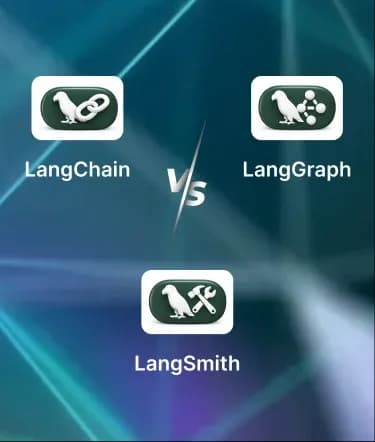
Think of building an AI application like constructing a smart building:
- LangChain = Your toolkit and blueprints (components and integrations)
- LangGraph = Your control system and wiring (workflow orchestration)
- LangSmith = Your monitoring dashboard and maintenance logs (observability)
Hire OpenAI Developers Today!

LangChain: Your AI Integration Toolkit
What It Does
LangChain provides pre-built components for common AI tasks. It's the foundation layer that connects various AI services and data sources.
Core Components
- LLM Integrations: Connect to OpenAI, Anthropic, and local models
- Prompt Templates: Reusable prompt structures with variables
- Memory Systems: Conversation history and context management
- Vector Stores: Connect to Pinecone, Weaviate, ChromaDB for semantic search
- Document Loaders: Process PDFs, Word docs, websites, and databases
Real-World Example
Customer Support Chatbot
Scenario: A SaaS company needs a chatbot that answers questions using their knowledge base.
LangChain Solution:
- Document loader ingests help articles
- Text splitter breaks content into chunks
- Vector store enables semantic search
- Chain combines retrieval + LLM to generate answers
When to Use LangChain
- Simple linear workflows (A → B → C)
- Document Q&A systems
- Basic chatbots with context
- Content generation pipelines
Limitations
- Complex decision trees
- Multi-step approval workflows
- Long-running processes requiring state persistence
LangGraph: Advanced Workflow Orchestration
What It Does
LangGraph handles complex workflows that require loops, conditions, and state management. It's built for applications where the path isn't straightforward.
Key Capabilities
- State Machines: Track complex application state across steps
- Conditional Routing: Dynamic decision-making based on outputs
- Cycles & Loops: Iterative refinement and retry logic
- Checkpointing: Save and resume workflows at any point
- Human-in-the-Loop: Pause for human approval before continuing
Real-World Example
Invoice Processing System
Scenario: An accounting firm processes vendor invoices with variable workflows.
LangGraph Workflow:
- Step 1: Extract data from invoice PDF
- Step 2: Validate against purchase orders
- Decision: If amount > $10k → Send to manager for approval
- Decision: If discrepancies found → Loop back for correction
- Final: Approved invoices → Auto-post to accounting system
Architecture: Nodes and Edges
LangGraph uses a graph structure:
- Nodes = Processing steps (functions that do work)
- Edges = Connections between nodes (what happens next)
- State = Shared data that flows through the graph
When to Use LangGraph
- Multi-step approval workflows
- Autonomous agents with tool usage
- Complex decision trees with conditional logic
- Processes requiring human intervention
- Long-running workflows with state persistence
Hire AI Developers Today!
LangSmith: Your AI Debugging & Monitoring Platform
What It Does
LangSmith is your observability platform. It shows you exactly what's happening inside your AI application—from development to production.
Core Features
- Tracing: See every step your AI takes (inputs, outputs, latency)
- Dataset Management: Organize test cases and expected outputs
- Evaluation: Automatically test quality across versions
- Monitoring: Track costs, errors, and performance in production
- Collaboration: Share traces and insights across teams
Real-World Example
E-commerce Product Recommendations
Problem: Your recommendation engine suddenly starts suggesting irrelevant products.
LangSmith Solution:
- Trace Analysis: View exact prompts and responses for failed recommendations
- Dataset Testing: Run 100 test cases to identify an accuracy drop
- Root Cause: The Discover prompt was too generic after recent changes
- Fix & Verify: Update prompt, re-test, deploy with confidence
Why LangSmith Matters
Traditional debugging doesn't work for LLMs because:
- Outputs are non-deterministic (different each time)
- Complex chains make it hard to find issues
- You need to see the full execution path
- Cost and performance tracking are critical
When to Use LangSmith
- Always - from day one of development
- Debugging why outputs are wrong
- Testing changes before deployment
- Monitoring production performance and costs
LangChain vs LangGraph vs LangSmith - Quick Comparison Guide
Choose Based on Your Needs
Simple Q&A Bot
- Use: LangChain + LangSmith
- Why: Linear workflow, no complex routing needed
Multi-Department Approval System
- Use: LangGraph + LangSmith
- Why: Conditional routing, human-in-loop, state persistence
Research Agent
- Use: LangChain + LangGraph + LangSmith
- Why: Components from LangChain, complex orchestration from LangGraph, debugging with LangSmith
Read Similar Article: LangChain vs LlamaIndex: Best Framework for RAG & AI
Why These Tools Shape the Future of IT
The AI Shift in Enterprise Technology
Traditional IT development follows predictable patterns with deterministic logic. AI-powered systems introduce new paradigms that these frameworks specifically address.
Key Industry Transformations
1. Healthcare & Life Sciences
- Clinical Documentation: LangGraph manages complex medical coding workflows with compliance checkpoints
- Drug Discovery: LangChain integrates research databases, LangSmith tracks experiment quality
- Patient Care: Autonomous agents triage symptoms, schedule appointments, coordinate care teams
2. Financial Services
- Fraud Detection: LangGraph routes suspicious transactions through escalating review levels
- Investment Analysis: Agents research companies, analyze financials, generate comprehensive reports
- Compliance: LangSmith provides audit trails for all AI-driven decisions
3. Manufacturing & Supply Chain
- Quality Control: Vision + LLM workflows detect defects, route for human inspection
- Inventory Management: Agents predict demand, coordinate ordering across suppliers
- Maintenance: LangGraph orchestrates predictive maintenance workflows
4. Legal & Professional Services
- Contract Analysis: Extract clauses, identify risks, suggest modifications
- Due Diligence: Research agents investigate entities, compile findings
- Compliance Review: Multi-stage approval workflows with expert checkpoints
Critical Success Factors
Why These Frameworks Are Essential
- Production Reliability: LangSmith's observability prevents costly failures in production
- Complex Automation: LangGraph handles enterprise workflows traditional tools can't
- Integration Speed: LangChain accelerates development with pre-built components
- Cost Control: Monitoring and optimization prevent budget overruns
- Compliance: Audit trails and human oversight meet regulatory requirements
The Development Paradigm Shift
Traditional software development focuses on deterministic logic and explicit programming. AI development introduces:
- Probabilistic Outputs: Results vary even with identical inputs
- Emergent Behavior: Unexpected capabilities appear from prompt engineering
- Context Dependency: Performance depends on prompts, examples, and data quality
- Continuous Tuning: Systems require ongoing evaluation and refinement
These frameworks provide the infrastructure to manage these new complexities at enterprise scale.
Getting Started: Practical Roadmap
Phase 1: Foundation
- Set up the LangSmith account for immediate tracing
- Build a simple LangChain prototype for the core use case
- Create an initial test dataset with 10-20 examples
Phase 2: Complexity
- Identify decision points requiring conditional logic
- Migrate to LangGraph for complex routing
- Implement human-in-loop checkpoints
Phase 3: Production
- Expand test dataset to 100+ cases
- Set up automated evaluations in CI/CD
- Configure production monitoring and alerts
- Deploy with a gradual rollout strategy
Final Thoughts
The combination of LangChain, LangGraph, and LangSmith represents a complete toolkit for production AI development:
- LangChain provides the building blocks
- LangGraph orchestrates complex workflows
- LangSmith ensures quality and reliability
As AI transforms industries from healthcare to finance, these frameworks provide the professional-grade infrastructure needed to build systems that are reliable, maintainable, and ready for enterprise deployment.
The future of IT isn't about replacing traditional development. It's about augmenting it with intelligent automation that these frameworks make practical at scale.

Divyesh Patel
A passionate problem solver driven by the quest to build seamless, innovative web experiences that inspire and empower users.