

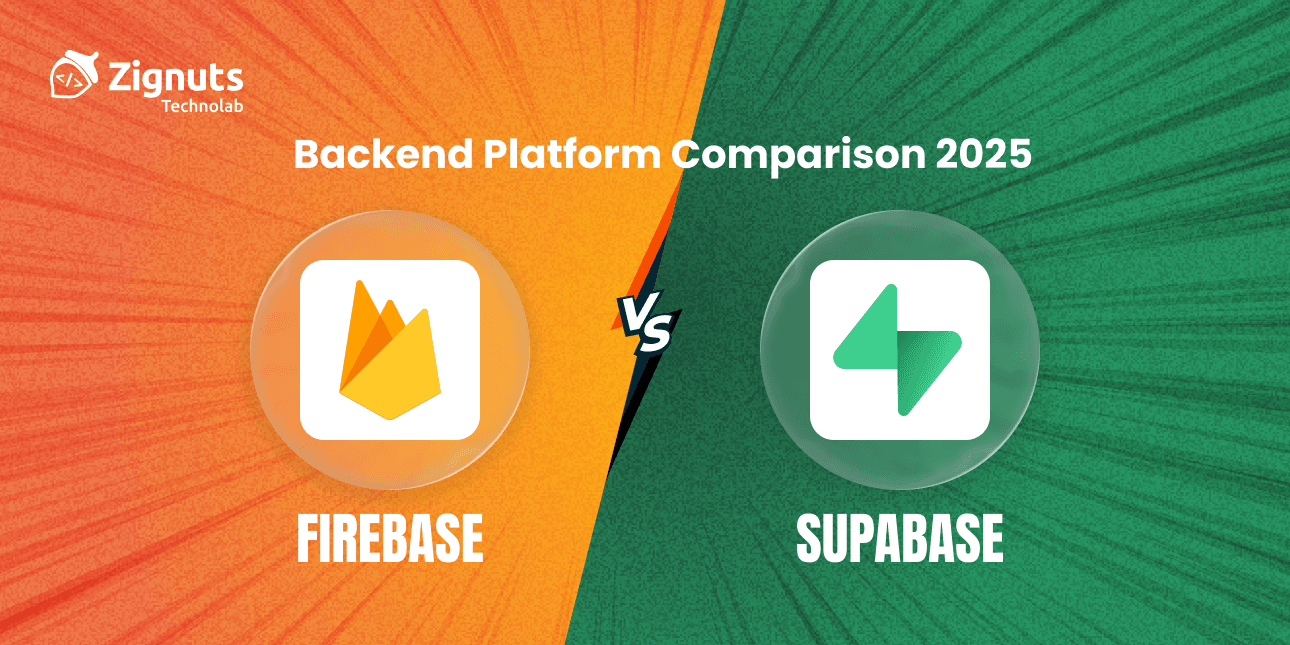
In the rapidly shifting landscape of 2026, the "Backend-as-a-Service" (BaaS) market has moved beyond simple data storage into the realms of Edge Computing and Generative AI integration. Choosing the right platform is no longer just about NoSQL vs SQL; it's about where your logic lives and how your data "thinks." At Zignuts, we’ve spent years mastering both ecosystems. As we enter 2026, the choice between Firebase and Supabase has become more nuanced than ever, and this guide decodes the current state of these heavyweights to help you architect your next breakthrough application.
The Rise of Firebase vs Supabase: 2026 Edition
In 2026, the BaaS landscape has evolved from simple hosting to intelligent orchestration. The choice now centers on whether you need a deeply integrated AI ecosystem or a high-performance, open-source relational powerhouse.
Firebase: The AI-First Veteran
Firebase, Google's powerhouse, is no longer just the "plug-and-play" mobile choice; in 2026, it has matured into a sophisticated AI-integrated ecosystem. It has shattered its "NoSQL-only" reputation and leaned heavily into autonomous development.
- Firebase Data Connect (Postgres Managed):
Bridging the gap between the Google ecosystem and relational power, Firebase now offers a managed PostgreSQL experience. Using GraphQL-like interfaces, you can now enjoy relational data integrity with the seamless Firebase SDK experience.
- Gemini 2.5 & Firebase Studio:
The introduction of "Agentic" development allows Gemini 2.5 to independently reason, refactor code, and manage database schemas directly within the new Firebase Studio.
- Thinking Budgets:
Developers can now set "Thinking Budgets" for AI models, controlling costs and latency for complex reasoning tasks without ever leaving the console.
Supabase: The SQL & Edge Challenger
Supabase has solidified its position as the primary platform for custom AI workflows and high-performance relational data. In 2026, it is the go-to for engineering-heavy teams that demand control without the vendor lock-in.
- Native pg_vector Supremacy:
Supabase has optimized pg_vector to rival dedicated vector databases. It now supports Hybrid Search, combining keyword and semantic search within a single SQL query, making it the gold standard for RAG (Retrieval-Augmented Generation).
- Edge Supremacy with Node & NPM:
The limitations of the past are gone. Supabase Edge Functions now support over 1 million NPM modules and the latest Deno 2.1 runtimes, allowing for ultra-low latency execution closer to your users.
- Database Branching & Passkeys:
New "Branching" features allow teams to test database changes in isolated environments, much like a Git workflow. Additionally, it has moved toward a Passkey-first security model, making biometric authentication the standard
Architecture: The Backbone of Your Application - Firebase vs Supabase
Firebase Architecture: Unified Intelligence & Multi-Model Power
By 2026, Firebase has transcended its "NoSQL-only" origins to become a multi-model powerhouse. While it maintains its legendary serverless simplicity, the architecture has evolved to handle structured, unstructured, and AI-ready data simultaneously.
- Firebase Data Connect (SQL Integration):
The most significant shift is the General Availability of Firebase Data Connect. You can now build on a fully-managed PostgreSQL foundation (powered by Cloud SQL) while utilizing GraphQL-like schemas. This allows you to handle complex relational data without losing the seamless, "self-driving" Firebase experience.
- AI-Native Infrastructure:
Firebase architecture now features integrated Gemini 2.5 capabilities. Through Firebase Studio, the platform doesn't just store data; it offers "Agentic" workflows where AI can autonomously optimize queries, refactor serverless functions, and even suggest schema migrations.
- Vertex AI & Vector Search:
Architecture now includes native support for vector embeddings directly within your database, making it effortless to build semantic search and recommendation engines.
Supabase Architecture: The Relational & Edge Supremacy
Supabase has matured into the "Standard" for developers who demand a portable, high-performance architecture. In 2026, it is no longer just a "wrapper" for Postgres; it is a global Edge Runtime.
- Hardened PostgreSQL at the Core:
Every project remains a dedicated, full-featured Postgres database. In 2026, this includes advanced Database Branching, allowing your team to fork your architecture for testing as easily as a Git branch.
- Edge Functions with Node & NPM Support:
Supabase has bridged the gap between Edge and Server. Its Edge Functions now support the full NPM ecosystem, running on a globally distributed architecture that executes logic closer to the user with near-zero cold starts.
- pg_vector & Local-First Sync:
Supabase has optimized its architecture for the "Local-First" movement. With improved real-time engines and native pg_vector support, it serves as a high-speed hub for AI agents that require massive relational context and low-latency retrieval.
Database Models: Choosing Your Data Structure - Firebase vs Supabase
In 2026, the "Backend Dilemma" has evolved. The choice is no longer just a binary split between NoSQL and SQL. With both platforms introducing cross-model capabilities and AI-driven data handling, your choice depends on whether you prioritize unstructured speed or relational intelligence.
Firebase: Multi-Model Agility & "Agentic" Data
Firebase has fundamentally redefined its database layer for 2026. While Firestore remains the heart of its NoSQL offering, the platform has matured into a multi-model powerhouse that eliminates the "square peg, round hole" struggle of the past.
- Firestore (NoSQL):
Continues to offer unmatched flexibility for hierarchical data and rapid iteration. It is the gold standard for apps with unpredictable schemas or those requiring "bulletproof" real-time syncing at a massive global scale.
- Firebase Data Connect (SQL):
This 2026 game-changer allows you to provision a fully-managed PostgreSQL database directly within Firebase. You no longer have to choose between the Firebase ecosystem and relational power; you can have both, using GraphQL to bridge the two.
- AI-Assisted Modeling:
Through Firebase Studio, Google’s Gemini 2.5 can now analyze your data patterns and automatically suggest indexing strategies or refactor document structures to prevent performance bottlenecks before they happen.
Supabase: The Relational Standard & Vector Mastery
Supabase has solidified its position as the premier choice for developers who demand the "Swiss Army Knife" of structured data. In 2026, it is recognized not just as a database, but as a high-performance engine for Relational AI.
- PostgreSQL Supremacy:
Supabase provides a hardened, full-featured Postgres environment. In 2026, this includes Database Branching, letting you fork your production schema to test complex migrations without risking your live data.
- Native pg_vector for RAG:
Supabase is the "Gold Standard" for Retrieval-Augmented Generation (RAG). By integrating pg_vector directly into the relational flow, you can store your metadata and AI embeddings in the same table, making hybrid search queries faster and more consistent than ever.
- Structured Real-time:
Unlike the "everything-syncs" approach, Supabase allows for granular Postgres Changes subscriptions. You can listen to specific rows or tables, giving you surgical control over how data flows to your frontend.
AI & Vector Search: The Intelligence Layer - Firebase vs Supabase
In 2026, the backend has transitioned from a passive data store to an active AI Orchestrator. The "dilemma" for developers is no longer just where to store text, but how to manage the "Thinking Budgets," vector embeddings, and autonomous agents that define the next generation of software.
Firebase: The "Agentic" Ecosystem
Firebase has leveraged the full Google AI stack to create an environment where the backend can essentially "think" for itself.
- Firebase Genkit & Agentic Workflows:
Moving beyond simple API calls, Genkit allows developers to build complex Agentic Patterns. These are autonomous workflows where AI can plan multi-step tasks, self-correct errors, and use "tools" (like your database or third-party APIs) to complete user requests without constant human oversight.
- Firebase AI Logic (Client SDKs):
A breakthrough in 2026, the Firebase AI Logic SDK allows you to call multimodal models (text, image, audio) directly from the client while maintaining server-side security. It integrates with App Check to ensure that your "Thinking Budget" isn't drained by unauthorized bots.
- Dynamic Prompting with Remote Config:
You can now A/B test and update your AI prompts or model versions in real-time using Firebase Remote Config, meaning you can fine-tune your app’s "personality" without a new App Store deployment.
Supabase: The Relational AI & MCP Titan
Supabase has doubled down on its "best-of-breed" approach, turning your PostgreSQL database into a high-performance hub for Retrieval-Augmented Generation (RAG).
- Advanced pg_vector Integration:
Supabase remains the gold standard for RAG. In 2026, it offers native support for HNSW (Hierarchical Navigable Small World) indexing, making vector similarity searches across millions of rows nearly instantaneous. You can join your relational business data with AI embeddings in a single SQL query, something that is still clunky in NoSQL environments.
- Model Context Protocol (MCP):
Supabase is a first-mover in the MCP movement. By acting as an MCP Server, Supabase allows AI tools (like Cursor, Claude, or Windsurf) to "read" your database schema, design tables, and even manage migrations using natural language. It turns your database into a context-aware partner for your AI assistant.
- Edge AI with Transformers.js:
Through Supabase Edge Functions, you can run lightweight embedding models (like gte-small) directly at the edge. This means you can generate vectors for user input locally and query the database without ever making an expensive trip to a centralized AI provider like OpenAI.
Authentication: Securing Your Users - Firebase vs Supabase
By 2026, authentication will have moved beyond simple passwords. As cyber threats evolve, both platforms have pivoted toward Identity Orchestration, prioritizing biometric security and AI-driven fraud prevention to ensure that a "secure login" is also a "frictionless login."
Firebase Authentication: The "Zero-Trust" Identity Hub
Firebase has transitioned from a standard login tool into a Zero-Trust Identity Platform. In 2026, it leverages the full power of Google’s security infrastructure to protect users across every touchpoint.
- Passkey-First Experience:
Firebase now defaults to Passkeys, allowing users to sign in using biometrics (FaceID, Fingerprint) or device PINs. This eliminates the need for passwords entirely, drastically reducing phishing risks.
- AI Fraud Protection:
Integrated with Gemini 2.5, Firebase Auth now features "Anomaly Detection" that monitors login patterns in real-time. If an agentic bot or an unusual IP tries to access an account, the system triggers an automatic "Step-up Authentication" (like a biometric check) without developer intervention.
- Seamless Google Ecosystem Integration:
It remains the gold standard for social logins. In 2026, "One-Tap Sign-In" with Google is more intelligent, instantly syncing user preferences and security settings across the entire Google Cloud ecosystem.
Supabase Authentication: Open Sovereignty & Custom Control
Supabase has matured into the premier choice for developers who want total control over their user data and security logic. In 2026, it emphasizes Privacy-First authentication and deep database integration.
- Native Passkey & Biometric Support:
Like its rival, Supabase has embraced the passwordless future. Its Auth service is now fully compatible with WebAuthn standards, allowing for biometric logins that are stored directly in your Postgres database’s security schema.
- SQL-Powered Authorization (RLS):
The true power of Supabase in 2026 lies in its Row Level Security (RLS). Because Auth and the Database are one, you can write complex security policies in pure SQL. For example, you can grant a user access to a row only if they are "authenticated via a specific hardware security key."
- Open-Source Identity (GoTrue):
Since it is built on the open-source GoTrue API, you have zero vendor lock-in. In 2026, Supabase allows for "Custom Auth Providers," meaning you can build your own proprietary biometric or blockchain-based login flow and host it yourself.
Real-Time Capabilities: Instant Updates - Firebase vs Supabase
In 2026, real-time is no longer just about "chat." It’s the engine behind multiplayer AI collaboration, live cursor tracking, and autonomous agent synchronization. While Firebase maintains its crown for effortless sync, Supabase has evolved into a powerhouse for high-frequency, structured event broadcasting.
Firebase: The Gold Standard of Sync
Firebase’s real-time engine remains the most "magical" experience for developers in 2026. It is built for a world where every millisecond of latency matters and offline consistency is a requirement, not a luxury.
- Blazing-Fast Firestore & RTDB:
Firebase continues to lead with extremely low-latency updates (often sub-10ms for the Realtime Database). Its battle-tested listeners automatically handle the heavy lifting of state synchronization across millions of concurrent users.
- Bulletproof Offline Mode:
The 2026 SDKs have perfected "latent-compensation." Users can keep interacting with your app in a tunnel or on a plane, and Firebase will intelligently merge those changes the moment they reconnect.
- Presence & Occupancy:
Tracking who is "online" or "typing" is built into the DNA of the Firebase Realtime Database, making it the preferred choice for collaborative tools like whiteboards and high-speed gaming.
Supabase: The Multiplayer "Muscle"
Supabase has moved far beyond its "budding plant" phase. In 2026, it will offer a sophisticated, globally distributed real-time network designed for developers who need surgical control over their data streams.
- Broadcast & Presence:
Supabase has separated "database changes" from "ephemeral state." Using Broadcast, you can send low-latency messages (like mouse movements or game events) without ever writing to the database, while Presence handles user online/offline status with ease.
- Postgres Changes (with Filters):
Unlike the "all-or-nothing" sync of the past, Supabase allows you to listen to specific SQL events. You can subscribe to an UPDATE only if a price column changes or a status is set to "shipped," significantly reducing client-side noise.
- Global Distribution:
Supabase Realtime now runs on a globally distributed network of clusters. This ensures that a user in Tokyo and a user in London experience the same near-instant updates by connecting to the nearest edge node.
Hire PostgreSQL Developers Today!

Edge Computing: Logic at the Speed of Light - Firebase vs Supabase
By 2026, the "cold start" problem, the dreaded delay when a function wakes up, is essentially a relic of the past. Modern backends now live on global Edge Networks, executing code in the same city as your users. This shift has turned serverless functions from "background workers" into the primary engine for high-performance, local-first applications.
Firebase: Cloud Functions 3.0 (The Google Global Fabric)
Firebase has integrated Cloud Functions 3.0, a massive leap that treats the entire Google Cloud network as a single, unified execution layer.
- Concurrency & Persistent Warmth:
In 2026, Firebase has mastered "Smart Pre-warming." Using AI-driven traffic prediction, the platform anticipates spikes and keeps instances warm before the first request even hits. Additionally, a single function instance can now handle up to 80 concurrent requests, drastically reducing the number of cold starts experienced during high traffic.
- Firebase Data Connect Integration:
Functions 3.0 are now "Data-Aware." They can be triggered by the new onMutationExecuted() event from your SQL database, allowing you to run complex post-processing logic immediately after a PostgreSQL transaction completes.
- Multi-Language Edge Support:
While Node.js remains the favorite, Firebase 2026 supports high-performance runtimes for Python 3.13 and Go 1.25, allowing you to use specialized AI and data science libraries directly at the edge.
Supabase: The Edge Runtime (Deno 2.1 & Full NPM)
Supabase has moved beyond "simple triggers" to provide a full-blown Edge Runtime that rivals traditional servers in capability but beats them in speed.
- Full NPM Compatibility (Native):
The most requested feature of the decade is now a reality. Supabase Edge Functions (built on Deno 2.1) support native NPM modules. You can import any package from the vast Node.js ecosystem, from Stripe and OpenAI to heavy-duty PDF generators, without the complex bundling of the past.
- WASM & Local-First Speed:
Supabase has optimized its runtime for WebAssembly (WASM). This allows you to run high-performance logic, like image processing or custom encryption, at the edge with near-native hardware speed. It is specifically designed for the "Local-First" movement, where the backend acts as a high-speed coordinator for offline-capable apps.
- Regional Invocations & Secrets Management:
In 2026, Supabase will allow you to pin functions to specific regions for regulatory compliance (like GDPR) or to keep logic physically close to your Postgres read replicas. With an upgraded Secrets Manager, managing environment variables across global deployments is now a one-click process in the CLI.
Notification Systems: Keeping Users Engaged - Firebase vs Supabase
In 2026, notifications have evolved from simple alerts into predictive engagement tools. The landscape has shifted toward "Intelligent Delivery," where AI determines not just what to send, but when and on which device a user is most likely to interact.
Firebase Notification System: AI-Driven Instant Connection
Firebase Cloud Messaging (FCM) remains the industry titan in 2026, now supercharged by Gemini 2.5 to move beyond manual targeting into autonomous user engagement.
- Intelligent Delivery & Thinking Budgets:
In 2026, FCM uses "Predictive Timing." Instead of blasting notifications all at once, it utilizes AI to analyze individual user patterns, delivering the message at the exact millisecond a user typically checks their device.
- Agentic Personalization:
Integrated with Firebase AI Logic, the system can now "write" localized, context-aware notification copy on the fly. If a user is in Tokyo during a rainstorm, the AI can refactor a "Summer Sale" alert into a "Stay Dry with Indoor Deals" message autonomously.
- Cross-Platform Mastery:
FCM continues to offer the most seamless integration for Android, iOS, and Web, with 2026 updates providing enhanced support for wearables and AR/VR headsets, ensuring your brand stays at the center of the "spatial computing" era.
Supabase Notification System: Orchestrated Edge Solutions
Supabase continues its "best-of-breed" philosophy in 2026. While it doesn't provide a proprietary delivery network like FCM, it has become the ultimate orchestration hub for high-performance, custom notification workflows.
- Edge-Triggered Notifications:
Using Supabase Edge Functions with full Node/NPM support, you can now trigger complex notification logic closer to the user. For example, an Edge Function can instantly calculate a price-drop alert and push it to a third-party provider like OneSignal or Resend with sub-millisecond latency.
- Native Webhooks & Postgres Triggers:
In 2026, Supabase’s real-time architecture allows you to create "database-level" alerts. A simple SQL trigger can detect a specific row change and automatically fire a webhook to an external AI agent that decides the best notification strategy.
- Modular Flexibility:
Supabase remains the choice for developers who want to avoid "Notification Lock-in." You can swap between providers (OneSignal, Twilio, or Courier) as your budget or scale changes, managing all your notification templates and logic within your own PostgreSQL instance.
Crash Reporting: Keeping Your App Stable - Firebase vs Supabase
In 2026, the stakes for app stability are higher than ever. With Google Play and the Apple App Store implementing stricter "Bad Behavior Thresholds," a high crash rate doesn't just annoy users; it can lead to your app being de-ranked or hidden from search results. Crash reporting has moved from simple logs to Predictive AI Diagnostics.
Firebase Crashlytics: The AI-Powered Safety Net
Firebase Crashlytics remains the industry standard for mobile developers in 2026, now supercharged by Gemini AI to move beyond reporting into active resolution.
- Gemini AI Insights:
When a crash occurs, Gemini automatically analyzes the stack trace and provides a human-readable summary of the cause. It doesn't just say where it broke; it explains why and suggests the exact code fix, often before you even open your IDE.
- Agentic Debugging via MCP:
Through the Model Context Protocol (MCP), you can now link Crashlytics directly to AI-powered editors like Cursor or Gemini CLI. You can literally ask your AI, "Fix the top crash affecting my tablet users," and it will refactor the code and create a pull request for you.
- Android Vitals Integration:
Deeply woven into the Android ecosystem, Crashlytics captures "User-Perceived" crashes and ANRs (App Not Responding) that traditional SDKs might miss, ensuring your app stays below the 2026 visibility-impact thresholds.
Supabase: Orchestrated Observability & Open-Source Control
Supabase maintains its "unbundled" philosophy. While it doesn't offer a native "Supabase Crashlytics," it has become the ultimate hub for Advanced Error Observability through deep third-party integrations.
- Sentry "Seer" Integration:
Most Supabase developers in 2026 utilize the native Sentry integration. Sentry’s AI agent, Seer, provides 94.5% accuracy in root-cause identification and can even create pull requests in GitHub, offering a powerful open-source alternative to the Google ecosystem.
- Logflare & SQL-Based Debugging:
Since Supabase owns Logflare, every error from your Edge Functions or Database is queryable via SQL. In 2026, you can use the Supabase Logs Explorer to run complex joins between your user data and error logs to see exactly which high-value customers are being impacted by a bug.
- Custom Observability Pipelines:
For teams requiring total data sovereignty, Supabase’s architecture allows you to pipe error logs into your own PostgreSQL instance. This gives you complete control to build proprietary dashboards or internal alerting systems that align perfectly with your 2026 security requirements.
User Analytics: Understanding Your Audience - Firebase vs Supabase
In 2026, user analytics have shifted from static "page view" tracking to Autonomous Behavioral Intelligence. Understanding your audience now requires more than just knowing where they clicked; it’s about predicting what they will do next using integrated AI models.
Firebase Analytics: The AI-Powered Insight Engine
Firebase Analytics (integrated with Google Analytics 4) remains the industry leader for mobile and web, now supercharged by Gemini 2.5 to provide a "predictive" rather than just "descriptive" view of your users.
- Predictive Audiences & Churn Modeling:
In 2026, Firebase doesn't just show you past behavior. Its AI models automatically create "Predictive Audiences" segmenting users who are likely to churn or those most likely to make a purchase in the next 24 hours.
- Firebase AI Logic Insights:
A new 2026 feature allows you to monitor your AI Agent usage. You can see how users are interacting with your generative AI features, tracking "Thinking Budgets" and model performance alongside traditional engagement metrics.
- Unified Cross-Platform Journey:
Because it is part of the Google ecosystem, Firebase provides a seamless "Identity Link" across Android, iOS, and Web, ensuring you see a single user journey even as they switch devices.
Supabase: Custom Analytics via SQL & Logflare
Supabase has matured into the premier choice for developers who want Total Data Sovereignty. In 2026, it is no longer just a "custom build," it is a high-performance orchestration of logs and relational data.
- Logflare & SQL-Driven Analytics:
Every user interaction is captured by Logflare and is fully queryable via SQL in the Supabase Logs Explorer. In 2026, you can perform complex joins between your "User Activity Logs" and your "Production Database," allowing you to see exactly how a user’s behavior correlates with their actual account data.
- Edge-Triggered Analytics:
Using Supabase Edge Functions, you can process and sanitize analytics data at the edge before it even hits your database. This allows for privacy-first tracking that complies with 2026 global data regulations by stripping PII (Personally Identifiable Information) in real-time.
- The "Build Your Own" Power:
Most Supabase teams in 2026 integrate with PostHog or Umami for a visual layer, using Supabase as the high-speed data warehouse. This gives you the flexibility to track custom "Vibe Coding" metrics or specific RAG (Retrieval-Augmented Generation) performance that standard tools might miss.
Pricing: Budgeting for Success - Firebase vs Supabase
In 2026, the pricing conversation has shifted from "Reads vs. Writes" to "Compute vs Tokens." As both platforms integrate advanced AI and SQL capabilities, choosing the right plan is about balancing the raw cost of data with the "Thinking Budgets" required for your AI agents.
Firebase Pricing: The Enterprise "AI-First" Model
Firebase has updated its Blaze Plan for 2026 to accommodate the new SQL and AI features. While it remains a pay-as-you-go model, it now offers more granular controls to prevent the "sticker shock" of the past.
- Firebase Data Connect (SQL) Costs:
Unlike the document-based Firestore, the new SQL service is billed based on Operations and Instance size. You get 250,000 operations/month for free, but you also pay for the underlying Cloud SQL instance (starting at approx. $9.37/month after a 3-month trial).
- "Thinking Budgets" for Gemini:
A major 2026 addition is the ability to set Token Caps for AI Logic. You can define exactly how much your app is allowed to "spend" on Gemini 2.5, reasoning per user, ensuring your AI features don't drain your bank account during a viral surge.
- The "Zero-to-Scale" Free Tier:
The Spark Plan remains generous for prototypes, but in 2026, it is specifically designed to get you "AI-ready" with free credits for Vertex AI and initial vector search operations.
Supabase Pricing: Predictable Resource Allocation
Supabase continues to lead with transparent, resource-based pricing. In 2026, they have refined their tiers to include dedicated "Compute Credits," making it the favorite for finance teams who hate surprises.
- The Pro Plan ($25/month) + Compute:
Supabase’s $25 plan now includes $10 in compute credits. This covers your primary instance and allows for "Micro" compute power. If your AI agents require more heavy lifting, you simply scale your compute size (e.g., Small, Medium, Large) for a fixed hourly rate.
- Predictable AI & Vector Storage:
Since pg_vector lives inside your database, you aren't charged per "AI search." You only pay for the Disk Space ($0.125/GB) and the Compute power required to run the queries. This makes Supabase significantly cheaper for data-heavy RAG (Retrieval-Augmented Generation) apps.
- Branching & Preview Costs:
A new 2026 line item is "Branching Compute." You only pay for the hours your Preview Branches are active (starting at ~$0.01/hour), giving you a professional CI/CD workflow without the cost of a full second production environment.
Developer Experience: Vibe Coding & Tooling - Firebase vs Supabase
In 2026, the barrier between "thinking of a feature" and "shipping a feature" has practically vanished. We have entered the era of Vibe Coding, a paradigm where developers use natural language to describe intent, and AI handles the implementation. This shift has forced both platforms to evolve their tooling from simple CLI commands into Autonomous Development Partners.
Firebase: The "AI Architect" (Firebase Studio)
Firebase has doubled down on the "zero-to-one" experience with Firebase Studio, an agentic, cloud-based IDE that turns prompts into production-ready infrastructure.
- Agentic Prototyping:
Within Firebase Studio, you don't just write code; you "vibe" with the App Prototyping Agent. You can upload a hand-drawn sketch or a Figma URL, and the AI will automatically provision your Firestore collections, set up Authentication flows, and generate a working Next.js or Flutter frontend.
- Natural Language Schema Evolution:
In 2026, you no longer need to manually write complex security rules or database indexes. You can simply tell the studio, "Ensure only premium users can upload high-res images," and the AI refactors your Security Rules and backend logic in real-time.
- Workspace Forking:
Studio allows you to fork your entire development environment, including chat histories with the AI agents. This lets you experiment with radical new features in a safe "sandbox" without touching your main development branch.
Supabase: The "Engineer’s Workflow" (Branching & CLI Mastery)
Supabase has prioritized professional-grade stability and "Git-like" control. While it supports Vibe Coding through integrations with tools like Bolt and Lovable, its core strength lies in its sophisticated deployment workflow.
- Database Branching (The Git of Data):
Supabase’s standout feature in 2026 is its native Database Branching. Just as you create a Git branch for code, you can now create a "Database Branch" that forks your schema, Edge Functions, and Auth settings into an isolated environment. This allows for safe, high-stakes migrations that can be tested with production-like data before merging.
- MCP (Model Context Protocol) Integration:
Supabase has embraced the MCP standard, allowing AI agents (like Claude or Cursor) to "read" your live database schema. This means your AI assistant has perfect context of your Postgres tables and RLS policies, making its code suggestions significantly more accurate than generic LLM outputs.
- CLI-First Automation:
The Supabase CLI has become a high-speed orchestration tool. In 2026, it supports one-command deployments for complex Multi-Region Edge Functions and automated "Type Generation," ensuring your frontend is always perfectly synced with your database schema.
Conclusion: Making the Right Choice for 2026
The decision between Firebase and Supabase in 2026 hinges on your architectural philosophy. If you seek a "self-driving" backend where Google’s Gemini AI handles the heavy lifting of orchestration and multi-model scaling, Firebase is your premier choice. However, if your application demands the precision of hardened PostgreSQL, total data sovereignty, and the flexibility of the Model Context Protocol, Supabase stands unrivaled.
Navigating these advanced relational structures and vector databases requires specialized expertise. At Zignuts, we help you bridge this gap. Whether you need to integrate complex RAG workflows or Hire PostgreSQL Developers to optimize your relational architecture, we have the talent to bring your vision to life.
Ready to build the future? Contact Zignuts today to consult with our backend architects. Let’s turn your 2026 product vision into a high-performance reality.

Deep Mistry
Digital Marketing Enthusiast | Diving into the world of trends, tools, and strategies, sharing discoveries that help create impactful online experiences.