

Building a successful product in 2026 requires more than just speed; it demands Adaptive Intelligence. As the global market shifts toward fully autonomous systems, decentralized architectures, and hyper-personalized user experiences, startups and enterprises face a new era of volatility. The traditional Minimum Viable Product (MVP) has fundamentally evolved. Today, it isn't just about being "minimal," it is about being "Intelligent, Interoperable, and Scalable" from day one.
The Zignuts MVP Development Process has been reimagined for 2026, integrating Agentic AI workflows, low-code acceleration, and predictive market validation. In an age where user expectations are set by instant AI responses and seamless cross-platform integration, we help companies move beyond "testing the waters." We empower them to transform visionary ideas into market-dominant products with surgical precision, leveraging Real-Time Data Synthesis to ensure every feature is backed by a validated demand signal.
By merging human creativity with machine efficiency, the Zignuts framework minimizes the "innovation tax," the cost of building features that nobody uses, and maximizes the velocity of product-market fit. Whether you are navigating the complexities of the EU AI Act, integrating Web3 components, or deploying Edge Computing solutions, our process is the definitive blueprint for launching resilient products in a high-frequency economy.
The Strategic Core of the MVP Development Process in 2026
In 2026, an MVP is no longer a "stripped-down" version of a vision; it is a Smart Foundation. The landscape has shifted from "build to learn" to "predict to build." By focusing on core functionalities powered by AI-driven insights, the Zignuts process ensures that every development hour is an investment in future dominance.
The strategic core of our 2026 methodology revolves around five key pillars:
Predictive Market Validation & Synthetic Testing:
We move beyond manual surveys. Zignuts utilizes Large Action Models (LAMs) to simulate market responses and analyze real-time global demand signals. By running thousands of "Digital Twin" simulations, we validate your value proposition before writing a single line of core logic, drastically reducing the risk of a "failed launch."
Hyper-Efficient Resource Allocation (The 80/20 Rule):
We leverage the latest 2026 low-code/no-code modules for standard, non-core features like authentication, payment gateways, and basic UI components. This allows us to reserve 80% of your engineering budget for high-value proprietary innovation, the "secret sauce" that sets your product apart.
Agentic Feedback Loops & Autonomous Iteration:
Instead of waiting for weekly analytics reports, we deploy autonomous AI agents directly into the MVP environment. These agents monitor early user behavior 24/7, identifying friction points, predicting churn, and suggesting architectural pivots in real-time. This creates a "Self-Optimizing MVP" that evolves faster than the competition.
Trust-First Architecture & Sovereign Data Compliance:
In an era of strict global data regulations (GDPR 3.0 and the matured EU AI Act), trust is a feature, not an afterthought. We bake ethical AI, bias detection, and privacy-by-design into the very first sprint. Our "Zero-Knowledge" infrastructure options ensure that your MVP is compliant across all jurisdictions from day one.
Interoperable Ecosystem Readiness:
No product is an island in 2026. We ensure your MVP is built with a "Plug-and-Play" architecture, ready to integrate with decentralized identities (DiD), IoT meshes, and existing enterprise AI ecosystems through standardized API protocols.
Hire Web Developers Today!

What Makes the 2026 Zignuts MVP Development Process Unique?
The Zignuts framework has transitioned from standard Agile to Intelligence-Augmented Development (IAD). In 2026, the speed of technology shifts is so high that traditional development cycles are often obsolete before they finish. We address modern hurdles like AI hallucinations, deep-tech data privacy, and rapid tech obsolescence through a structured, 2026-ready roadmap that prioritizes resilience over rigidity.
The unique value of the Zignuts process lies in these advanced 2026 pillars:
AI-Augmented Discovery & Synthetic User Research:
We don't just "gather requirements" through manual interviews. We utilize LLM-driven competitive mapping and create "Agentic Personas," high-fidelity digital twins of your target audience. These personas "interact" with your concept in thousands of simulated environments, surfacing edge cases and hidden user needs that traditional discovery would miss.
Hybrid Development Model (Custom + AI-Assisted Scaffolding):
We bridge the gap between "fast" and "robust." By combining high-performance custom coding (specializing in Rust, Go, and Python for 2026 performance standards) with AI-assisted scaffolding, we launch up to 3x faster than traditional methods. This ensures that while the structure is built at machine speed, the business logic is crafted with human ingenuity.
Predictive UI/UX Prototyping:
We move beyond static designs. Zignuts creates "Clickable Intelligence" prototypes. These aren't just mockups; they are powered by real-time data patterns that demonstrate exactly how the product will adapt to user inputs, showing stakeholders a vision of the final product that is grounded in functional reality.
Automated "Shift-Left" Compliance & Security:
In the 2026 regulatory landscape, waiting for a post-build audit is a recipe for failure. Our process integrates automated security protocols into the IDE (Integrated Development Environment). Every line of code is instantly scanned for compliance with GDPR 2.0, the EU AI Act, and CCPA 2026, ensuring your MVP is legally bulletproof from the first commit.
Cognitive Load Optimization:
A unique 2026 challenge is "app fatigue." Our process includes a Cognitive UX Audit, where we use neuro-design principles to ensure your MVP delivers maximum value with minimum mental effort for the user, a critical factor for early-stage adoption in a hyper-saturated market.
Dynamic Tech-Stack Decoupling:
To prevent vendor lock-in and obsolescence, we build using a modular, "Pluggable Architecture." This means if a better AI model or a faster database emerges midway through development, we can swap it out with zero downtime or architectural rework.
Unmatched Advantages of the Zignuts MVP Development Process
By choosing Zignuts in 2026, businesses gain a competitive edge that transcends traditional software engineering. We have moved past the era of "code for the sake of code." Our process is a strategic business accelerator that leverages the most advanced technological shifts of the mid-2020s to provide the following distinct advantages:
Hyper-Accelerated Time-to-Market
In the high-frequency economy of 2026, a six-month development cycle is a liability. The Zignuts process slashes the path from ideation to launch to just 6–10 weeks. By utilizing AI-assisted scaffolding and modular "pluggable" components, we bypass the repetitive groundwork of traditional builds, allowing your team to focus exclusively on the unique innovations that define your brand.
Intelligence-First User Insights
Gone are the days of waiting for post-launch surveys to understand user frustration. Our MVPs come equipped with Real-time Agentic Analytics. Autonomous AI agents monitor every user interaction, identifying friction points as they happen. This provides you with deep, "live" feedback loops that allow for mid-sprint pivots, ensuring your product evolves at the same speed as your users' needs.
Precision-Built ROI & Zero-Waste Development
Traditional MVP development often suffers from "feature creep," where a significant portion of built features are never used. Zignuts uses Predictive Feature Prioritization, an AI-driven audit that evaluates every proposed function against real-world market demand signals. This ensures that every hour of development is spent on high-impact, proprietary logic that drives immediate user retention and business value.
Modular, Future-Proof Scalability
We don't build "throwaway" prototypes. Every Zignuts MVP is constructed on a Cloud-Native & AI-Ready modular architecture. This means that when you are ready to scale from a small pilot group to a massive global audience, you won't need a costly rewrite. Our "decoupled" approach allows you to upgrade individual modules, whether it's swapping an AI model or adding a decentralized payment gateway, without ever touching the core system.
Sustainable "Green-Code" Efficiency
In 2026, operational efficiency is heavily tied to computational energy consumption. Zignuts integrates Sustainable Software Engineering (Green Coding) into our DNA. By optimizing algorithms to reduce CPU cycles and utilizing serverless architectures that only draw power when needed, we minimize the digital footprint of your product while simultaneously meeting modern ESG (Environmental, Social, and Governance) standards.
Sovereign Security & Trust
In a landscape of strict data regulations, we provide Post-Quantum Cryptography (PQC) readiness and automated compliance audits. Your MVP isn't just secure; it’s built to be trusted. We ensure that your data handling meets the most stringent 2026 global standards, including the mature EU AI Act and GDPR 2.0, giving you a "compliance-first" advantage that attracts high-tier partners and investors.
Real-World Success: AI-Driven Healthcare Logistics Portal
To see the Zignuts MVP Development Process in action, look at our recent collaboration with a global logistics provider aiming to optimize medical supply chains, a sector where efficiency isn't just a metric, but a lifesaver.
[Image showing the 8-week transformation from simulated discovery to autonomous deployment]
Phase 1: Agentic Discovery & Stress-Testing
Traditional discovery relies on historical data, which often fails during disruptions. We simulated 10,000 delivery scenarios using AI agents to stress-test the supply chain against extreme weather, traffic surges, and equipment failure. This revealed a critical insight: 14% of specialized medicine was being lost due to minor transit delays that affected temperature stability. Consequently, we identified "Real-Time Temperature-Based Rerouting" as the absolute "Must-Have" feature, pivoting away from simple GPS tracking.
Phase 2: Predictive Prototyping & Digital Twins
Instead of a static mockup, Zignuts built a Functional Digital Twin of the supply chain in just 10 days. This virtual replica allowed the client to demonstrate "what-if" scenarios, such as rerouting a shipment of vaccines in response to a sudden heatwave, to potential investors. This high-fidelity proof of concept was instrumental in the client securing Series A funding before the full MVP was even coded.
Phase 3: The Launch of the Autonomous Dispatcher
The MVP featured an Autonomous Dispatching Agent, a goal-oriented AI that handles 80% of scheduling, route adjustments, and carrier assignments without human intervention. In 2026, this agent doesn't just "report" delays; it "resolves" them by automatically negotiating with secondary couriers to maintain delivery windows.
The Outcome: Measurable ROI from Day One
- Rapid Launch: The portal was live in the market in just 8 weeks.
- Waste Reduction: Medical supply waste was reduced by 22% in the first quarter of operation due to precision rerouting.
- Operational Gain: Administrative scheduling overhead dropped by 40%, allowing human operators to focus solely on high-value exceptions.
- Predictive Replenishment: By integrating with hospital inventory sensors, the system now predicts supply drops 48 hours in advance, triggering autonomous replenishment to prevent stockouts.
Breaking Down the 2026 MVP Development Process Phases
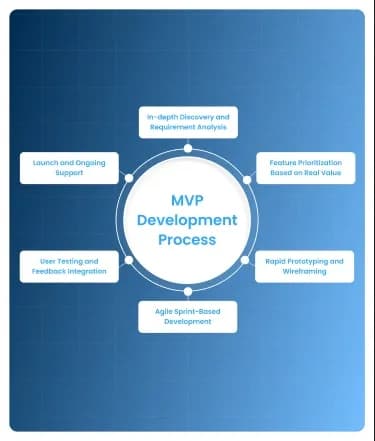
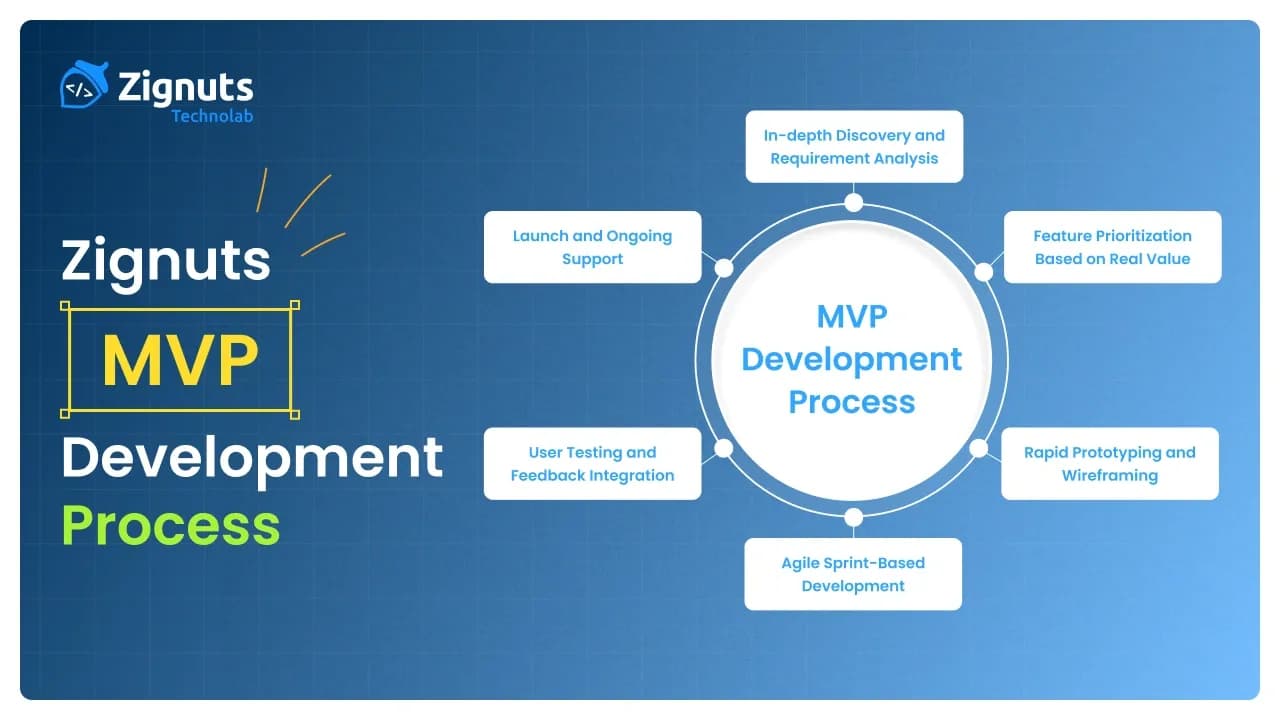
Our refined 6-step cycle is built for the high-velocity, intelligence-first markets of 2026. We have moved beyond simple task-tracking to an Agent-Orchestrated Lifecycle that ensures your product is smarter, faster, and more resilient than anything built with traditional methods.
Phase 1: Synthetic Market Simulation & Personas
In 2026, we don't start with "guesses." We create AI-driven "Ideal Customer Profiles" (ICPs), sophisticated digital twins of your target users. By running your value proposition through thousands of simulated interactions, we identify friction points and demand signals before a single line of code is written. This "Synthetic Discovery" allows us to stress-test your business model against 2026 market volatility with 90% higher accuracy than traditional surveys.
Phase 2: Modular "Intelligent Feature" Architecture
We categorize features into "Minimum Intelligent Features" (MIFs). Using the 2026 MoSCoW-AI framework, we prioritize functionalities that offer immediate utility while ensuring the backend is entirely modular. This "Pluggable Architecture" allows you to swap out AI models (e.g., transitioning from a general LLM to a domain-specific model) as the technology evolves, preventing technical debt from day one.
Phase 3: Rapid Prototyping & Generative Design
Visualizing the future takes days, not months. We use Generative Design Systems to create high-fidelity, interactive prototypes in record time. These aren't just pictures; they are "Clickable Intelligence" mockups that simulate real-world data flows, allowing stakeholders and early investors to experience the "brain" of your product before the full build begins.
Phase 4: Agile "Intelligence" Sprints
Our sprints have evolved from standard coding to AI-Augmented Development. In two-week cycles, our senior engineers work alongside "Coding Agents" to build, test, and refine the proprietary logic at the heart of your product. This hybrid human-AI approach allows us to maintain a pace of 3x the industry average, delivering working, high-performance features in every cycle.
Phase 5: Automated QA & Ethical Bias Audits
In the era of the 2026 EU AI Act and global privacy standards, "good enough" testing is a risk. We deploy Automated "Shift-Left" Security and Ethical Audits that scan for bugs, security vulnerabilities, and algorithmic bias simultaneously. We ensure your MVP is not only performant across all devices but also socially responsible and legally compliant in all target jurisdictions.
Phase 6: Autonomous Post-Launch & Self-Healing
Once live, your product isn't left alone. We implement Autonomous Support Agents and Self-Healing Code Patches. Our systems monitor 24/7 for anomalies; if a minor bug or performance lag is detected, the system can autonomously deploy a temporary fix or "re-route" logic to ensure 99.9% uptime. This proactive maintenance allows you to focus on scaling while we ensure the engine never stops.
Sustainable "Green Coding" in the MVP Development Process
In 2026, environmental responsibility has transitioned from a corporate social responsibility (CSR) "extra" to a core technical requirement. As global data center energy consumption hits record highs, the Zignuts MVP Development Process integrates Sustainable Software Engineering at every layer of the stack. We believe the greenest code is the code that performs with the least computational friction.
Our 2026 sustainability framework focuses on three innovative dimensions:
Carbon-Aware Workload Scheduling:
Not all compute hours are created equal. Zignuts MVPs are built with Carbon-Aware APIs that communicate with local power grids. For non-urgent background tasks such as batch data processing or non-critical AI model fine-tuning, our systems automatically shift execution to times when renewable energy (solar, wind) is at peak availability on the grid, or move the workload to data centers in low-carbon regions.
Energy-Efficient "Green Algorithms":
We move beyond standard algorithmic complexity to focus on Power-to-Performance ratios. By utilizing lean data structures and optimizing code to reduce CPU cycles, we minimize the thermal output of your application. This includes implementing "Short-Circuiting" logic and efficient memory management that prevents hardware from staying in high-power states longer than necessary.
AI Inference Optimization:
AI is the largest energy consumer in modern apps. In 2026, we utilize Model Distillation and Quantization to shrink massive AI models into lightweight versions that deliver 95% of the performance at a fraction of the energy cost. We also implement "Early Exit" strategies in our neural networks, where the model stops processing as soon as it reaches a confident result, saving massive amounts of power over millions of user sessions.
Hardware Lifecycle Extension:
By building software that is highly optimized and compatible with a wide range of hardware specifications, we ensure your MVP doesn't contribute to 2026's growing e-waste problem. Our "Lean UI" approach ensures that even users on older devices can enjoy a premium experience without needing to upgrade their hardware.
Quantum-Ready Security for the MVP Development Process
As quantum computing moves from a theoretical possibility to an operational reality in 2026, the risk of "Harvest Now, Decrypt Later" (HNDL) attacks has become a boardroom priority. At Zignuts, we recognize that an MVP launched today must protect the data of tomorrow. Our MVP Development Process now incorporates Post-Quantum Cryptography (PQC) readiness as a standard architectural layer.
Cryptographic Agility:
We don’t lock your product into a single encryption standard. Our architecture is "agile," meaning we use a modular security layer that allows you to swap out traditional algorithms (like RSA or ECC) for NIST-standardized quantum-resistant ones (such as ML-KEM or CRYSTALS-Kyber) without a total system overhaul.
Hybrid Security Models:
For 2026 launches, we implement a dual-layer approach. By combining classical encryption with post-quantum wrappers, we ensure your MVP is compliant with current standards while being "quantum-safe" against future decryption threats.
Compliance with 2026 Mandates:
With the 2026 EU Quantum Act and updated NIST guidelines now in effect, our PQC audits ensure your startup is ready for the first wave of binding quantum-safe regulations, making your product more attractive to enterprise partners and high-tier investors.
Hire Web Developers Today!
Hyper-Personalization: The New "Minimum" in the MVP Development Process
In 2026, a "viable" product is no longer one that simply works; it is one that anticipates. Generic user experiences are now viewed as "broken" by Gen Z and Alpha audiences. The Zignuts process has redefined the "M" in MVP to include Hyper-Personalization, moving beyond basic segmentation to individualized, real-time adaptation.
Context-Aware Adaptation:
Using Real-Time Behavioral Synthesis, our MVPs don't just remember a user's name; they adapt the entire UI and feature set based on the user’s immediate context, such as their physical location, current local weather, device type, and even perceived intent.
Predictive Engagement:
We integrate lightweight, on-device AI models that forecast what a user might need next. Whether it's bringing a frequently used tool to the forefront during a specific time of day or proactively suggesting a workflow, the MVP acts as an "Intelligent Co-pilot."
Privacy-First Customization:
In line with 2026 "Zero-Party Data" trends, we build personalization engines that rely on transparent, consent-based inputs. By explaining why a feature has adapted (e.g., "Adjusted for your current high-speed commute"), we build the radical trust necessary for high retention.
Dynamic UX Re-ranking:
Our AI-driven engines dynamically re-rank the entire interface based on real-time engagement patterns. This ensures that the most valuable features for a specific individual are always just one tap away, drastically reducing the cognitive load and increasing the product’s "stickiness."
Conclusion: Lead the Market with an Intelligence-Driven MVP
The MVP Development Process in 2026 is no longer a race to build the fastest prototype; it is a strategic journey to build the smartest foundation. By integrating Agentic AI, predictive market validation, and sustainable "Green Coding," Zignuts ensures that your product is not only viable but also resilient against the rapid technological shifts of the mid-2020s. From Quantum-ready security to hyper-personalized user experiences, our methodology is designed to turn your visionary concepts into market-dominant realities with surgical precision and zero wasted effort.
To navigate this complex landscape of autonomous systems and strict global regulations, you need a partner that combines deep technical expertise with future-forward innovation. When you choose to Hire Web Developers from Zignuts, you are gaining a team that understands how to blend human creativity with machine efficiency to maximize your ROI and accelerate your path to product-market fit.
Ready to transform your idea into a scalable, future-proof product? Contact Zignuts today to start your journey. Let our experts guide you through a refined MVP Development Process tailored to your unique business goals and schedule your strategic discovery session.

Nirav Chaudhari
A results-driven professional with a passion for transforming ideas into impactful, user-focused solutions. Known for a sharp eye for detail, strategic thinking, and a collaborative approach that drives product success from concept to launch.

Visha Patel
A strategic thinker with a knack for turning data into actionable insights. Driven by curiosity and clarity, they bridge the gap between problems and solutions with precision