

As we navigate the technology landscape of 2026, the way software systems talk to each other has evolved into a complex ecosystem of microservices, edge computing, and Artificial Intelligence-driven interactions. The digital infrastructure powering our smart cities, autonomous agents, and personalized healthcare relies heavily on predictable and scalable communication methods. We are no longer just building interfaces for human consumption but for sophisticated artificial intelligence models that ingest and process data at unprecedented speeds. Despite the rise of newer high-performance protocols like gRPC and the continued popularity of GraphQL for frontend flexibility, the fundamental backbone of the web remains rooted in established architectural standards. Consequently, the necessity for strict adherence to these standards has grown as we move away from monolithic structures toward distributed systems that must operate independently yet cohesively across global availability zones.
When developers and system architects build backend services today, two terms frequently surface in design meetings, code reviews, and technical documentation. While they share a linguistic root and are often used interchangeably in casual conversation or by automated coding assistants, they represent two distinct concepts in the Software Development Lifecycle. One represents the theory or the set of academic constraints defined decades ago to ensure network reliability, while the other represents the practice or the actual implementation deployed in the cloud to solve business problems. This confusion often leads to miscommunication where teams claim to adhere to a specific style but fail to implement the core constraints that make that style effective. Understanding the nuance between them is what separates a junior coder who simply writes endpoints from a software architect who designs resilient systems. This guide breaks down these concepts with a modern perspective, ensuring you have the clarity needed for high-level system design, effective team collaboration, and the creation of future-proof software.
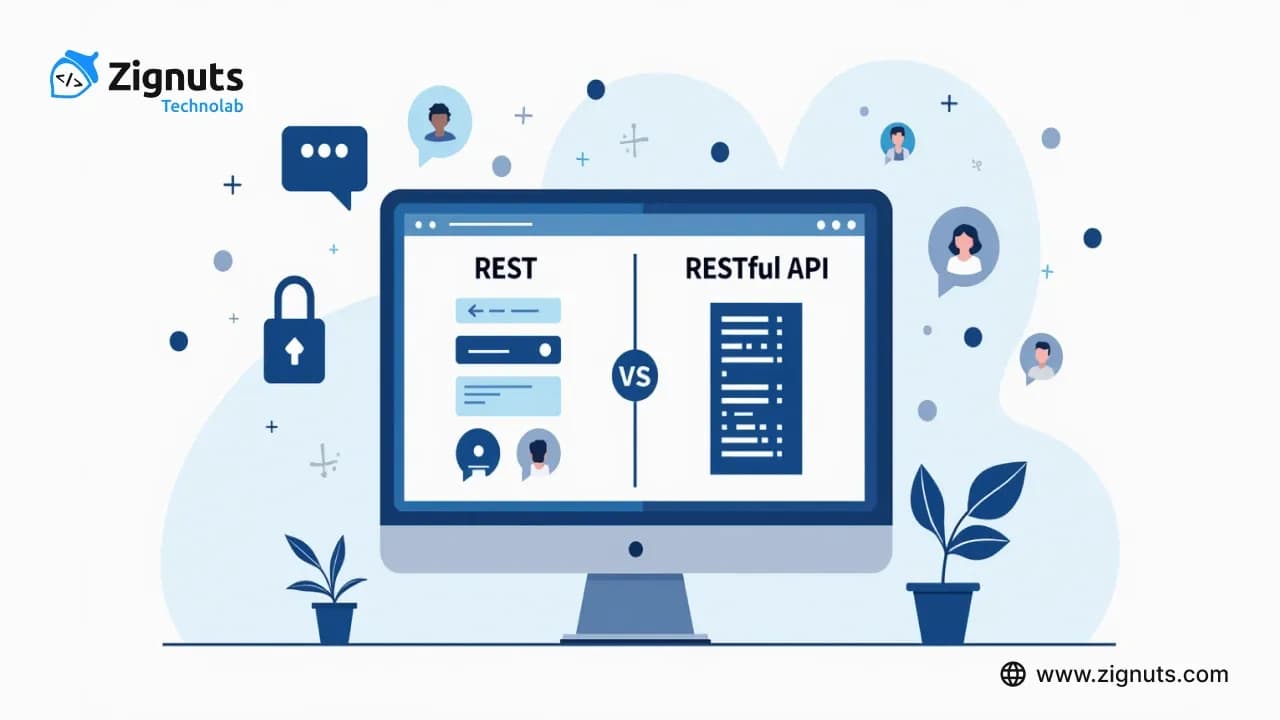
Defining the Core Concepts of REST vs RESTful API
To clear up the confusion, we must first look at the definitions. The first concept refers to Representational State Transfer, which is an architectural style originally outlined by Roy Fielding in his doctoral dissertation back in 2000. It is effectively a set of academic constraints and guidelines. It is not code. It is not a specific protocol. It is a philosophy that dictates how a distributed hypermedia system should behave to be scalable and reliable. It emphasizes constraints like statelessness, cacheability, and a uniform interface. In the modern era, this architectural style acts as the governing constitution for web communication, ensuring that systems remain loosely coupled and efficient.
Client Server Separation
The user interface concerns are completely separated from the data storage concerns, allowing both sides to evolve independently without dependency hell. This separation allows a mobile development team to iterate on the user interface while the backend engineers restructure the database without either team halting progress. It is the foundation of modern agile workflows where interface portability is paramount across devices ranging from smartwatches to holographic displays.
Stateless Interactions
Every single request from the client must contain all the information necessary to understand the request, and the server cannot utilize any stored context on the server. In a cloud native world, this is critical because it allows traffic to be distributed effortlessly across thousands of server instances. If a specific server fails, the request can be rerouted to another instance immediately because no session data is locked away on the failed machine.
Cacheability
Responses must implicitly or explicitly define themselves as cacheable or not to prevent clients from reusing stale or inappropriate data in response to further requests. By effectively utilizing caching directives, networks can eliminate some interactions entirely, which reduces latency and server load. This is vital for maintaining high performance in global applications where checking the server for static data like product catalogs every single time would be wasteful and slow.
Layered System
The client cannot ordinarily tell whether it is connected directly to the end server or to an intermediary along the way, such as a load balancer or security gateway. This abstraction enables architects to introduce load balancers, shared caches, and security gateways to the infrastructure. The client remains unaware of these intermediate layers, which simplifies the client code while allowing the system to scale and secure itself behind the scenes.
Uniform Interface
The system architecture is simplified, and the visibility of interactions is improved by applying a general principle of generality to the component interface. By adhering to a consistent way of interacting with resources, the architecture simplifies and decouples the system. This allows independent evolvability where the implementation details can change as long as the interface contract remains honored, ensuring that legacy clients do not break when the server is updated.
The second concept describes the actual web services that adhere to those constraints. When a developer builds a system that respects the guidelines of the architectural style, the resulting product is described using this adjective. Think of it as the difference between the laws of physics and a bridge. The laws of physics are the theoretical constraints, while the bridge is the practical implementation that must obey those laws to stand up. In 2026, building these implementations means creating endpoints that are predictable, scalable, and compatible with the massive amount of automated traffic generated by AI agents.
Resource Identification
Individual resources are identified in requests using URIs as resource identifiers, ensuring that every data point has a specific address. This means that a user, a document, or an image is conceptually distinct from the representation returned to the client. In 2026, stable identifiers are crucial for maintaining data integrity across distributed ledgers and complex knowledge graphs where items must be uniquely addressable.
Representation Manipulation
Clients manipulate resources through representations such as JSON or XML, so the client holds a representation of the resource rather than direct access to the database. When a client wants to update a record, it does not send raw database commands. Instead, it sends a representation of the desired stat,e such as a JSON object, and the server takes on the responsibility of making the persistent data match that representation.
Self-Descriptive Messages
Each message includes enough information to describe how to process the message so the parser knows exactly what to do with the payload. Each HTTP request or response contains all the metadata necessary for the recipient to understand it. This includes media type information, which tells the parser whether it is dealing with an image, text, or a specific data format, ensuring correct processing without external documentation.
Hypermedia as the Engine of Application State
The client interacts with the application entirely through hypermedia provided dynamically by application servers, often referred to as HATEOAS. This constraint is often the most overlooked, yet it is the differentiator for a truly mature system. It allows the server to guide the client by including hypermedia links in the response, dynamically showing what actions are currently available based on the state of the resource, much like a website menu changes based on user permissions.
Hire Dedicated Developers Today!

Analyzing the Key Differences in REST vs RESTful API
The primary distinction lies in the separation of theory and execution. The architectural style functions as a blueprint. It provides the rules for how resources should be identified and manipulated. It dictates that the client and server must remain independent, allowing them to evolve separately without breaking the system. It also mandates that the interaction must be stateless, meaning every single request contains all the necessary context. The implementation is what you actually deploy to your cloud environment. It translates those theoretical rules into concrete HTTP methods. While the theory talks about resource manipulation, the implementation uses specific verbs like GET, POST, PUT, and DELETE to get the job done. In a modern context, this implementation ensures that a mobile app can talk to a server or an IoT device can send telemetry data without needing to maintain a permanent connection. The implementation focuses on the practical arrangement of URLs and the proper use of status codes to communicate success or failure. However, the divergence goes deeper than just definitions as it impacts how teams make decisions during critical design phases.
Scope of Definition
REST represents the overarching architectural constraints and the complete philosophy of how the distributed system is structured. It is concerned with the long-term evolvability of the network application as a whole. Conversely, the implementation specifically refers to the web service interface that exposes data to consumers. In 2026 terms, the architecture is the city planning strategy, while the interface is the specific layout of the roads and traffic lights that autonomous vehicles navigate daily.
Protocol Independence vs Specificity
A key theoretical difference often missed is that the architectural style is technically protocol-agnostic. While it was designed alongside HTTP, it does not strictly demand it, as the constraints could theoretically apply to other application protocols. However, the practical implementation is intrinsically tied to the HTTP protocol. Being truly practical means leveraging specific HTTP features like caching headers, TLS encryption, and methods like PATCH or OPTIONS to manage data flow efficiently over the public internet.
Rigidity vs Pragmatism
The academic definition is binary, meaning a system either adheres to the constraints completely or it does not. In the real-world development environment, strict adherence can sometimes hinder performance or usability. Therefore, the practical implementation often exists on a spectrum of maturity. Developers might occasionally trade perfect architectural purity for performance gains such as creating a batch endpoint to upload multiple records in one go, which technically modifies the resource modeling concept but solves a real business latency problem.
Practical Implementation Strategies for REST vs RESTful API
Let us look at how this works in a real-world scenario relevant to 2026, such as an autonomous logistics network. Designing the interface for this system requires strict adherence to the standards to ensure reliability. In a high-stakes environment where thousands of autonomous units are navigating physical space simultaneously, the software architecture must be fail-safe. The theoretical guidelines provide the safety rails, while the practical coding creates the engine that drives the operation.
The Blueprint
The system requires a way to track autonomous drones, manage battery charging stations, and update delivery manifests without the server needing to remember the previous state of the drone. The architecture dictates that the drone (the client) is responsible for reporting its full state in every heartbeat. The server does not keep a session open for the drone, which saves memory and allows the backend to handle millions of connections effortlessly.
The Functional Endpoints
To translate this blueprint into a working system, we define clear and predictable endpoints.
- GET /drones This retrieves a list of all active units in the field, allowing operations managers to see the global fleet status.
- GET /drones/{id} This fetches specific telemetry data for a single unit, providing granular details like battery temperature and altitude.
- POST /deliveries This creates a new shipment order in the system, generating a unique ID for tracking the package journey.
- PATCH /deliveries/{id} This updates partial information, such as the current status or GPS location of a package, without needing to resend the entire delivery object.
- DELETE /drones/{id} This removes a unit from the active registry when it is decommissioned or sent for long-term repair.
By using these standard HTTP methods, the system remains predictable. The use of nouns in the URL structure ensures clarity. The implementation handles the business logic while respecting the constraints of statelessness and cacheability. If a request fails, the client knows it can retry without worrying about server-side state corruption. Beyond the basic verbs, a mature implementation in 2026 incorporates deeper strategies to handle complex network realities.
Ensuring Idempotency
In a logistics network, connections are often unstable as drones fly through dead zones. The API must be designed so that repeating a request does not cause errors. For example, using the PUT method to update a resource is idempotent. If a drone sends a request to update its coordinates and does not receive an acknowledgement, it can safely send the exact same request again. The server will simply overwrite the coordinates with the same data, ensuring the system state remains consistent without creating duplicate entries.
Semantic Status Code
A robust implementation moves beyond just returning 200 OK for everything. To communicate effectively with automated AI agents, the API utilizes the full spectrum of HTTP status codes.
- 201 Created is returned when a new delivery order is successfully logged, telling the client the resource now exists.
- 202 Accepted is crucial for asynchronous processing. If a drone requests a complex flight path calculation, the server returns this code to indicate the request is queued but not yet completed, preventing the client from timing out while waiting.
- 409 Conflict helps manage the state. If two operators try to assign the same drone to different missions simultaneously, this code alerts the client to the version conflict.
Content Negotiation
Modern systems must support various clients with different capabilities. Through content negotiation headers, the implementation serves different data formats for the same resource. A web dashboard for a human operator might request Accept: application/json to get a readable format, while the bandwidth-constrained drone might request Accept: application/x-protobuf to receive a highly compressed binary format. This flexibility allows the exact same endpoint to serve multiple stakeholders efficiently.
Hire Dedicated Developers Today!
Overcoming Challenges in REST vs RESTful API Development
Even with a solid understanding of the architecture, developers face hurdles when applying these principles to complex modern applications. The gap between the theoretical purity of the dissertation and the messy reality of production systems often requires pragmatic compromises. In 2026, when backend services are hit by millions of requests per second from both human users and automated AI agents, these challenges become even more pronounced.
Data Over-fetching and Under-fetching
A common issue arises when the standard endpoint returns too much data for a mobile interface or too little for a desktop dashboard. The architectural guidelines suggest a uniform interface, but practical needs vary. For instance, a smartwatch app might only need a user's first name, but the /users/{id} endpoint returns their entire address history and preferences. This wastes bandwidth and battery life. The solution involves using query parameters to filter fields effectively. By implementing sparse fieldsets, such as GET /users/{id}?fields=firstName, status, developers can strictly limit the payload size, mimicking the efficiency of newer query languages while staying true to the architectural style.
Versionin
As systems evolve, changes are inevitable. You cannot simply change an endpoint that thousands of users rely on. Breaking backward compatibility is a cardinal sin in API development. The best practice involves incorporating versioning directly into the URL path, such as /v2/accounts, to ensure backward compatibility while introducing new features. However, sophisticated teams in 2026 often prefer header-based versioning. By asking clients to send a specific header like Accept-Version: v2, the URL remains clean and semantic. Additionally, using standard "Sunset" HTTP headers helps warn developers well in advance when an old version is scheduled for deprecation.
Security
In the zero-trust environments of 2026, statelessness is a huge advantage for security. Since the server stores no session state, authentication must happen with every request using tokens, typically via headers. This makes the system robust against various session-hijacking attacks. Beyond simple tokens, modern implementations rely heavily on Mutual TLS (mTLS), where both the client and server authenticate each other via digital certificates. This ensures that even if a token is intercepted, it cannot be used by an unauthorized machine. Furthermore, implementing fine-grained scopes within OAuth 2.0 tokens ensures that a marketing tool can read user data but cannot delete it.
The N+1 Query Proble
One of the most persistent performance bottlenecks occurs when a client needs to fetch a list of resources and then their related child resources. For example, fetching a list of ten orders and then making ten separate network calls to get the customer details for each order. This creates "chatter" on the network that kills performance. To solve this without breaking the architectural constraints, developers implement "compound resources" or side-loading. This allows the API to return the main resource and its related data in a single response envelope, or to utilize HTTP/3 multiplexing to handle multiple requests in parallel over a single connection.
Handling Long-Running Operations
The standard request-response model assumes that work happens immediately. However, AI processing tasks like generating a video or analyzing a large dataset take time. Keeping an HTTP connection open for minutes is brittle and prone to timeouts. The solution is the "Asynchronous Request-Reply" pattern. The API accepts the request and immediately returns a 202 Accepted status along with a "Location" header pointing to a status monitoring endpoint. The client can then poll this new URL to check progress, decoupling the request from the processing time and preventing gateway timeouts.
Documentation Drift
In rapid development cycles, the code often changes faster than the documentation, leading to developer frustration. Since the interface is the product, inaccurate documentation is a product defect. In 2026, the industry standard is "Code-First" documentation using specifications like OpenAPI (formerly Swagger). By generating the documentation definition directly from the codebase annotations, teams ensure that the API reference is always 100% accurate. This also allows for the automatic generation of client SDKs, significantly speeding up the integration process for third-party developers.
Recognizing Limitations in REST vs RESTful API Architectures
While this approach is the industry standard for general web services, it is not the perfect tool for every job. In the hyper-connected world of 2026, engineers must be pragmatic rather than dogmatic. There are specific scenarios where adhering to this strictly stateless request-response model will create bottlenecks that degrade user experience or inflate infrastructure costs. Understanding these boundaries is just as important as knowing the benefits.
Real Time Interactions
The architecture relies fundamentally on the client initiating requests. This is inefficient for applications requiring instant updates where the server needs to push data to the client immediately. In scenarios such as live holographic meetings, real-time collaborative editing suites, or high-frequency trading platforms, the latency introduced by opening and closing HTTP connections is too high. The traditional workaround of polling, where the client asks "Do you have new data?" every second, is wasteful of bandwidth and battery life. Technologies like WebSockets are superior here as they allow persistent bi-directional communication where the server can send updates the moment they happen.
High Frequency Streaming
For systems like 8K video streaming or massive multiplayer gaming servers, the overhead of standard HTTP headers is significant. Every packet in a RESTful interaction carries metadata about the request, which adds unnecessary weight when the goal is simply to blast a continuous stream of binary data. These use cases require specialized protocols designed for continuous data streams rather than discrete resource transactions. In gaming specifically, the reliability mechanisms of HTTP (TCP) can actually be a hindrance because waiting to retransmit a lost packet causes "lag," which is worse than simply skipping the frame. Therefore, UDP-based protocols are often preferred over the rigid structure of this architectural style.
Complex Data Relationships
One of the most significant friction points arises when dealing with highly interconnected graph data. Modern social networks or knowledge graphs often require fetching a user, their friends, the friends' recent posts, and the photos associated with those posts. In a strict resource-based architecture, this might require chaining multiple API calls together or building a rigid custom endpoint that breaks the uniform interface constraint. This "under-fetching" problem forces the client to make multiple round-trip requests to the server, which kills performance on mobile networks. In these specific cases, query languages like GraphQL allow the client to describe exactly the complex nested data structure it needs in a single request, offering a flexibility that resource-based endpoints struggle to match.
Internal Microservice Communication
While text-based formats like JSON are excellent for public-facing APIs because they are human-readable, they are inefficient for internal communication between microservices. In a cluster where AI agents are processing petabytes of data, the time spent parsing text-based JSON can add up to significant latency and compute costs. For machine-to-machine communication within a private network, binary protocols like gRPC using Protocol Buffers are far more efficient. They produce smaller payloads and require less CPU power to parse than the verbose text representations typically used in this architectural style.
Constrained IoT Environments
In 2026, the world is filled with "smart dust" and low-power sensors deployed in agriculture or remote infrastructure. These devices often operate on varied connectivity and tiny batteries. The verbosity of HTTP and the requirement for complete representations can be too heavy for these constrained environments. A sensor waking up to send a few bytes of temperature data should not have to establish a heavy TCP connection and send a large header block. Lightweight messaging protocols like MQTT or CoAP are designed specifically for these constraints, minimizing the data overhead to the absolute bare minimum, which extends the device lifecycle significantly compared to a standard web service approach.
Future Outlook on REST vs RESTful API
As we look toward the future of web development, the distinction between the guiding principles and their practical application remains vital. The architectural style provides the theoretical foundation for scalability, while the implementation allows developers to build robust, maintainable systems. By mastering both the rules and the execution, you ensure that your applications are ready to handle the demands of the modern web. Whether you are building for human users or AI agents, sticking to these proven standards guarantees a level of interoperability and efficiency that is critical in the interconnected digital world of 2026.
The debate surrounding REST vs RESTful API is transforming from a semantic argument into a strategic imperative. As artificial intelligence models become the primary consumers of our digital interfaces, the need for self-descriptive and discoverable services is greater than ever before. An AI agent exploring the web does not have the intuition to guess how a custom API works. It relies on the predictability of standard HTTP methods and hypermedia controls to navigate complex workflows autonomously. Therefore, adhering to the strict constraints of the architecture is no longer just about academic purity but about enabling the next generation of automated commerce and interaction, where software negotiates with other software without human intervention.
Furthermore, we are witnessing the solidification of hybrid architectures where these concepts play a central anchoring role. The future is not about choosing one protocol over another but about effective orchestration. We will continue to see systems where high-speed internal communication happens via binary protocols like gRPC, while the public-facing interface remains a strictly standardized implementation of the classic architectural style. This ensures that while we optimize for raw performance internally, we maintain the universal accessibility that made the web successful in the first place. The longevity of this architectural style lies in its simplicity and its alignment with the fundamental way the internet works. Technologies may come and go, but the principles of statelessness and resource orientation provide a stable foundation that allows businesses to pivot and scale without rewriting their entire infrastructure every few years. Ultimately, the developers who succeed in this era will be those who look beyond the syntax of the code to understand the enduring philosophy of the architecture itself.
Conclusion
Mastering the distinction between REST and RESTful API is more than a vocabulary exercise; it is a fundamental requirement for building software that survives the rapid evolution of the 2026 digital landscape. While the architectural style offers the blueprint for scalability, the practical implementation determines how effectively your system interacts with the world of AI agents and global microservices. Success today requires a balanced approach that respects these established standards while pragmatically addressing the performance needs of real-time users. By acknowledging the strengths and limitations of this architecture, you empower your organization to build digital products that are not only robust and secure but also capable of evolving alongside the next wave of technological innovation.
Building resilient, future-proof backend infrastructure is a complex undertaking that demands high-level architectural expertise. To ensure your next project meets these rigorous standards, Hire Dedicated Developers who possess the deep technical knowledge to bridge the gap between theoretical constraints and practical application.
Ready to elevate your software architecture? Contact Zignuts today to discuss your vision, and let our expert team help you build a robust, scalable backend that stands the test of time.

Ekta Trivedi
A Node.js enthusiast focused on building scalable, high-performance applications that power the next generation of web technologies