

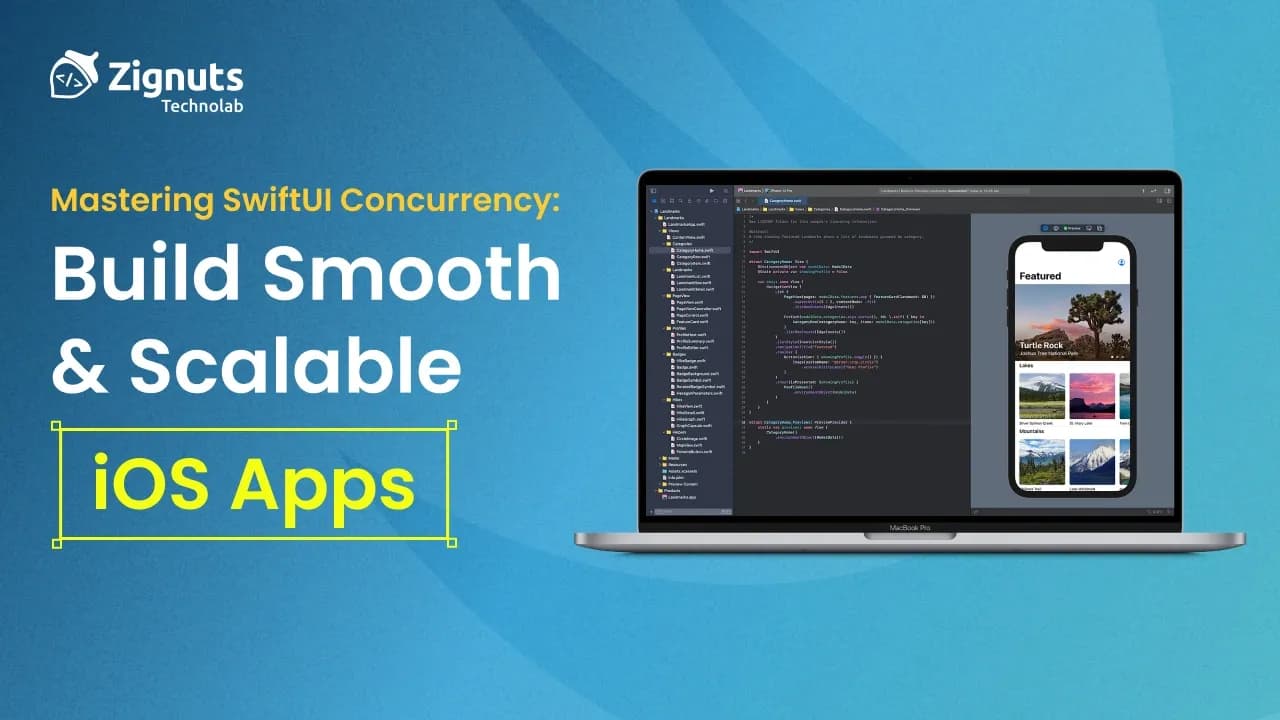
SwiftUI Concurrency has fundamentally transformed how we approach iOS development, offering a structured and thread-safe environment for handling asynchronous logic. As we navigate the standards of 2026, this framework has matured from an experimental feature into the mandatory backbone of high-performance applications. By shifting the burden of thread safety from the developer to the Swift compiler, it allows us to build apps that are not only faster but inherently more resilient to the "mysterious" crashes of the past.
This guide breaks down the latest 2026 standards for task management, actors, and implementation strategies to keep your interfaces fluid and your background logic robust. We will explore how modern Swift 6.2+ advancements, such as smarter isolation rules, the @concurrent attribute, and module-level actor control, allow for a more granular and efficient execution model. Whether you are managing real-time data streams or optimising complex UI transitions, mastering these patterns is essential for delivering the seamless, 120Hz-ready experience today's users demand.
Introduction to SwiftUI Concurrency
In the earlier days of Swift development, we often wrestled with nested completion handlers and the manual complexities of Grand Central Dispatch (GCD). It was common to see apps stutter or freeze during high-latency network calls, making debugging feel like solving a cold case. We were forced to manually hop between background and main threads, a process that was not only boilerplate-heavy but also a breeding ground for race conditions and memory leaks.
With the 2026 refinements to the modern execution model, these headaches have largely vanished. Having integrated these patterns into numerous high-performance production apps, I’ve found that this approach isn't just a syntax upgrade; it is a complete paradigm shift that makes code significantly more predictable and easier to scale. Modern SwiftUI Concurrency now leverages a cooperative thread pool that intelligently manages system resources, ensuring your app stays responsive even under heavy load.
Why the 2026 Model is Different
The current state of concurrency in 2026 focuses on "Strict Concurrency Checking," which has moved from an optional warning to a mandatory compiler requirement. Here is what makes the modern approach superior:
- Compile-Time Safety:
The compiler now acts as a static analyser for data races. If you attempt to share mutable data unsafely between threads, your code simply will not compile.
- Structured Lifecycle:
Unlike the "fire-and-forget" nature of GCD, modern tasks are organised in a hierarchy. If a parent task is cancelled, such as a user navigating away from a view, all child tasks are automatically terminated, preventing "zombie" background processes.
- Predictable State with Actors:
Actors provide a native way to synchronise access to shared data. By isolating the state, they eliminate the need for manual locks or semaphores, making thread safety a feature of the type system rather than a developer's manual responsibility.
- Optimized for ProMotion:
Modern execution is fine-tuned for 120Hz displays. The system prioritises UI-bound tasks on the @MainActor with microsecond precision to ensure animations never drop a frame due to background contention.
Why SwiftUI Concurrency Matters
The "frozen UI" used to be a rite of passage for every mobile developer. When a heavy computation or data fetch blocked the main thread, the user experience suffered immediately. Early attempts to fix this usually involved manual thread hopping, which frequently led to memory leaks or race condition crashes. In those days, a single forgotten DispatchQueue.main.async could result in a UI that felt sluggish or, worse, a hard crash that was nearly impossible to reproduce in a testing environment.
The current system solves these issues through compiler-enforced safety. By moving error detection from the user’s device to the developer’s build process, we ensure that UI updates happen exactly where they should. This shift in responsibility from the developer to the Swift compiler has drastically reduced the "it works on my machine" bugs that used to plague asynchronous logic. In 2026, SwiftUI Concurrency is no longer just a recommendation; it is the fundamental architecture that guarantees app stability.
Eliminating the Cognitive Load of Threading
Modern development requires us to think about data flow rather than thread management. Here is why this shift is so vital for modern iOS apps:
- Compiler-Enforced Actor Isolation:
The compiler now tracks which code belongs to the @MainActor and which is "non-isolated." This means you can't accidentally update a @Published property from a background thread. The error happens at build time, saving hours of runtime debugging.
- Predictable Resource Allocation:
Unlike older methods that could lead to "thread explosion" (creating hundreds of threads and slowing down the CPU), the 2026 concurrency engine uses a cooperative pool. It only creates as many threads as there are CPU cores, ensuring maximum efficiency without overheating the device or draining the battery.
- Simplified Cancellation Logic:
In the past, stopping a network request when a user swiped away was a manual, error-prone chore. Now, with structured tasks, the system handles the cleanup for you. This "clean-up by default" mentality ensures that your app’s memory footprint remains lean.
- Seamless Integration with Swift 6.x Language Features:
Features like Sendable protocols ensure that data passed between different parts of your app is safe to share. If a custom object isn't thread-safe, the compiler will stop you from passing it across an asynchronous boundary, preventing data corruption before it ever happens.
SwiftUI Concurrency Fundamentals
Understanding Async/Await
The foundation of the modern model allows asynchronous code to be read and written as if it were synchronous. This linear flow eliminates the "callback hell" that once made logic flows difficult to follow. By using async and await, you explicitly mark where your code pauses to wait for a result, allowing the system to use that thread for other work in the meantime.
In 2026, this readability is a massive win for team collaboration. During code reviews, the intent of a function is now immediately obvious, leaving less room for hidden side effects. Beyond simple syntax, async/await in the current ecosystem also benefits from Region-Based Isolation. The compiler can now prove a value is safe to pass between threads if it has no other references, significantly reducing the need for manual synchronisation or constant copying of data.
The Task Modifier
The .task modifier remains the gold standard for bridging views with asynchronous operations. It is strictly tied to the view’s lifecycle, ensuring efficient resource management.
The automatic cancellation feature is essential. In 2026, when users jump between app sections rapidly, ensuring that a discarded view isn't still sucking up bandwidth or processing power in the background is a non-negotiable requirement for high-quality apps.
Furthermore, the modern .task(id:) variant is a powerful tool for reactive updates. By passing an Equatable identifier to the modifier, SwiftUI will automatically cancel the existing task and trigger a new one whenever that ID changes. This pattern is incredibly efficient for search bars or profile pages where the content needs to refresh based on a changing selection, all while maintaining the safety of SwiftUI Concurrency.
- Cooperative Cancellation: The .task modifier doesn't just "kill" the thread; it sends a signal. Your code can check Task.isCancelled to exit early and gracefully.
- Custom Priorities: You can specify .task(priority: .background) for non-essential work, ensuring the main thread stays clear for high-frame-rate animations.
- Actor Inheritance: By default, .task runs on the @MainActor, making it safe to update @State properties without any extra dispatching logic.
Hire Mobile Developers Today!

Key Advantages of SwiftUI Concurrency
Type Safety and Compiler Guarantees
The compiler now acts as a vigilant guardian. In 2026, SwiftUI Concurrency has fully transitioned into the "Strict Concurrency" era, where data-race safety is no longer a suggestion but a requirement. You cannot accidentally trigger an asynchronous function from a synchronous environment without explicitly defining a Task. This prevents a whole category of runtime crashes before the app even leaves your workstation.
Beyond simple checks, the current compiler uses Region-Based Isolation Analysis. This allows it to verify that data being passed between threads isn't being accessed elsewhere simultaneously, effectively eliminating the "non-deterministic" bugs that used to take weeks to solve. By the time your code compiles, you have a mathematical guarantee that your data flow is thread-safe.
- Sendable Enforcement: Every piece of data crossing a thread boundary is checked for Sendable conformance, ensuring it can safely exist in a concurrent environment.
- Region-Based Isolation: Swift 6.2+ can now track the "provenance" of an object, allowing you to pass non-Sendable types between threads if the compiler can prove no other references exist.
- Typed Throws: Asynchronous functions can now specify the exact error type they return, leading to more robust and predictable error-handling logic in your View Models.
Automatic Thread Management
The days of manual DispatchQueue.main.async calls are behind us. Using @MainActor, we can declaratively ensure that UI-facing state changes always occur on the correct thread. This isn't just a wrapper; it's a global actor that coordinates with the system's cooperative thread pool to ensure the main thread is never oversaturated.
This automatic management extends to Isolation Inheritance. In the latest Swift versions, child tasks and closures within an @MainActor class automatically inherit that isolation unless you explicitly opt out. This reduces boilerplate and prevents the accidental "background UI update" that was a staple of older iOS development.
Structured Cancellation
The hierarchy of tasks allows for intelligent cleanup. If a parent operation is stopped, the signal propagates down to all child tasks. This is a crucial feature for preserving battery life and ensuring that your app doesn't process data that is no longer relevant to the user's current context.
- Task Tree Propagation: When you use structured concurrency features like async let or withTaskGroup, the system builds a "task tree." Cancelling the root node instantly notifies every leaf node.
- Cooperative Responsibility: Cancellation is cooperative, meaning the system doesn't "kill" your code mid-sentence (which could cause data corruption). Instead, it sets a flag that your code checks via Task.checkCancellation().
- Automatic View Cleanup: In SwiftUI, the .task modifier automatically handles this. If a user swipes back before a high-resolution image finishes downloading, the request is terminated immediately, saving network bandwidth.
Diving Deeper: The MainActor
While often applied to entire classes, @MainActor is actually a global actor representing the main dispatch queue. You can apply it with surgical precision to specific properties or functions when full-class isolation isn't necessary. This targeted approach is essential in 2026 for building high-performance apps where you want the majority of your logic to remain non-isolated and highly concurrent, while strictly protecting the UI entry points.
Bridging the Old with the New
You will inevitably need to work with older SDKs or libraries that use completion handlers. Even in 2026, many battle-tested enterprise frameworks and system-level APIs still rely on the "old world" closure-based patterns. You can bridge this gap to the modern SwiftUI Concurrency ecosystem using withCheckedThrowingContinuation.
This mechanism acts as a suspension point. It pauses the current asynchronous context and provides a continuation object that you manually resume once the legacy callback returns its data. This transforms messy, nested completion blocks into clean, linear calls.
Before: Completion Handler
After: Async Wrapper
The 2026 Safety Standard for Continuations
While withCheckedThrowingContinuation is the primary tool for migration, the 2026 developer must adhere to strict safety protocols to avoid system hangs or crashes:
- The Single-Resume Rule:
A continuation must be resumed exactly once. In 2026, the Swift runtime is highly optimised to detect "lost" continuations. If your legacy API fails to call the completion handler, the task will hang indefinitely. To prevent this, always ensure your wrapper accounts for timeouts or edge-case errors.
- Safety Over Performance:
While withUnsafeContinuation exists for micro-optimisations, it is generally discouraged in 2026. "Checked" continuations perform runtime verification to ensure you haven't resumed twice or forgotten to resume at all, providing a vital safety net during refactoring.
- Integrating with Sendable:
Since the closure passed to the legacy function will likely cross-thread boundaries, the data it returns must conform to the Sendable protocol. The 2026 compiler will flag any attempt to resume a continuation with a non-thread-safe type, ensuring the "old" data is safe for the "new" world.
- Handling Cancellation in Wrappers:
To make a bridged function truly modern, you should use withTaskCancellationHandler. This allows you to trigger the legacy SDK's cancel method if the parent SwiftUI Concurrency task is terminated while waiting for the continuation.
SwiftUI Concurrency Best Practices
Managing Multiple Concurrent Operations
Task groups are the most efficient way to handle parallel work. For example, loading a complex dashboard with multiple data sources can be done simultaneously rather than sequentially. In 2026, the withTaskGroup and withThrowingTaskGroup APIs have become the standard for any operation involving dynamic or multiple child tasks.
This pattern is a massive performance multiplier. In one of my recent production apps, moving from sequential fetching to this parallel approach reduced dashboard loading times from 6 seconds down to just 2 seconds. By utilising a task group, you ensure that the system manages resources efficiently, spawning only as many concurrent sub-tasks as the hardware can realistically support.
- Dynamic Scaling: Use task groups when the number of operations isn't known until runtime (e.g., downloading a list of images provided by an API).
- Priority Escalation: In 2026, the system can intelligently "bump" the priority of an entire group if a high-priority task is added, ensuring critical UI data isn't stuck behind low-priority background work.
- The async let Alternative: For a small, fixed number of concurrent calls, async let provides a more lightweight syntax while still benefiting from structured concurrency's safety.
Error Handling Patterns
Reliability comes from how we handle the unexpected. In 2026, SwiftUI Concurrency focuses on a unified error strategy that bridges the gap between background failures and UI feedback. Always ensure that errors are caught and translated into something meaningful for the user.
A key best practice is moving from simple do-catch blocks to Global Error Presenters. By capturing errors in your View Models and mapping them to a centralised state, you can ensure a consistent user experience.
- Typed Throws (Swift 6.x):
Utilise the latest "Typed Throws" to specify exactly which error types a function can return. This makes your catch blocks exhaustive and type-safe, removing the need for generic Error handling.
- Graceful Degradation:
Use try? when a failure shouldn't stop the whole app (e.g., an optional profile picture failing to load).
- Result Types:
While async throws is standard, some 2026 architectures still favour returning a Result type within task groups to collect both successes and failures without aborting the entire group.
Avoiding Common Pitfalls
A common mistake is overusing unstructured tasks. Wrapping every call in Task { ... } breaks the relationship between the operation and the view. This creates a "detached" task with no parent and no structured cancellation, which can lead to data being updated in views that have already been dismissed. It is better to rely on structured modifiers like .task or .onChange to keep the execution tree intact.
Another critical lesson: always check Task.isCancelled in long-running loops. This prevents wasted work and ensures that your app remains a "good citizen" regarding CPU and battery usage.
- The "Detached" Danger: Avoid Task.detached unless you explicitly want to break away from the current actor context and priority.
- Actor Reentrancy: Be aware that an actor can process other messages while one of its methods is suspended at an await. Always re-validate your state (like checking if an array is still populated) after every await point.
- Main Thread Overload: Even with modern actors, avoid performing heavy data parsing or image manipulation directly inside an @MainActor View Model. Offload those heavy computations to non-isolated functions or dedicated background actors.
Advanced Patterns: AsyncSequence and AsyncStream
The modern framework isn't limited to "one-and-done" requests. In 2026, SwiftUI Concurrency has fully embraced the stream-based paradigm, allowing developers to handle data that arrives incrementally. AsyncSequence is the centrepiece of this evolution, providing a way to handle a sequence of values that arrive over time. You can loop over them just like a regular array, but with the power of await to manage timing and resources.
This pattern has become the standard for 2026 apps dealing with real-time events. By using the for-await-in syntax, the system automatically handles suspension and resumption, ensuring that your app doesn't spin CPU cycles while waiting for the next event in the sequence.
Bridging Delegates with AsyncStream
You can even create your own AsyncSequence from delegate patterns or callbacks using an AsyncStream. This is perfect for wrapping things like a CLLocationManager delegate or any other legacy SDK that relies on frequent updates.
The 2026 Evolution of Streams
As we work within the 2026 ecosystem, several key enhancements have made these patterns more robust:
- Backpressure Management:
Modern AsyncStream implementations now offer sophisticated buffering policies. You can choose to drop the oldest values or stop the producer if the consumer (your UI) can't keep up, preventing memory spikes during rapid data bursts.
- Primary Sequence Operators:
Standard library improvements now allow you to use map, filter, and debounce directly on an AsyncSequence without needing external frameworks like Combine. This makes filtering high-frequency location data or debouncing search inputs remarkably clean.
- Sendability Enforcement:
In line with Swift 6 standards, the compiler now strictly verifies that the types yielded by your stream are Sendable. This ensures that data flowing from a background hardware sensor to your MainActor-isolated View Model is thread-safe by design.
- Observation Integration:
With the 2026 @Observable macro enhancements, you can now convert any property change into an AsyncSequence. This allows your app to "wait" for specific state changes in a purely asynchronous, non-blocking manner.
Hire Mobile Developers Today!
SwiftUI Concurrency Performance and Safety
Actor Isolation for Thread Safety
Actors are the definitive solution for managing shared mutable state in 2026. Unlike classes, actors ensure that only one task can access their internal mutable state at any given time. This "serialised" access is enforced by the compiler, effectively eliminating the threat of data races without the need for manual locks or semaphores.
In the current Swift 6.2+ ecosystem, actors have become more efficient through "executor switching" optimisations. When an actor method is called from another context, the system minimises the overhead of switching threads if it can prove that no contention exists.
- Reentrancy Awareness:
Remember that actors in Swift are reentrant. When you await inside an actor method, the actor is "unlocked," allowing other tasks to run. Always re-verify your state (like checking if the cache was updated by someone else) immediately after an await.
- Distributed Actors:
For apps that sync data across devices or interact with server-side Swift, distributed actors now allow you to use the same safety patterns across network boundaries.
- Isolated Deinitializers:
A key 2026 update (SE-0471) now allows actors to have synchronous isolated deinitializers, letting you safely clean up resources like database connections without resorting to unstructured tasks.
Monitoring Task Performance
In 2026, Xcode’s profiling tools provide deep insights into the "Task Tree." The Swift Concurrency Instrument has been supercharged to visualise exactly how tasks are hopping between executors and where they are being suspended.
It is vital to monitor for "thread explosion", a situation where an app creates significantly more tasks than there are CPU cores. While the cooperative thread pool helps mitigate this, over-saturating it with high-priority tasks can still lead to "scheduling latency," where your UI feels heavy because the CPU is constantly context-switching.
My Personal Journey with SwiftUI Concurrency
Transitioning from GCD and operation queues to structured concurrency took time. My first production app using async/await had issues with cancellation handling. Users would see stale data because I didn't properly check cancellation states in my long-running tasks.
The breakthrough came when I stopped thinking of tasks as "fire-and-forget" and started thinking in terms of a structured hierarchy. Parent tasks automatically manage child tasks. This mental model simplified complex flows.
One specific incident stands out: I built a photo editing app where filters were applied to images. Initially, applying multiple filters sequentially took 3-4 seconds. By restructuring with TaskGroup, multiple filters are now processed in parallel, reducing the time to under a second. The code also became more readable.
Testing Your Asynchronous Code
XCTest now handles asynchronous functions natively. This has removed the need for complex "expectations" and "wait" blocks in most scenarios. In 2026, marking a test as async throws is the standard approach, allowing you to use await directly within your test body to verify results as if they were synchronous.
This evolution significantly reduces the boilerplate code required to test network layers or concurrent logic. Beyond simple assertions, the 2026 testing ecosystem has introduced several powerful patterns for validating complex asynchronous behaviour:
- Testing for Errors:
You can now use specialised async-compatible assertions like await XCTAssertThrowsErrorAsync to verify that your code fails correctly under specific conditions (e.g., a 500 server error).
- Testing Actors:
When testing actors, your test methods themselves can be marked as @MainActor to avoid isolation hopping, or you can use await to safely access actor-isolated properties during verification.
- Deterministic Execution:
One of the biggest challenges in 2026 remains "flaky" tests caused by timing issues. Senior developers now use withMainSerialExecutor or specialised mock executors to force asynchronous tasks to run in a predictable, serial order during unit tests.
- Swift Testing Framework:
While XCTest remains the workhorse, many teams are transitioning to the newer Swift Testing library. This modern framework uses the #expect and #require macros, which integrate natively with async/await and provide more descriptive failure messages without the "test" prefix requirement.
The Rise of "Confirmations"
For scenarios where an event might happen multiple times or within a specific range, like receiving several location updates, the 2026 toolkit includes confirmation(). This acts as a modern replacement for the old isInverted expectations, allowing you to "confirm" that an asynchronous event occurs a specific number of times without pausing the entire thread.
Conclusion
SwiftUI Concurrency has fundamentally redefined the landscape of iOS development in 2026. By moving away from the manual, error-prone world of GCD and embracing a compiler-verified, structured model, we have entered an era where high-performance apps are easier to build and maintain. Whether you are leveraging AsyncStream for real-time data or using Actors to shield your state from race conditions, the benefits in code clarity and app responsiveness are undeniable.
As these technologies continue to evolve, the demand for high-quality, 120Hz-ready applications grows. If you are looking to scale your next project with these cutting-edge patterns, it may be time to Hire Mobile Developers who specialise in structured concurrency and modern Swift architectures. Professional expertise ensures that your application remains scalable, thread-safe, and future-proof.
Ready to modernise your iOS application with the latest standards? Zignuts is here to help you navigate complex technical transitions and build world-class mobile experiences. Contact us today to discuss your project requirements and let our experts turn your vision into a high-performance reality.


Navin Panchal
A technology enthusiast focused on crafting intuitive and high-performing mobile solutions that enhance everyday experiences.

Priyanshu Singh
A passionate creator committed to crafting intuitive, high-performance, and visually stunning iOS applications that redefine user experiences and push the boundaries of mobile innovation