

Artificial Intelligence has evolved from a disruptive trend into the fundamental operating system of the global enterprise. In 2026, we are moving beyond simple automation toward Agentic AI and self-evolving ecosystems. Organizations are no longer just integrating AI as a "feature"; they are architecting AI-native platforms where autonomous agents reason, plan, and execute complex multi-step workflows with minimal human oversight. This shift from "deterministic code" to "intent-driven development" means developers now build the tools and boundaries for intelligence rather than scripting every individual task.
As industries pivot toward hyper-personalized user experiences and real-time predictive intelligence, the demand for Sovereign AI has reached an inflection point. Businesses must now deploy scalable, ethical, and high-performance models that reside within their own secure infrastructure to ensure data privacy and regulatory compliance. In this landscape, where Inference Economics, the art of optimizing model performance versus compute cost, determines market leadership, hiring dedicated AI developers is no longer an elective strategy. It is a critical requirement for building the next generation of intelligent, self-healing, and future-proof software solutions.
Why You Should Hire Dedicated AI Developers for Modern Businesses
The global AI market is no longer just "growing"; it is industrializing, with a projected value of USD 1.81 trillion by 2030. As of 2026, over 70% of enterprises have embedded AI into their core operations, moving it from an experimental "feature" to the default operating layer of the business. Organizations that hire dedicated AI talent to lead their digital strategy are seeing exponential gains in several critical pillars of the modern economy:
From Simple Automation to Agentic Workflows
In 2026, the paradigm has shifted from "automation" to Agentic AI. Unlike traditional bots that follow linear, brittle scripts, dedicated AI developers build autonomous agents capable of multi-step reasoning and goal-based execution. These agents don't just follow a sequence; they possess the "agency" to observe system states, plan actions, and call upon various tools or APIs to achieve a high-level objective. By hiring specialists, businesses can move beyond basic task-execution to full-process autonomy where AI manages entire workflows like end-to-end financial auditing or autonomous supply chain rerouting during global disruptions with minimal human intervention.
Real-Time Intelligence & Predictive Operations
The industry has moved beyond reactive data analysis toward Real-Time Predictive Intelligence. Modern AI systems now process terabytes of local and cloud data simultaneously, allowing businesses to detect market shifts or operational anomalies weeks before they appear in traditional reports. Dedicated AI developers architect these systems to move from "responding" to "proactively optimizing," turning data into a defensive and offensive moat. This transition to prescriptive operations allows a company to not only forecast demand but to automatically adjust production schedules and logistics in real-time, effectively eliminating the "latency" between insight and action.
Hyper-Personalized, Multimodal Experiences
Customer engagement in 2026 is multimodal by default, requiring a sophisticated fusion of text, voice, and vision. Dedicated AI developers are essential for integrating these disparate data streams into a single, context-aware user experience. Imagine a "digital employee" that can "see" a customer’s product issue through a smartphone camera, understand their verbal frustration through sentiment analysis, and generate a personalized solution in real-time. This level of personalization is high-fidelity and deeply empathetic, allowing brands to build trust through systems that interact with human-like nuance across every digital touchpoint.
ROI-Driven Cost Optimization (Inference Economics)
The "experimental phase" of AI has ended, and the focus in 2026 is squarely on Inference Economics. As models move into production at scale, the cost of running them (inference) can quickly eclipse the cost of training. Specialized AI developers maximize your ROI by employing advanced techniques like quantization, model distillation, and speculative decoding. These methods allow high-reasoning models to run on cheaper, more efficient hardware without sacrificing performance. By optimizing the "cost-per-token," dedicated talent ensures that your AI initiatives are as financially sustainable as they are technologically advanced.
Architecting for the "Agent-to-Agent" (A2A) Economy
In 2026, your software doesn't just serve human users; it serves other AI agents. This is the era of the Agent-to-Agent (A2A) Economy, where your business must be "machine-readable." Dedicated AI developers build the standardized protocols and "machine-consumable" interfaces that allow external AI agents, such as a customer’s personal shopping assistant, to autonomously negotiate, book services, or exchange data with your enterprise. Without specialized developers to build these autonomous bridges, your business risks becoming invisible to the automated assistants that now drive the majority of consumer and B2B transactions.
Implementing Sovereign AI & Ethical Governance
With global regulations like the EU AI Act and local data residency laws reaching full maturity, AI developers are the front line of Sovereign AI. They build private, localized models that run within your own secure infrastructure, ensuring that proprietary data never crosses unauthorized borders. Beyond compliance, these experts implement Explainable AI (XAI) frameworks. This ensures that every autonomous decision, whether a loan approval or a medical diagnostic recommendation, is traceable, fair, and legally defensible, protecting your organization from the reputational and legal risks of "black-box" algorithmic bias.
Self-Healing Systems & Autonomous QA
Modern AI-native developers deploy self-healing monitoring layers that treat software as a living, biological entity. Using AIOps and predictive ML, these systems identify performance bottlenecks, memory leaks, or code vulnerabilities the moment they emerge. Rather than just alerting an administrator, a self-healing system autonomously suggests and deploys patches, reroutes traffic to healthy nodes, and learns from every incident to prevent future occurrences. This reduces the Mean Time to Repair (MTTR) to near-zero, ensuring that your enterprise software evolves and repairs itself in production while your human teams stay focused on high-level innovation.
What a Strategy to Hire Dedicated AI Developers Brings to the Table
Hiring a dedicated AI developer ensures your project has the specialized expertise required to navigate the high-stakes 2026 landscape. In an era where AI is the primary driver of enterprise value, a top-tier developer provides much more than code; they provide the architectural intelligence to build systems that think, learn, and scale.
Orchestration of Agentic Frameworks
The shift from simple chatbots to Agentic AI requires mastery of orchestration frameworks like LangGraph, CrewAI, and AutoGen. Dedicated developers use these to build multi-agent systems where specialized digital workers, one for planning, one for execution, and one for validation, collaborate to solve complex problems. This strategy transforms software from a tool that waits for instructions into a proactive partner that executes entire business workflows autonomously.
Mastery of Advanced LLM Ops & GraphRAG
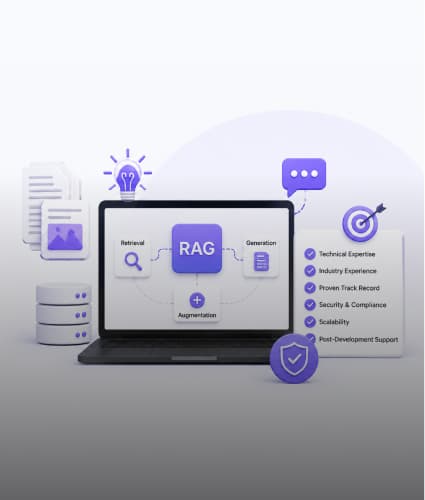
Modern AI requires "connected context," not just raw data. Specialized developers implement GraphRAG (Knowledge Graph-enhanced RAG), which replaces disconnected text chunks with structured entities and relationships. By building these "knowledge fabrics," developers enable your AI to perform multi-hop reasoning, answering complex questions that require connecting dots across thousands of documents while significantly reducing hallucinations.
AI-Native Programming (Rust, Mojo, and Python)
In 2026, performance is a competitive advantage. While Python remains the language of AI research, dedicated developers are increasingly using Rust for memory safety and Mojo for high-performance execution that rivals C++. This "AI-native" approach ensures that your models run with the lowest possible latency and the highest hardware efficiency, which is critical for real-time applications like autonomous vehicles or high-frequency financial trading.
Inference Optimization & Edge AI
With the rise of Inference Economics, managing the cost of running AI is as important as the AI itself. Dedicated talent utilizes Quantization (4-bit/8-bit), Model Distillation, and Speculative Decoding to shrink massive models into efficient engines. This allows you to deploy powerful AI directly on Edge devices or within private clouds, slashing your dependency on expensive third-party APIs and reducing your GPU energy footprint.
AI Governance & Algorithmic Trust
As the EU AI Act and other global regulations reach full enforcement, "black-box" systems have become a liability. Dedicated AI developers implement Explainable AI (XAI) and bias-mitigation protocols by design. They build traceability into every decision-making loop, ensuring your company can provide "Audit Logs for Reasoning" and prove that your autonomous systems are fair, transparent, and compliant with international law.
Cognitive Architecture & Long-Term Memory (LTM)
To provide truly personalized experiences, AI needs to remember. Dedicated developers design Cognitive Architectures using advanced Vector Databases (like Pinecone or Milvus) paired with Long-term Memory (LTM) modules. This allows AI agents to maintain "session-less" context, remembering a user's past preferences, historical data, and nuanced feedback over months or years, creating a seamless and deeply personalized user journey.
Synthetic Data Engineering
Data scarcity and privacy laws often prevent the use of real-world datasets for training. Dedicated AI developers solve this through Synthetic Data Engineering using generative models to create high-fidelity, privacy-compliant datasets that mimic the statistical properties of real data. This allows you to train robust, specialized models in "data-poor" environments without compromising security or regulatory standing.
Hire AI Developers Today!

Why Hire Dedicated AI Developers from Zignuts Technolab
The value of a dedicated AI partner has shifted from basic implementation to strategic orchestration. At Zignuts Technolab, we provide more than just technical talent; we provide the architectural backbone for your autonomous future.
Here’s why global enterprises choose Zignuts Technolab for dedicated AI developers in 2026:
1. Experts in Agentic & Multimodal AI
Our developers are no longer just "coding models"; they are building Agentic Ecosystems. We specialize in:
- Autonomous Agents: Developing digital workers that can reason, plan, and interact with other business APIs independently.
- Multimodal Integration: Building systems that process text, voice, and vision simultaneously for a 360-degree user experience.
- Small Language Models (SLMs): Optimizing high-performance, cost-effective models for specific industry niches.
2. AI-Native Agile & Observability
In 2026, transparency is non-negotiable. We go beyond standard agile by incorporating AI Observability into our development cycle.
- Real-Time Monitoring: We implement frameworks to track model performance, bias, and "hallucination" rates in production.
- Continuous Integration for ML (MLOps): Automated pipelines ensure your AI evolves and improves with every new data point, without downtime.
3. Sovereign & Ethical AI Frameworks
With the full implementation of 2026 global AI regulations (like the EU AI Act), we prioritize your data's integrity.
- On-Premise & Private Cloud AI: We help you build Sovereign AI solutions that keep your proprietary data entirely within your control.
- Ethical Guardrails: Every solution we build includes baked-in bias detection and explainability (XAI) to ensure trust and compliance.
4. Scalable "AI Studio" Engagement Models
We offer the flexibility required for the fast-paced 2026 market. Hire via our AI Studio Model, which provides:
- On-Demand Scaling: Instantly add specialists in Vector Databases, Prompt Engineering, or Robotics as your project matures.
- Hybrid Teams: Our developers integrate directly into your Slack, Jira, or internal dev-tooling, functioning as a seamless extension of your workforce.
5. End-to-End Autonomous Lifecycle Support
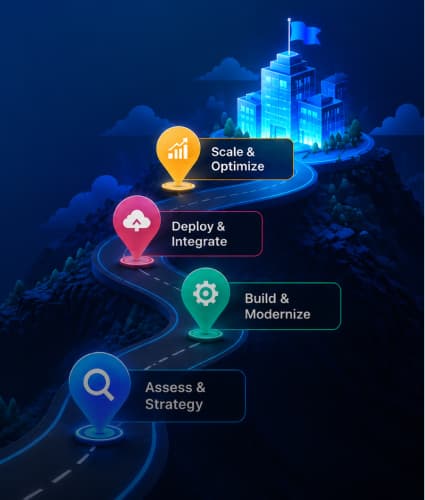
From the initial "Agentic Strategy" to the final optimization of Inference Economics, we manage the entire journey.
- Prototyping & Sandboxing: Rapidly test AI use cases in secure environments before full-scale rollout.
- Inference Optimization: We specialize in "making every watt count," reducing your cloud compute costs through advanced model quantization and distillation.
Use Cases of AI Development
The use cases for AI have moved beyond isolated tasks to autonomous, end-to-end business outcomes. AI is no longer just "assisting"; it is often the primary driver of operational logic.
Here are the most impactful applications of AI development in 2026:
Agentic Workflow Automation
The most significant shift this year is the rise of Agentic AI. Unlike traditional automation, these autonomous agents can reason, use tools, and execute multi-step tasks independently, such as an AI sales agent that autonomously researches leads, personalizes outreach, and schedules meetings without human intervention.
Real-Time Predictive Intelligence
Predictive analytics has evolved into Prescriptive Operations. Systems now process live data streams to not only forecast demand but to automatically adjust supply chains, reroute logistics in real-time to bypass disruptions, and optimize energy consumption across smart factories.
Multimodal Generative AI
Generative AI in 2026 is Multimodal by default. Businesses are building systems that seamlessly integrate text, voice, and vision. This powers context-aware "digital employees" that can "see" a customer’s product through a camera, understand their verbal frustration, and generate a personalized solution in real-time.
Cognitive Computer Vision
Modern vision systems have moved beyond simple tagging to Behavioral Analysis and Contextual Recognition. In retail, AI cameras now detect "intent to purchase" or potential theft by analyzing movement patterns. In manufacturing, computer vision provides autonomous quality control that "learns" to identify new types of defects without manual reprogramming.
Autonomous Fraud & Cyber Defense
With the sophistication of 2026 cyber threats, AI is now the only defense capable of operating at "machine speed." Self-Healing Security Agents identify anomalies the moment they emerge, autonomously isolating compromised systems and deploying patches before a human analyst is even alerted.
Deep Research & Strategy Agents
Enterprises are deploying Deep Research Agents that can cross-verify facts, evaluate thousands of data sources, and offer high-quality strategic insights. These systems transform raw market noise into actionable business strategies, enabling faster, data-backed decision-making for leadership teams.
The Business Impact of Hire Dedicated AI Developers in 2026
Hiring dedicated AI developers is no longer just about building software; it is about re-engineering your business for an autonomous economy. In 2026, the measurable advantages of a specialized team include:
1. Accelerated Time-to-Market with AI-Native Sprints
In a landscape where AI capabilities evolve weekly, speed is your greatest asset. Dedicated teams use AI-augmented development pipelines and pre-built agentic frameworks to move from concept to production significantly faster than generalist teams. They don't just "write code," they orchestrate intelligent systems that are ready to scale immediately.
2. Radical Risk Mitigation & Algorithmic Trust
With the 2026 regulatory environment, including the full enforcement of the EU AI Act, "black-box" systems are a major liability. Dedicated AI developers ensure higher accuracy through Explainable AI (XAI) and rigorous bias-mitigation protocols. They build secure, compliant architectures that protect your proprietary data while preventing costly "model drift" or hallucinations.
3. Compounding Long-Term ROI via Compound AI Systems
By 2026, the most successful businesses will have shifted focus from isolated pilots to Compound AI Systems. Dedicated developers maximize this impact by building systems that don't just perform a task; they learn from every transaction, continuously reducing marginal costs and uncovering new revenue streams through autonomous operational efficiency.
4. Future-Readiness through Self-Evolving Infrastructure
The AI of 2026 is never "finished." A dedicated team provides the continuous monitoring and MLOps (Machine Learning Operations) necessary to keep your systems at the cutting edge. By implementing self-learning loops and modular architectures, your developers ensure that as new foundational models emerge, your business can swap and upgrade components without needing to rebuild your entire infrastructure.
How to Get Started
Building the next generation of intelligent software starts with the right talent.
Zignuts Technolab can help you hire dedicated AI developers who are aligned with your vision and equipped with the latest AI tools and methodologies.
📩 Get in touch with us today to discuss your AI development needs and start building transformative solutions that drive business growth.
Final Thoughts
In the current landscape, the transition from static automation to Agentic AI has made the decision to Hire AI developers a prerequisite for market leadership. By securing specialized talent, businesses move beyond simple integration to building autonomous, self-healing ecosystems that drive real-time intelligence and multimodal customer experiences. This focused expertise ensures that your organization navigates the complexities of Inference Economics and Sovereign AI compliance while maintaining high-performance infrastructure. Ultimately, partnering with experts like Zignuts transforms AI from a technical experiment into a scalable, future-proof engine for sustainable growth.

Deep Mistry
Digital Marketing Enthusiast | Diving into the world of trends, tools, and strategies, sharing discoveries that help create impactful online experiences.