

In 2026, the traditional boundaries of software engineering have dissolved. We are no longer just talking about moving code from a laptop to a server; we are discussing the orchestration of AI-driven autonomous pipelines, self-healing infrastructure, and Platform Engineering.
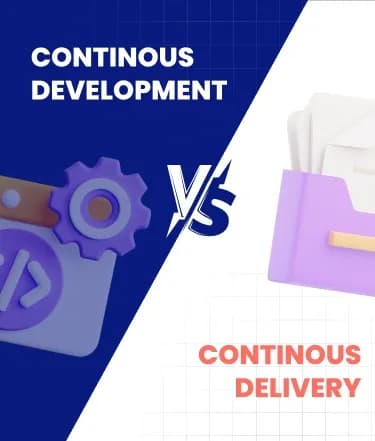
As we cross the threshold into the era of Agentic AI, software delivery has shifted from static, scripted sequences to dynamic, "intent-based" systems. Today, DevOps has matured into a discipline where "manual" is a bottleneck and "automated" is the baseline. Central to this evolution is the choice between two powerhouses of automation: Continuous Deployment (CDp) and Continuous Delivery (CD). While they share an acronym, they represent two distinct philosophies of risk management, governance, and release velocity.
The 2026 landscape is defined by AIOps, where machine learning models predict failure patterns before a single line of code hits production, and GitOps, which ensures your infrastructure is as agile as your application. Whether you are aiming for the "Zero-Touch" speed of a global SaaS platform or the "Safety-First" precision of a regulated financial institution, understanding the nuance between these two practices is your organisation's competitive edge.
The AI-Enhanced Framework of Continuous Delivery: Continuous Deployment vs Continuous Delivery
In 2026, Continuous Delivery (CD) has evolved into a sophisticated "Release on Demand" model. It ensures that your codebase is always in a deployable state, backed by AI-driven predictive testing that identifies potential regressions before they happen. However, the final "Go" signal remains a human decision, a strategic choice that balances technical readiness with business timing. This approach provides a safety buffer that is often the deciding factor for organizations prioritizing governance over automated immediacy.
The 2026 Workflow
AI-Augmented Commits:
Developers push code to platforms like GitHub, where AI agents perform real-time security and "clean code" audits. These agents don't just find errors; they actively suggest refactors to improve long-term maintainability and performance before the build even begins. This ensures that the foundation of the delivery pipeline is high-quality, peer-reviewed code generated with machine precision.
Autonomous Validation & Predictive Testing:
CI tools execute a hierarchy of tests tailored to the specific code change. In 2026, ML models analyse historical failure data to determine which tests are most relevant, reducing build times by up to 40%. By skipping redundant checks and focusing resources on high-risk code paths, teams achieve a faster feedback loop without sacrificing the rigorous standards expected in the Continuous Deployment vs Continuous Delivery debate.
Self-Healing Test Suites:
To eliminate the frustration of "flaky" tests, modern pipelines utilise AI to automatically reconcile environment discrepancies. If a test fails due to a network timeout or a misconfigured container rather than a code bug, the AI repairs the environment and reruns the test. This prevents false negatives from stalling the pipeline and ensures that human reviewers only intervene for genuine logical issues.
Governance Gates:
The software is packaged into immutable containers and staged in environments that perfectly mirror production. AI-powered "Compliance-as-Code" checks run automatically to ensure the release meets the latest global legal and security standards, such as GDPR or the EU AI Act. This automated verification provides the necessary documentation for the manual approval phase that distinguishes the delivery model.
Strategic Release:
A product owner or release manager triggers the deployment based on business readiness. By 2026, this decision is supported by Release Forecasting AI, which analyses real-time market data and system telemetry to predict the impact of the release on user sentiment and system stability. This allows the organisation to choose the optimal moment for launch, maximising impact while minimising disruption.
Hire DevOps Engineers Today!

Key Benefits of Continuous Delivery
Strategic Precision:
This model allows organisations to align their releases with business milestones, such as major marketing launches or specific maintenance windows. Unlike the "always-on" nature of deployment, delivery provides the control to hold a feature until the market is perfectly primed for it, offering a balanced perspective on Continuous Deployment vs Continuous Delivery.
Compliance Guardrails:
For regulated industries like FinTech and HealthTech, having a "Human in the Loop" is often a legal necessity. Continuous Delivery provides a clear audit trail of human approval and verified "Evidence of Quality," ensuring that every production change is signed off by an accountable stakeholder who has reviewed the AI-generated risk reports.
Reduced Cognitive Load:
Platform Engineering teams provide "Golden Paths," which are standardised, pre-approved workflows that handle the heavy lifting of infrastructure. This allows developers to focus purely on feature innovation and code quality while the autonomous platform manages the complexity of staging, security scanning, and cross-service validation.
Enhanced Risk Mitigation:
By maintaining a final manual checkpoint, teams can perform last-minute exploratory testing or subjective usability checks that automated scripts might overlook. This extra layer of human intuition ensures that the user experience is polished and that the software aligns with the brand's quality standards before reaching the end user.
The Zero-Touch Velocity of Continuous Deployment: Continuous Deployment vs Continuous Delivery
Continuous Deployment (CDp) is the ultimate realisation of the "paved road" in modern engineering. In this model, every change that successfully clears the automated gauntlet is pushed instantly to live production. By 2026, the primary differentiator in the Continuous Deployment vs Continuous Delivery conversation is the removal of the manual "gate." This is supported by AIOps and Continuous Verification, where the system doesn't just deploy the code, it monitors its own physiological health post-launch and autonomously triggers a rollback if the slightest anomaly in user behaviour or system latency is detected.
The 2026 Workflow
Automated Security (DevSecOps):
In the rapid-fire world of deployment, security cannot be a final step; it must be instantaneous. Every code push undergoes immediate, AI-driven vulnerability scanning and real-time SBOM (Software Bill of Materials) generation. This ensures that any third-party dependency with a newly discovered zero-day exploit is blocked at the source, keeping the production environment secure without slowing down the release velocity.
Predictive Testing & Chaos Simulation:
Rather than running every test in a linear fashion, the 2026 pipeline uses historical telemetry and machine learning to predict potential failure points. It prioritises deep-dive simulations on high-risk code segments while simultaneously running "mini-chaos" experiments to see how the new code handles simulated network partitions or database latency. This high-speed validation is what allows the system to bypass human review safely.
Shadow Deployment & Traffic Mirroring:
To ensure 100% reliability, changes are often deployed to a "shadow" environment. Here, the new version of the software processes real, live traffic data in parallel with the current production version, but the responses are not sent to the users. This allows the system to verify performance, data integrity, and API compatibility against real-world conditions before the "actual" switch is flipped, providing a level of certainty that manual testing could never achieve.
Instant Production Live via GitOps:
Once the code is validated, it hits production immediately through GitOps tools like ArgoCD or specialised 2026 AI-orchestrators. The transition is typically managed via Canary Releases, where the new code is exposed to 1% of users, then 5%, and finally 100% as the AI confirms that all health signals remain green. This "hands-off" approach is the hallmark of the deployment philosophy in the Continuous Deployment vs Continuous Delivery spectrum.
Key Benefits of Continuous Deployment
Hyper-Fast Feedback Loops:
The most significant advantage is the speed of the iteration cycle. Developers and product teams see their features in the hands of real users within minutes of completing the code. This allows for rapid A/B testing and "fail-fast" mentalities where user data, not executive opinions, dictates the product roadmap.
Elimination of "Release Anxiety":
When an organisation moves to Continuous Deployment, the psychological weight of a "Release Day" disappears. When you deploy 50 or 100 times a day, a single deployment is no longer a high-stakes event. This cultural shift reduces stress among engineering teams and leads to more stable, incremental improvements rather than risky, massive overhauls.
Operational Efficiency & Scalability:
By removing manual bottlenecks, the organisation avoids the "approval tax" that usually slows down growing teams. There are no meetings to "approve the release" or waiting for a specific manager to be available. The platform acts as the ultimate authority, allowing the engineering team to scale their output linearly without increasing administrative overhead.
Autonomous Resilience:
In 2026, Continuous Deployment is synonymous with self-healing. If a new deployment causes a 2% increase in error rates, the system detects it faster than any human operator could and performs an automatic, sub-second rollback. This ensures that even when a mistake reaches production, its impact is contained and remediated instantly.
Comparative Analysis: Continuous Deployment vs Continuous Delivery
In 2026, choosing between Continuous Deployment vs Continuous Delivery is no longer a matter of technical capability; both are supported by high-performance AI engines, but a strategic decision based on your organisation’s risk profile and market objectives. While they share the same automated foundation, the nuances in their execution define how your brand interacts with its users and regulatory bodies.
The Final Step: Manual Strategic Signal vs Autonomous Execution
The most visible distinction in the Continuous Deployment vs Continuous Delivery debate remains the "deployment trigger." In Continuous Delivery, the pipeline prepares a "production-ready" artefact, but a human stakeholder, typically a Product Manager or Release Engineer, provides the final approval. This is often used as a strategic lever to align software launches with marketing campaigns or business cycles. In contrast, Continuous Deployment removes the human from the loop entirely. Once the code clears the automated testing suite, it is instantly pushed to live servers, prioritising speed and immediate value over coordinated timing.
Release Frequency: Business-Synchronised vs Instantaneous Velocity
When evaluating Continuous Deployment vs Continuous Delivery, frequency is a major factor. Continuous Delivery is often "Business-Defined," meaning releases might happen once a day, once a week, or whenever the business reaches a specific milestone. This is ideal for organisations that need to coordinate documentation updates, customer support training, or legal notifications alongside a release. Continuous Deployment, however, operates at "Live Velocity." Code changes flow into production multiple times per hour, ensuring that bug fixes and minor features reach the end-user as fast as the CPU can process the pipeline.
Risk Mitigation: Human Intuition vs AI-Powered Self-Healing
Risk management has been revolutionised by AI in 2026 for both models, but the approach differs. Continuous Delivery relies on a "Human Review + Automated Tests" hybrid. Automated systems handle the heavy lifting of regression and security testing, while humans provide a final check for subjective elements like UX feel and brand alignment.
Continuous Deployment takes a more aggressive, technical approach to safety through AIOps and Continuous Verification. In this model, the system monitors live telemetry data immediately after a push. If the AI detects a 1% spike in error rates or a slight dip in conversion, it triggers an autonomous "sub-second rollback," reverting to the previous stable state before a human would even notice a problem.
Organisational Fit: Enterprise Governance vs SaaS Agility
The choice of Continuous Deployment vs Continuous Delivery often reflects the "Organisational DNA."
- Continuous Delivery is the gold standard for Enterprises and Regulated Industries (such as FinTech, Healthcare, or Aerospace). These sectors require strict audit trails, "Evidence of Quality" documentation, and clear accountability for every change that reaches the public.
- Continuous Deployment is the preferred path for SaaS platforms, Startups, and High-Scale Web applications. For these teams, the cost of a delayed release is often higher than the cost of a minor bug that can be auto-remediated. It allows for a "fail-fast" culture where rapid iteration leads to faster product-market fit.
Primary Goal: Release Readiness vs Release Velocity
Ultimately, the two practices serve different masters. The goal of Continuous Delivery is Release Readiness, ensuring that the software is always capable of being deployed, giving the business the confidence to move whenever they choose. The goal of Continuous Deployment is Release Velocity, minimising the "Lead Time to Value" so that the distance between a developer's idea and a user's experience is as short as humanly (and artificially) possible.
Strategic Implementation: Continuous Deployment vs Continuous Delivery
Deciding which model to implement depends on your industry's risk appetite, technical maturity, and how your business defines "value." In 2026, the choice between Continuous Deployment vs Continuous Delivery is often handled by Platform Engineering teams who build "Golden Paths" standardised, secure, and automated workflows that simplify the developer experience.
When to Choose Continuous Delivery
Regulatory Complexity:
If your software operates in highly scrutinised sectors, Continuous Delivery is non-negotiable. It provides a vital "Air Gap" for manual compliance verification, ensuring that every release includes a digital signature for standards like SOC2, HIPAA, or the EU AI Act.
High-Touch UX & Change Management:
For enterprise platforms (B2B), frequent UI changes can disrupt user productivity. Delivery allows you to batch features into a cohesive update, complete with updated documentation, training videos, and internal support briefings.
Complex Migrations & Legacy Interop:
When a release requires a multi-step database migration or a synchronised update with a legacy third-party API, the manual trigger in Continuous Delivery prevents "partial" deployments that could lead to data corruption.
A/B Testing & Marketing Alignment:
If your business strategy relies on coordinated "Big Bang" launches or seasonal promotions, Continuous Delivery gives the marketing team the power to flip the switch when the market is perfectly primed, rather than when the code is finished.
Manual Quality Assurance:
In scenarios where subjective human experience is critical, such as high-end gaming or creative design tools, Continuous Delivery allows for final exploratory testing that automated scripts might overlook.
Pro Tip: A banking app in 2026 uses Continuous Delivery to ensure that even though the code is "ready," it only goes live after a final compliance check against the latest regional regulations, preventing multi-million dollar fines from automated errors.
When to Choose Continuous Deployment
SaaS and Cloud-Native Agility:
For digital-first products, staying ahead of the competition requires constant iteration. Continuous Deployment allows you to release tiny updates, sometimes hundreds of times a day, ensuring that your product is always evolving based on real-time data.
Bug-Fix Efficiency:
In the Continuous Deployment vs Continuous Delivery spectrum, Deployment wins on MTTR (Mean Time To Recovery). When a critical bug is found, the fix can be live in minutes. This is vital when the cost of a bug being live for 10 minutes is significantly less than the cost of a 2-hour manual approval delay.
Mature Observability & AIOps:
This model is for teams with advanced "Shift-Right" capabilities. If your infrastructure uses AIOps tools to monitor real-time user behaviour and can detect "silent failures" (like a drop in checkout conversions), you have the safety net required for zero-human intervention.
Developer Empowerment:
Continuous Deployment fosters a culture of "Extreme Ownership." When a developer knows their code is going live immediately, the quality of initial commits increases, and the feedback loop from real-user data becomes the ultimate teacher.
Infrastructure as Code (IaC) Maturity:
Continuous Deployment works best when your infrastructure is as agile as your code. Teams using serverless or containerised environments (Kubernetes) can leverage automated scaling and self-healing to support high-velocity releases.
Pro Tip: E-commerce giants use Continuous Deployment to test tiny variations of checkout buttons in real-time. By leveraging AI to monitor the conversion rate of every micro-release, the system can automatically revert any version that causes even a 0.5% drop in sales.
Overcoming Challenges in Continuous Deployment vs Continuous Delivery
Neither path is without obstacles. In 2026, the challenges have shifted from "how to build a pipeline" to "how to manage its complexity" within an increasingly autonomous environment. Successfully navigating Continuous Deployment vs Continuous Delivery requires more than just tools; it requires a strategy to handle the technical debt and operational noise that modern speed creates.
The 2026 Challenges
The Flaky Test Epidemic:
Automated pipelines are only as good as the tests that guard them. In 2026, "flaky" tests, those that pass or fail inconsistently without code changes, are the leading cause of pipeline friction. Organisations are now utilising AI-driven self-healing mechanisms that use heuristics to adapt when UI identifiers change slightly, preventing build failures. Without this, the high-velocity requirements of Continuous Deployment would lead to constant, false-alarm rollbacks.
Escalating Security Debt:
With the acceleration of release cycles, security can no longer be a "checkpoint" at the end of the line. "Shifting left" has become non-negotiable, yet many teams struggle with Security Debt, the accumulation of unpatched vulnerabilities in third-party dependencies. To survive the Continuous Deployment vs Continuous Delivery transition, security must be baked into the developer’s IDE with real-time feedback, ensuring that vulnerabilities are remediated the moment code is written, not hours before a production launch.
Observability Overload & Signal Fatigue:
Continuous Deployment generates a massive "tsunami" of telemetry data. By 2026, the sheer volume of logs, traces, and metrics exceeds human capacity to interpret. High-performing teams must use AIOps 2.0 to filter "noise" from actual "signals." This involves intelligent alert suppression and event correlation, ensuring that engineers only receive alerts that require genuine human judgment rather than routine system fluctuations.
Environment Drift and Complexity:
As pipelines scale to handle multi-cloud and serverless architectures, maintaining consistency between staging and production becomes a major hurdle. In the context of Continuous Deployment vs Continuous Delivery, even a minor "drift" in configuration can cause a validated build to fail in the live environment. Teams are overcoming this by enforcing Infrastructure as Code (IaC) and using ephemeral, containerised test environments that are destroyed and recreated for every single build.
The Culture Gap:
Perhaps the greatest challenge is the cultural shift required for full automation. Moving from the manual safety of Continuous Delivery to the autonomous nature of Continuous Deployment requires a high level of trust in the system. Organisations must foster a "DevOps Mindset" where developers take full ownership of their code's performance in production, supported by blameless post-mortems and a commitment to continuous learning.
Hire DevOps Engineers Today!
2026 Best Practices for Continuous Deployment vs Continuous Delivery
As the software landscape shifts toward autonomous operations, the "paved road" to production is no longer just about automation; it's about intelligent orchestration. In 2026, excelling at Continuous Deployment vs Continuous Delivery requires a commitment to removing cognitive load from developers while maintaining rigorous, AI-backed safety standards.
1. Embrace Platform Engineering and "Golden Paths"
In 2026, elite organisations have moved away from letting every team build their own custom pipelines. Instead, they embrace Platform Engineering to create "Golden Paths." These are standardised, pre-approved, and opinionated workflows that automate the creation of repositories, CI/CD configurations, and security scaffolding.
- The "Day 2" Evolution: By 2026, Golden Paths have evolved beyond simple templates to Inherited Pipelines. This means when a platform team updates a security scan or a deployment rule, it automatically propagates across all 500+ microservices without requiring manual pull requests from individual developers.
- Why it matters: It ensures that every service follows the same high standards for security and reliability by default. When comparing Continuous Deployment vs Continuous Delivery, Golden Paths provide the foundational consistency needed for either model to scale.
2. Implement Feature Flags to Decouple Deployment from Release
One of the most critical practices in 2026 is separating the technical act of deploying code from the business act of releasing a feature. By using sophisticated Feature Flags, you can push code into production (Continuous Deployment) but keep the functionality hidden behind a digital toggle.
- AI-Driven Progressive Delivery: Modern feature flags are now integrated with AI agents that perform "Smart Rollouts." Instead of a manual "5% to 10%" increase, the AI monitors real-time user sentiment and system load, automatically expanding the release to compatible user segments while keeping the blast radius small.
- Why it matters: This allows you to test code in the live environment without impacting the broader customer base. In the Continuous Deployment vs Continuous Delivery spectrum, feature flags provide the "manual control" of delivery with the "automated speed" of deployment.
3. Move from Monitoring to Continuous Verification
Traditional monitoring is reactive, but in 2026, the standard is Continuous Verification. This involves using AI to actively watch production metrics (such as p99 latency, CPU spikes, and 4xx/5xx error rates) for a set "soak period" immediately following a deployment.
- Autonomous Feedback Loops: If the AI detects a deviation from the established baseline within the first 5 minutes, it triggers an autonomous, sub-second rollback. This high-speed safety net is the "secret sauce" that makes Continuous Deployment safer than manual Continuous Delivery in high-scale environments.
- Why it matters: It removes the need for a human to stare at a dashboard post-release. The system handles the "hand-holding" of new code, allowing engineers to move straight to the next task.
4. Enforce "Everything as Code" (IaC and PaC)
To prevent the dreaded "environment drift" where staging and production behave differently, you must version-control everything. Infrastructure as Code (IaC) and Policy as Code (PaC) ensure that your servers, networks, and security rules are defined in Git alongside your application logic.
- GitOps Reconciliation: In 2026, tools like ArgoCD or Flux are mandatory. They ensure that the live state of your infrastructure always matches the state declared in your repository. If a "hotfix" is made manually in the cloud console, the system will detect the drift and automatically revert it to the versioned, secure state.
- Why it matters: It ensures that every environment is an identical clone of the last. In the Continuous Deployment vs Continuous Delivery debate, IaC is the only way to guarantee that a test passing in staging will actually behave the same way in production.
5. Shift-Left Security with Real-Time Guardrails
By 2026, security is no longer a "gate" at the end of the pipeline; it is an "ambient" presence throughout. This involves real-time SBOM (Software Bill of Materials) generation and automated vulnerability scanning at the moment a developer saves their code.
- Policy Enforcement: Using Policy-as-Code, pipelines can automatically block any deployment that doesn't meet specific security criteria (e.g., "No critical vulnerabilities" or "Must have encrypted secrets"). This turns compliance into a real-time service rather than a quarterly headache.
- Why it matters: Catching a security flaw in the IDE is 100x cheaper and faster than catching it after a breach. This proactive stance allows teams to maintain the high velocity of Continuous Deployment without compromising on safety.
Conclusion: Navigating the Future of Software Delivery
The debate between Continuous Deployment vs Continuous Delivery is no longer a question of which is superior, but which one aligns with your organisational risk appetite and business velocity in an AI-first world. By 2026, the integration of AIOps, self-healing test suites, and autonomous verification has blurred the lines between these two practices. While Continuous Delivery offers the strategic "Human in the Loop" gate necessary for high-stakes enterprise environments, Continuous Deployment provides the "Zero-Touch" speed essential for hyper-growth SaaS platforms.
Ultimately, successful software delivery in this era requires a robust cultural shift toward automation and "Everything as Code." Transitioning to these intelligent pipelines demands high-level expertise in platform engineering and security automation. To build, scale, and secure your modern infrastructure, you must Hire DevOps Engineers who are proficient in 2026’s autonomous toolsets. By doing so, you ensure that your delivery pipeline is not just a conveyor belt for code, but a strategic engine for innovation and reliability.
Ready to Modernise Your Pipeline?
Are you looking to implement AI-driven CI/CD workflows or transition from manual delivery to autonomous deployment? Our team of experts is ready to help you navigate the complexities of modern DevOps. Contact Zignuts today to discuss your project requirements and let us help you build the intelligent software pipelines of the future.

Divyesh Patel
A passionate problem solver driven by the quest to build seamless, innovative web experiences that inspire and empower users.