

In the digital landscape of 2026, where decentralized data architectures and agentic AI-driven operations define the market, protecting your information is no longer just a precaution it is a baseline for survival. As the global cloud backup market surpasses $7 billion this year, enterprises are shifting their focus from simple "cloud as a place" storage to "intelligence-led" resilience. Imagine waking up to find that your vital business intelligence has vanished due to a sophisticated AI-orchestrated ransomware strain, a cross-region hardware failure, or an environmental disaster impacting a major data hub. The fallout in today's high-speed economy is catastrophic: immediate financial drain (with the average breach cost exceeding $4.5 million), total operational paralysis, and a permanent loss of customer trust.
This is why modern cloud-based backup solutions have evolved into an invisible, autonomous fabric of business logic. They no longer just copy files; they utilize machine learning to establish behavioral baselines, identify anomalies in real-time, and provide immutable "clean-room" recovery environments. In this guide, we’ll explore the 2026 state of these services including the rise of sovereign clouds and zero-trust architectures the evolving types available, and how to select the most resilient option to future-proof your digital assets.
What are Cloud-Based Backup Solutions?
In 2026, these services represent a sophisticated evolution of data protection, moving far beyond simple storage on remote hardware. They allow organizations to securely transmit and store immutable snapshots of their data on high-performance remote clusters managed by specialized global providers. These solutions have integrated Agentic AI and machine learning to establish behavioral baselines, which allow them to detect encryption patterns or unauthorized deletions the moment they occur effectively serving as an early-warning system against ransomware.
By leveraging hyperscale global infrastructure, they offer near-infinite elasticity, allowing your storage pool to grow automatically alongside your database without manual provisioning. Furthermore, the 2026 landscape emphasizes Data Sovereignty; depending on your specific legal and governance requirements, you can now opt for specialized "Sovereign Cloud" partitions. these are physically and logically isolated environments that guarantee your sensitive records never cross national borders, ensuring compliance with evolving regulations while maintaining the full performance benefits of the cloud.
Beyond simple recovery, modern solutions integrate seamlessly with DevSecOps pipelines, allowing teams to instantly clone production-grade test environments from existing backups. This "Data-as-Code" approach ensures that while your data is protected, it remains an active asset for innovation rather than a stagnant archive.
How Cloud-Based Backup Solutions Work
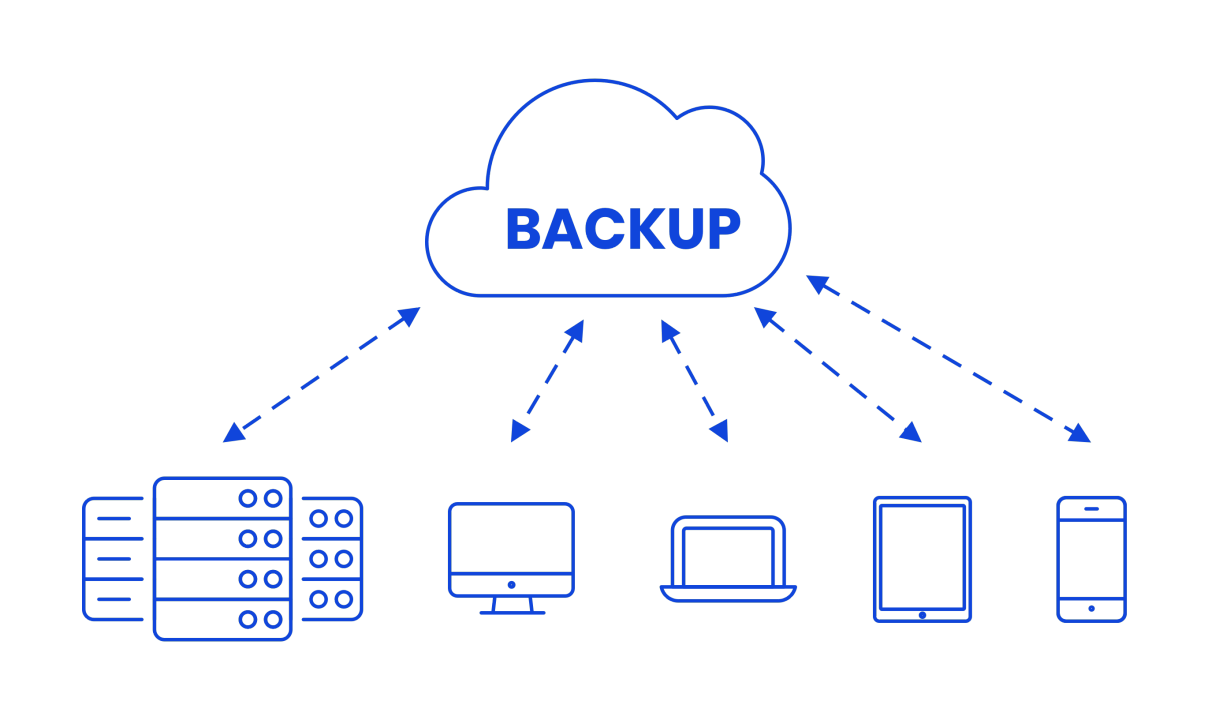
In 2026, cloud backup has transitioned from a passive storage task to an active, autonomous ecosystem. The workflow is no longer just about copying files; it’s about creating a living, resilient mirror of your database.
Data Transfer
The journey begins at the source whether it’s a localized server or an edge computing node. In 2026, your information moves via ultra-low latency 5G/6G slices or dedicated fiber interconnects. These systems use Smart Orchestration to monitor your network’s "heartbeat," automatically throttling bandwidth during peak business hours and accelerating during troughs. This ensures that even multi-petabyte datasets stay synchronized without causing a millisecond of lag in your live customer-facing applications.
Quantum-Resistant Encryption
Security is the cornerstone of 2026 backup protocols. As quantum computing advances, traditional RSA and ECC encryption are being phased out in favor of Post-Quantum Cryptography (PQC). Your data is shielded by lattice-based or hash-based algorithms that are mathematically designed to resist attacks from even the most powerful future quantum processors. This "Store Now, Decrypt Later" protection ensures your data remains a "black box" to unauthorized entities, both during its high-speed transit and while it sits in long-term cold storage.
Geo-Redundant & Multi-Cloud Mesh
Modern storage follows an Active-Active Geo-Mesh approach. Once ingested, data isn't just sitting in one building; it is fragmented, encrypted, and distributed across a mesh of global "Availability Zones." In 2026, many organizations take this further with Multi-Cloud Redundancy, where a single backup is mirrored across two different providers (e.g., AWS and Azure). This "Grid Resilience" ensures that if an entire cloud region goes dark due to a cyber-warfare event or a massive environmental catastrophe, your database remains online and accessible from a different geographic and provider-agnostic coordinate.
Intelligent Incremental & AI-Deduplication
To minimize carbon footprints and storage costs, 2026 solutions utilize Predictive Deduplication. Instead of just looking for changed files, AI agents analyze data blocks to identify redundant patterns across your entire organization. Using Intelligent Incremental Updates, the system only transmits the unique "delta" (the change). For example, if you update one million rows in a table, the system identifies that 90% of the underlying data structure remains identical and only sends the 10% change, drastically reducing bandwidth and energy consumption.
Instantaneous "Zero-RTO" Recovery
The final and most critical stage is restoration. In 2026, the concept of "waiting for a download" is obsolete for mission-critical databases. Live Mounting (or Zero-RTO recovery) allows your applications to connect directly to the backup repository as if it were a local disk. The cloud provider spins up a "Virtual Standby" instance of your database in seconds. While your app runs off this temporary cloud mirror, the system quietly reconstructs your local environment in the background, ensuring that your business never experiences a single minute of downtime.
Types of Cloud-Based Backup Solutions
In 2026, database management has moved toward a tiered, "intelligence-first" approach. Understanding these four primary methodologies is essential for building a resilient Recovery Point Objective (RPO) and Recovery Time Objective (RTO) strategy that can withstand modern cyber threats.
Full Database Backups
This involves generating a comprehensive, bit-for-bit mirror of the entire environment, including every table, index, schema, and metadata configuration. In 2026, full backups are often "Synthetic," meaning they are constructed in the cloud by merging previous backups to avoid taxing your production servers.
- Use Case: Critical as a "Golden Image" for baseline synchronization, major system migrations, or for small-scale applications that require a simple, self-contained recovery file.
- Pros: The most straightforward recovery path; everything is contained in a single package, making it highly reliable for total system restores.
- Cons: High resource consumption; even with 2026 bandwidth, the storage overhead and time required to move massive datasets can be significant.
Incremental Backups
These capture only the "deltas" or blocks of data created since the most recent backup of any kind. Modern incremental backups now operate at the Byte-Level, identifying tiny changes within files to further reduce data transfer.
- Use Case: The 2026 standard for high-volume enterprises looking to minimize network congestion and carbon footprints by reducing data transmission.
- Pros: Extremely fast execution and minimal storage footprint; it allows for very frequent backup windows (e.g., every 15–30 minutes).
- Cons: Recovery can be complex and slower, as the system must "replay" the entire chain of increments starting from the last full backup.
Differential Backups
A differential backup captures all changes made since the last full backup. Unlike the incremental approach, the volume of data grows cumulatively each day until a new full cycle is triggered.
- Use Case: Ideal for databases where data changes are frequent but not massive, providing a middle-ground strategy for organizations that prioritize faster restoration over storage savings.
- Pros: Significantly faster restoration than incremental backups because you only need two components: the initial full backup and the single latest differential file.
- Cons: Storage requirements grow steadily between full backup intervals, which can lead to higher cloud storage costs if not managed via automated lifecycle policies.
Continuous Data Protection (CDP)
CDP is the "live recording" of your database. It logs every single transaction or "write" operation in real-time or near-real-time (sometimes called Journaling). In 2026, "True CDP" provides a granular history of every second of your data’s life.
- Use Case: Non-negotiable for high-frequency trading platforms, healthcare systems, and mission-critical databases where a loss of even 60 seconds of data could lead to legal or financial ruin.
- Pros: Achieves a near-zero RPO; it allows you to "rewind" your database to a millisecond before a corruption or ransomware event occurred.
- Cons: Requires constant, high-speed bandwidth and sophisticated management software. In 2026, this is often mitigated by using Edge-CDP, where changes are cached locally before being streamed to the cloud.
Technical Options for Cloud-Based Backup Solutions

In 2026, the technical landscape for database protection has shifted toward "Active Resilience." Organizations no longer choose a single method based solely on cost, but rather on how well it integrates with their AI-driven workflows and global compliance needs.
Direct Public Integration
This involves using native cloud tools or advanced third-party software to push data directly into hyperscale environments. In 2026, this has evolved into "Serverless Backup," where you don't manage any underlying infrastructure. It provides a highly elastic destination that can scale to petabytes instantly, often utilizing AI-driven Tiering to move data between hot and cold storage based on real-time access patterns.
- 2026 Context: In this model, the organization maintains total control over encryption keys (using Bring Your Own Key - BYOK) and logic, while the provider ensures the physical hardware is carbon-neutral and globally available.
- Example: Utilizing AWS S3 Intelligent-Tiering to store SQL snapshots, where the system uses machine learning to automatically move older backups to "Glacier Deep Archive" to save costs while keeping them instantly searchable via metadata.
Managed Service Providers (MSP) & BaaS
For teams that prefer a hands-off approach, Backup as a Service (BaaS) through an MSP is the primary choice. In 2026, MSPs act as "Resilience Partners." They don't just store data; they take over the continuous monitoring, automated patching, and crucially Regular Recovery Testing. This provides a "Peace of Mind" guarantee backed by strict Service Level Agreements (SLAs) that define exactly how many minutes it will take to get your database back online.
- 2026 Context: Modern MSPs now include Ransomware Clean-Rooms, where they test your backups in an isolated environment to ensure they are free of malware before you ever trigger a restore.
- Example: Partnering with an Oracle Managed Service to handle the end-to-end protection of a complex ERP database, where the MSP provides a monthly "Proof of Recoverability" report.
Cloud-to-Cloud (C2C) Redundancy
As multi-cloud strategies become the standard in 2026, C2C backup ensures that your data isn't locked into a single ecosystem. This method involves transferring data from one SaaS or IaaS provider to a completely different one. This "Provider Agnostic" approach protects you against a total regional outage or a catastrophic failure of a single major cloud vendor.
- 2026 Context: This is specifically valuable for protecting SaaS-born data (like Salesforce or Google Workspace) which, contrary to popular belief, is not automatically backed up by the provider against accidental deletion or internal threats.
- Example: Syncing your Microsoft 365 or Azure SQL database entries to a secondary Google Cloud Storage bucket, ensuring that a service disruption at Microsoft doesn't halt your entire global operation.
Hybrid On-Premises to Cloud
This setup combines local high-speed appliances with the vast scale of the cloud. In 2026, these appliances are often Hyperconverged Infrastructure (HCI) units that cache the most recent 24–48 hours of backups for "Instant Local Recovery," while simultaneously streaming immutable copies to the cloud for long-term disaster recovery.
- 2026 Context: This is the ideal solution for businesses with "Data Gravity" where the database is so large or latency-sensitive that moving it entirely to the cloud is impractical. It allows for the speed of a local restore with the safety net of off-site storage.
- Example: A global manufacturing plant using a local NetApp or Dell appliance to keep production data on-site for immediate access, while the gateway streams encrypted blocks to Azure Blob Storage for regulatory compliance and disaster resilience.
Hire Dedicated Developers Today!

Leading Providers of Cloud-Based Backup Solutions

In 2026, the provider landscape has shifted toward Autonomous Resilience and Quantum-Ready Security. The "Big Three" hyperscalers, along with enterprise specialists, have integrated advanced AI to transform backups from static archives into active, self-healing datasets.
Amazon Web Services (AWS)
AWS continues to lead with its comprehensive AWS Backup ecosystem, which now features AI-driven "Vault Lock" and logically air-gapped vaults. In 2026, AWS has expanded its Automated Restore Testing, which periodically executes "mock" recoveries in isolated environments to verify data integrity without human intervention.
- Key 2026 Features: Multi-party approval for critical backup deletions, cross-account/cross-region "Immutable Snapshots," and native malware scanning that cleans recovery points before they are restored to production.
Microsoft Azure
Microsoft has solidified its position with Azure Backup and Azure Site Recovery (ASR), deeply integrating Azure Copilot for AI-assisted disaster recovery planning. Azure’s 2026 updates focus on "Application-Aware" consistency, ensuring that complex SQL clusters and Kubernetes-based databases are recovered in perfect transactional sync.
- Key 2026 Features: Seamless integration with Microsoft Entra for Zero-Trust access, "Instant-Mount" capabilities for Multi-TB databases, and specialized Sovereign Cloud zones for strict GDPR and regional compliance.
Google Cloud Platform (GCP)
GCP is the 2026 choice for high-speed, data-heavy AI workloads. Its Enhanced Backups for Cloud SQL now utilize Google’s global fiber backbone for near-instantaneous data movement. GCP has introduced "Project-Level Resilience," allowing organizations to recover an entire cloud project including networking and IAM settings alongside the database.
- Key 2026 Features: Logically air-gapped "Backup Vaults" that are invisible to the source project’s administrators, integrated vector search for querying backup metadata, and a "Carbon-Zero" dashboard to monitor the environmental impact of your storage.
Enterprise Specialists: IBM and Oracle
While hyperscalers focus on general-purpose cloud, these providers dominate the high-compliance and legacy sectors in 2026:
- Oracle Cloud (OCI): Features the Autonomous Database 26ai, which includes "Self-Healing" backups that automatically patch and tune themselves. Its Maximum Availability Architecture (MAA) provides 99.995% uptime guarantees through automated cross-cloud failover.
- IBM Cloud: Focuses on Quantum-Safe Cryptography for its Object Storage backups. IBM is the preferred partner for financial and healthcare sectors requiring "Cyber-Resilient" air-gapped storage that meets the most stringent 2026 regulatory standards.
Benefits of Modern Cloud-Based Backup Solutions
In 2026, the advantages of moving to a cloud-native backup model have shifted from simple convenience to essential business resilience. As global data volumes soar, these solutions provide the intelligence and agility required to stay competitive.
Global Accessibility and Hybrid Work Support
With your data backed up to the cloud, it is accessible from any geographic location with a secure internet connection. In 2026, this enables decentralized IT teams to trigger full-scale disaster recovery protocols without ever needing to enter a physical office. This flexibility is vital for the modern hybrid workforce, ensuring that critical data is never trapped behind a single physical perimeter.
Hyperscale Elasticity
Forget the days of forecasting and purchasing physical hard drives months in advance. Cloud-based backup solutions offer virtually limitless storage that expands and contracts automatically based on your real-time database needs. Whether your data grows by gigabytes or petabytes, the cloud scales to accommodate you instantly, ensuring you never run out of space during a critical backup window.
Off-site Isolation and Air-Gapping
Storing data away from your primary production network creates a vital "Security Gap." In 2026, many cloud providers offer "Immutable Air-Gapped Vaults" backup sets that are logically separated from your main account and cannot be modified or deleted, even by an administrator. This provides a definitive safeguard against insider threats and sophisticated ransomware that attempts to wipe out backup logs.
AI-Driven Operational Efficiency
Modern solutions utilize Autonomous Backup Orchestration to eliminate human error. In 2026, AI agents monitor the health of your backups, automatically retrying failed jobs and self-healing corrupted data blocks. This shift from manual management to "Self-Driving Backups" ensures that your recovery points are consistent, verified, and ready to use 100% of the time.
Financial Flexibility and OpEx Optimization
Cloud models transform backup from a massive upfront capital expenditure (CapEx) into a predictable operating expense (OpEx). Using a "Pay-As-You-Go" model, you only pay for the specific storage and compute resources you consume. In 2026, Predictive Billing AI helps organizations forecast these costs with extreme accuracy, preventing budget surprises as data footprints grow.
Environmental Sustainability and ESG
In 2026, environmental impact is a key business metric. Cloud data centers are significantly more energy-efficient than traditional on-premises rooms, often running on 100% renewable energy. By moving your backups to the cloud, you can reduce your organization's carbon footprint by up to 95%, helping you meet strict ESG (Environmental, Social, and Governance) targets.
Enhanced Data Sovereignty and Compliance
Modern cloud backups are built to navigate the complex web of global data laws. Providers offer Sovereign Cloud regions that ensure your data remains within specific national borders to comply with regulations like GDPR or local data residency acts. Automated compliance tagging also ensures that sensitive records are retained only as long as legally required, simplifying the audit process.
Challenges and Considerations for Cloud-Based Backup Solutions
Selecting the right cloud backup provider for databases is a high-stakes decision in 2026. While the technology has matured significantly, several critical challenges remain that require proactive strategic planning.
The Evolving Security Landscape
In 2026, security is the foremost challenge as databases have become the primary targets for AI-augmented cyberattacks. Traditional encryption is no longer enough; sophisticated actors now use automated tools to seek out backup credentials. To counter this, your 2026 Strategy must prioritize "Immutable Backups" data sets that are locked into a read-only state for a fixed duration, making them impossible to delete or alter even if an administrator's account is compromised. Additionally, adopting a Zero-Trust architecture ensures that every access request to your backup repository is continuously verified based on identity, device health, and geographic location.
Performance and Network Bandwidth Constraints
The massive volume of modern databases can easily saturate business bandwidth, leading to "backup lag" where the data being sent to the cloud is hours behind the live production environment. This performance bottleneck is a significant hurdle for real-time operations. A resilient 2026 Strategy involves implementing 5G/6G failover or dedicated private fiber interconnects (like AWS Direct Connect or Azure ExpressRoute) to ensure a high-speed, consistent data pipe. Utilizing WAN optimization and edge-caching can also help by pre-processing data at the network’s edge before it travels to the central cloud.
Hyperscale Scalability and Cost Management
While the cloud offers infinite space, the "hidden costs" of scalability can quickly spiral out of control. As your database grows, so do your storage fees, data egress charges, and API call costs. Without careful oversight, the financial burden can outweigh the benefits. The best 2026 Strategy is to utilize AI-driven lifecycle policies that automatically migrate aging, infrequently accessed backups to "Cold Storage" or "Deep Archive" tiers. This automated tiering ensures you are only paying premium rates for the most critical, recent recovery points.
Complexity and Ease-of-Use
In an era of multi-cloud environments, managing various interfaces can lead to "Configuration Fatigue," where a single misclicked setting can expose an entire database to the public internet. Complexity is the enemy of security. A streamlined 2026 Strategy involves prioritizing platforms that offer a centralized "Single-Pane-of-Glass" management console. These unified dashboards allow your team to monitor backups across AWS, Azure, and on-premises sites from one location, reducing the risk of human error and simplifying the training requirements for your IT staff.
Integration and Multi-Database Compatibility
Not every cloud backup solution is compatible with every type of modern data engine. In 2026, many businesses use a mix of Relational (SQL), NoSQL, and newer Vector Databases for AI applications. Ensuring your backup tool "speaks the language" of all these systems is a common challenge. Your 2026 Strategy should focus on selecting providers that offer native integration for your specific database engines. This ensures that the backups are "Application-Consistent," meaning they capture a perfect, usable snapshot of the data without requiring the database to be taken offline during the process.
Why Choose Modern Cloud-Based Backup Solutions?

In 2026, the complexity of data has outpaced the capacity of traditional hardware. Cloud-native protection offers a level of resilience that on-site systems simply cannot match. From AI-assisted threat detection to carbon-neutral data centers, these solutions are designed for the future. They offer the agility needed to pivot during a crisis, ensuring that your business remains functional while others are still searching for their recovery tapes.
The decision to migrate to a cloud-based framework is no longer just an IT choice; it is a fundamental business continuity requirement. In an era where Ransomware-as-a-Service (RaaS) has become a multibillion-dollar industry, cloud-native backups provide an immutable air-gap that physical disks cannot replicate. Unlike local backups that are susceptible to the same network-wide attacks as your primary servers, cloud repositories in 2026 use Zero-Trust architecture, requiring continuous authentication for every data request.
Furthermore, cloud-based solutions integrate AI-powered predictive analytics. These systems don't just store data; they actively analyze it for signs of corruption or tampering. If a sudden surge in data encryption is detected a hallmark of a ransomware attack the system can automatically freeze the backup set and alert administrators before the infection spreads. This proactive stance transforms your backup from a "last resort" into a frontline defense mechanism.
By choosing the cloud, you are also future-proofing your operations against "Data Gravity." As your database scales into the petabyte range, moving it locally becomes a multi-day ordeal. Cloud-native recovery allows you to spin up virtual instances of your database in a different region in minutes, maintaining global availability even if your primary site is offline. This level of speed and reliability is why 2026 enterprises view cloud-based backup solutions as the heartbeat of their digital resilience strategy.
The Rise of Autonomous Data Self-Healing in Cloud-Based Backup Solutions
A breakthrough in 2026 Cloud-Based Backup Solutions is the move from reactive recovery to Autonomous Self-Healing. Traditional backups were static archives that required an administrator to manually trigger a restore after a failure was discovered. In contrast, modern self-healing systems act as a living immune system for your database. These solutions utilize "Data Watchdogs" specialized AI sub-routines that move beyond simple monitoring to perform active, real-time remediation.
These Watchdogs constantly verify the integrity of your stored information using high-speed cryptographic checksums. If the system detects "Silent Data Rot" (spontaneous bit flips caused by hardware aging) or a suspicious encryption pattern indicative of a latent ransomware "sleeper" cell, it doesn't just send an alert. Instead, it automatically fetches a healthy version of the corrupted data block from a mirrored, geo-redundant zone and replaces it before the end-user or the primary application ever notices a glitch.
Key Capabilities of Self-Healing Backups in 2026
- Proactive Block-Level Repair: By the time a traditional system would report a "corrupted file" error, an autonomous solution has already re-replicated the healthy data across the mesh.
- Predictive Hardware Failure Mitigation: AI agents analyze telemetry from the underlying cloud hardware to predict drive failures before they occur, preemptively moving your backup sets to "healthier" nodes.
- Automated Ransomware Rollback: If the system detects a rapid change in file entropy (a sign of mass encryption), it can autonomously isolate the infected blocks and revert to the last known "clean" state in milliseconds, effectively neutralizing the attack's impact.
- Zero-Toil Maintenance: This ensures that your Recovery Point Objectives (RPOs) are not just a theoretical setting in a dashboard, but a mathematically verified reality, as the system "heals" itself to maintain 100% data consistency.
Strategic Compliance & The Sovereign Cloud Era in Cloud-Based Backup Solutions
As we progress through 2026, "Data Nationalism" has led to strict new regulations across more than 70 countries. Cloud-Based Backup Solutions now offer specialized Sovereign Cloud Modules. These allow businesses to leverage the high-performance interfaces of global hyperscalers while ensuring that the physical storage of data and the personnel managing it remain within a specific legal jurisdiction (e.g., the EU, India, or Brazil).
This is critical for databases containing sensitive PII (Personally Identifiable Information) or intellectual property, as it prevents legal exposure during international data transfers while still providing the high-speed disaster recovery of the cloud. In 2026, sovereignty is no longer a niche requirement; it is a "table stakes" feature for any multinational enterprise.
The Four Pillars of Sovereign Cloud Backups
To be truly sovereign in 2026, Cloud-Based Backup Solutions must adhere to four strict technical and legal pillars:
- Data Residency & Placement: Every byte of your backup, including metadata and system logs, must physically reside on servers located within national borders. This protects against the "Data Gravity" trap, where data placement today dictates where your applications must live tomorrow.
- Operational Independence: Management and technical support of the backup infrastructure are handled exclusively by citizens of the host country who hold the necessary security clearances. This eliminates the risk of "extraterritorial influence" or foreign government access.
- Legal Jurisdiction & Protection: Your data is governed solely by local laws. This ensures that foreign authorities cannot make legal claims to access your sensitive records, providing a "Sovereign Shield" against international subpoenas or the US CLOUD Act.
- Zero Data Egress Architectures: Advanced 2026 frameworks are designed to ensure data never leaves its designated sovereign zone, even during replication or AI-driven deduplication processes.
Strategic Benefits for Regulated Industries
For sectors like Banking, Healthcare, and the Public Sector, sovereign Cloud-Based Backup Solutions provide a "Compliance-by-Design" architecture. Rather than treating regulations as an afterthought, these solutions embed GDPR, NIS-2, and local data acts directly into the software stack.
By utilizing Customer-Managed Keys (CMK) stored in-country, organizations ensure that even the cloud provider cannot decrypt their backups. This builds a "Trust Bucket" with regional customers and regulators, transforming what was once a legal burden into a significant competitive advantage in the global market.
Conclusion
The transition to Cloud-Based Backup Solutions represents the final shift from fragile, manual data management to a state of permanent digital resilience. In 2026, the risks of data loss are too high to rely on aging on-premises hardware or static backup schedules. By adopting an autonomous, AI-driven, and sovereign-compliant cloud strategy, businesses can protect their intellectual property against the most sophisticated cyber threats and environmental disruptions.
To implement these complex architectures effectively, many organizations choose to Hire Dedicated developers who specialize in cloud-native security and database orchestration. Expert developers can ensure that your backup fabric is not only secure but optimized for cost and performance across multi-cloud environments.
Ready to safeguard your digital future? Contact Zignuts today to discuss your custom database protection strategy. Our experts are here to help you navigate the 2026 cloud landscape and build a fail-safe recovery ecosystem tailored to your business.

Zignuts Technolab
Zignuts Technolab delivers future-ready tech solutions and keeps you updated with the latest innovations through our blogs. Read, learn, and share!