

In the digital landscape of 2026, AI-powered image generation has evolved from a futuristic novelty into a fundamental tool for modern web development. Integrating these capabilities into your workflow can dramatically transform your project, whether you are crafting an immersive creative platform or automating visual assets for your Vue.js application. For businesses upgrading legacy applications, Vue.js migration services can also help modernize existing front-end architectures and prepare them for AI-powered capabilities.
This transformation is driven by the rise of AI-native design systems and Real-time Latent Consistency Models (LCMs), which allow images to be synthesized and refined directly within the browser at sub-second speeds. In 2026, front-end engineers are no longer just "building interfaces"; they are orchestrating intelligence. By leveraging advanced architectures like FLUX.2 and Gemma 3, developers can provide users with hyper-personalized visual experiences that adapt to their preferences and behavior in real time.
This updated guide explores how to implement next-generation image synthesis using the latest 2026 standards, featuring high-performance APIs and the most recent Vue 3 composition patterns. We will focus on the shift toward agentic development, where your Vue components act as a bridge between user intent and powerful neural engines, ensuring your applications remain at the cutting edge of the generative revolution.
Introduction to AI Image Generation in Vue
By 2026, the technology behind AI image generation has shifted toward Real-time Latent Consistency Models (LCMs) and advanced architectures like FLUX.2 and Imagen 4. These models don't just follow text prompts; they understand spatial relationships, brand aesthetics, and even complex typography with near-human intuition. This evolution has moved us away from the "slot machine" era of prompting toward a more intentional agentic workflow.
Today, AI models function as intelligent design partners that can interpret intent and maintain stylistic consistency across entire project libraries. The introduction of multi-modal reasoning means these engines can now cross-reference your existing UI components to ensure the generated visuals fit perfectly within your application's layout and color theory. Whether you are generating high-fidelity photorealistic scenes or abstract vector art, the latency has dropped significantly, allowing for instant inference that can happen as the user types.
Benefits for Vue.js Applications
Dynamic and Adaptive User Interfaces: Move beyond static assets by creating personalized UI elements that adapt to user preferences and browsing behavior in real-time.
Cost-Efficient Prototyping and MVPs: Rapidly generate high-fidelity placeholder assets or complete conceptual mockups directly within your Vue environment, reducing the need for extensive early-stage design resources.
Scalable and Automated Asset Production: Effortlessly automate the creation of unique social media banners, blog headers, and marketing visuals by linking your generator to your CMS or backend logic.
Collaborative Creativity and Brainstorming: Use AI as an integrated co-creator within your application, helping users brainstorm, visualize ideas, and refine concepts through natural language iteration.
Enhanced Accessibility and Localization: Automatically generate alt-text or localized visual variants that cater to diverse cultural contexts and accessibility standards, broadening your app's global reach.
Integrating AI Image Generation in Vue: What We'll Build
We are going to build a high-performance Vue 3 application that interfaces with the 2026 version of Pollinations.ai. This service remains a favorite in the developer community because it offers an open-source, registration-free gateway to state-of-the-art models like FLUX.2 Schnell, providing instant visual feedback without the friction of API keys.
Setting Up Your Vue.js Project
In 2026, the development ecosystem has shifted towards maximum efficiency and type safety. We lean heavily on Vite 7, which has introduced Rolldown, a high-performance, Rust-based bundler that replaces legacy JavaScript pipelines. This ensures that your AI-driven applications benefit from near-instant cold starts and lightning-fast Hot Module Replacement (HMR), allowing you to see visual AI tweaks in the browser as quickly as you can save your files.
Prerequisites:
Node.js 22+ (Jod): The 2026 LTS standard, featuring native ESM support, stable built-in fetch, and a high-performance WebSocket client for real-time AI status streams.
NPM 11.x or Bun 1.5+: Use NPM 11 for its enhanced supply chain security and "Trusted Publishing" features, or Bun for its integrated native bundler and ultra-fast dependency resolution.
Proficiency in Vue 3 & TypeScript 5.x: Essential for managing the complex data structures returned by modern neural APIs.
1. Initialize the Project
Scaffold your environment using the most recent Vue build tools. This setup is pre-optimized for AI Image Generation in Vue, ensuring all dependencies are tree-shakable.
Recommended selections for this project:
TypeScript:Yes (Non-negotiable in 2026 for handling API contracts).
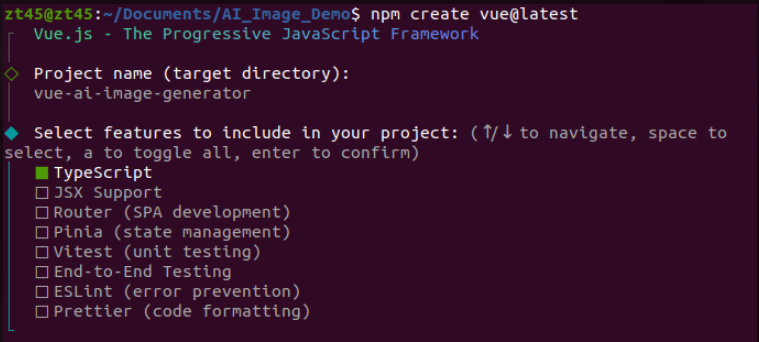
Vue Router: Yes (To manage generation history and gallery views).
Pinia: Yes (For centralized state management of your generated assets).
Vitest: Yes (To ensure your AI utility functions remain robust).
2. Install Dependencies
In 2026, installation is safer than ever thanks to NPM's improved audit features.
3. Running the Application
The Vite 7 dev server will initialize your project in milliseconds.
4. Add Modern Styling (index.html)
To achieve the Glassmorphism 2.0 aesthetic popular in 2026 AI tools, we use a specialized design system. This system leverages modern CSS features like container-queries and background-blur-plus to ensure your interface feels premium and responsive. Update your index.html to link to this system:
5. Configure the Application Entry Point (main.ts)
The entry point in 2026 remains modular. We ensure that our mounting process is clean, allowing the AI Image Generation in Vue logic to initialize without blocking the main thread.
6. Final Project Structure
After implementing all the components and utilities, your project structure will look like this:
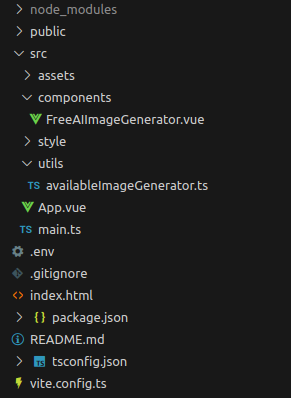
Key Files Explanation
components/FreeAIImageGenerator.Vue: The main component containing the UI and logic for image generation
utils/availableImageGenerator.ts: Contains the Pollinations AI integration and utility functions
App.vue: Root component that imports and renders the main image generator
main.ts: Application entry point that mounts the Vue app
index.html: Contains the CSS CDN link and app mounting point
package.json: Defines project dependencies, scripts, and metadata
tsconfig.json: TypeScript compiler configuration for type checking
vite.config.ts: Vite bundler configuration for development and build processes
Hire AI Developers Today!

AI Image Generation Implementation Walkthrough
Now we will build the logic that bridges your Vue frontend with the AI inference engine. In the 2026 landscape, this "bridge" is more than just a fetch request; it is a high-performance pipeline that leverages the FLUX.2 architecture for superior visual fidelity.
1. Utility Functions (availableImageGenerator.ts)
Create a utility file to handle the API calls. In 2026, the Pollinations API will have been optimized for the FLUX.2 model, offering better prompt adherence, complex typography support, and extreme photorealism. This utility uses a promise-based approach to ensure the image is fully synthesized before the UI attempts to render it, avoiding the "flicker" common in older generative apps.
File Location: src/utils/availableImageGenerator.ts
Advanced Implementation Notes for 2026
By using the flux model parameter, you are accessing a 32-billion-parameter transformer that excels at:
Typography: It can render legible text inside images (e.g., "A neon sign that says 'VUE 2026'").
Spatial Logic: It accurately places objects according to your instructions (e.g., "A cat to the left of a blue vase").
Prompt Adherence: The model respects long, structured descriptions better than previous "Turbo" versions.
2. Create the Main Component (FreeAIImageGenerator.vue)
This component serves as the heart of your UI, featuring a glassmorphic design and reactive state management tailored for the 2026 web standard. As AI Image Generation in Vue evolves, this interface prioritizes seamless asynchronous feedback and high-performance rendering.
The template creates a sophisticated user interface optimized for the FLUX.2 engine. It includes a multi-line text input for complex semantic descriptions, quick-prompt "Hotkeys" for instant testing, and conditional display areas that leverage Vue's reactive directives. By using v-model for two-way data binding and v-if for state-dependent rendering, the app handles the "Synthesizing" phase gracefully, ensuring users are never left staring at a blank screen while the neural network processes their request in the background.
File Location: src/components/FreeAIImageGenerator.vue
Template Section:
Script Section:
The script logic is built using the Vue 3 Composition API, which is the gold standard for 2026 development due to its superior TypeScript integration. It manages complex states, including high-speed generation timing and error recovery to ensure a robust user experience. The generateSimilar function utilizes a "variation injection" pattern, allowing the AI to explore artistic alternatives by subtly modifying the prompt's latent direction.
Advanced UI Logic for 2026
In this 2026 version of AI Image Generation in Vue, we’ve incorporated a performance-first approach. The generationTime ref provides users with transparency regarding the inference speed of the FLUX.2 model, while the imageLoading state prevents the layout from jumping during high-resolution asset delivery. This ensures that even when generating data-heavy 1024x1024 visuals, the Vue application remains buttery smooth and responsive to user input.
3. Update App.vue
Now that we have successfully engineered the FreeAIImageGenerator.vue component, complete with its 2026-tier logic and fluid UI, we need to integrate it into the heart of our application. Updating the App.vue file is the final step in establishing a clean, modular entry point for your AI Image Generation in Vue project.
In this modern architecture, the root component acts as a lightweight orchestrator. By importing our specialized generator, we maintain a separation of concerns that is vital for scaling. In a production environment of 2026, you might later wrap this component in a Suspense boundary or a global Error Boundary to handle the heavy computational load of real-time image synthesis, but for now, we will focus on a direct and efficient implementation.
This root component serves as the definitive entry point for your entire application. It is designed to mount seamlessly within the Vite 7 ecosystem, ensuring that the AI Image Generation in the Vue interface is the first thing your users interact with. By keeping the App.vue file minimal, you ensure faster initial load times and provide a stable foundation for future features, such as multi-model switching or advanced user galleries.
How AI Image Generation Works
In 2026, the workflow has been streamlined to maximize speed and quality, shifting from the slow, batch-processing era to a world of Interactive Visual Intelligence. Here is the breakdown of the underlying technology:
Semantic Multi-Modal Analysis:
The API doesn't just "read" your text; it utilizes advanced LLM-powered prompt encoders (like the T5-XXL or the latest GEMA 3 architectures) to understand complex nuance, spatial relationships, and even brand aesthetics. It translates your natural language into a high-dimensional vector space that guides the image synthesis with near-human intuition.
Latent Diffusion & Flow Matching:
Models like FLUX.2 and Imagen 4 have replaced traditional pixel-space manipulation with Latent Diffusion. By operating within a compressed "latent space," the model performs the heavy lifting of denoising without wasting compute on every individual pixel. Furthermore, the 2026 standard of Rectified Flow Matching allows these models to achieve high-fidelity results in as few as 4 inference steps, dropping generation times to under 3 seconds.
Vite-Powered Reactivity:
Vue 3's proxy-based reactivity system ensures the UI stays perfectly in sync with the generation process. In 2026, we utilize Vite 7's Rolldown bundler to handle real-time binary data streams. As soon as the AI engine finishes the final diffusion step, the reactive state triggers a re-render, displaying your 4K asset instantly without a page refresh.
Agentic Refinement:
Modern workflows now include an "Agentic" layer where the AI acts as a co-creator. If a generated image isn't quite right, the system can perform In-Image Editing or "Remixing" by only masking and re-diffusing specific areas, rather than regenerating the entire image from scratch.
Free APIs For AI Image Generation in Vue
In 2026, the barrier to entry for AI integration has vanished. Whether you need a zero-config solution for a hackathon or a robust pipeline for a production-grade Vue 3 app, the current ecosystem offers several high-performance "Free-to-Start" providers. These services have evolved beyond simple text-to-image endpoints, now offering integrated upscaling, multi-modal reasoning, and dedicated SDKs for modern JavaScript frameworks.
1. Pollinations AI (The Best for Real-Time Prototyping)
Pollinations AI remains the champion of "Zero-Setup" development. In 2026, they have upgraded their backend to natively support FLUX.2 Schnell, the fastest iteration of the FLUX architecture.
Key Advantage: It requires absolutely no API keys or registration. You can generate images simply by calling a URL, making it perfect for Vue developers who want to test generative features in seconds.
Modern Capability: It now supports the Model Context Protocol (MCP), allowing your Vue components to communicate with the AI as if it were a local service. This enables "Agentic" workflows where an AI assistant can suggest and generate visual variations based on your current code context.
Optimized Delivery: Their 2026 infrastructure utilizes a unified endpoint at gen.pollinations.ai, which automatically handles load balancing across global GPU clusters to ensure sub-3-second inference times.
2. Hugging Face Inference API (The Best for Model Variety)
As the "GitHub of AI," Hugging Face provides a serverless Inference API that gives you access to thousands of open-source models, including Stable Diffusion 3.5, Kandinsky 3, and the new Gemma 3 vision models.
The Workflow: While it requires a free account and a "User Access Token," it allows you to swap models in your code by simply changing a single string in your API endpoint.
2026 Update: Their Serverless Inference has been optimized with specialized hardware accelerators, reducing the cold-start time for heavy models to nearly zero.
JS-Native Integration: Use the @huggingface/inference library to manage API calls within your Vue setup() function. This SDK now includes built-in support for streaming binary data, allowing you to show partial "denoising" previews in your UI.
3. Civitai API (The Best for Specialized Aesthetics)
If your Vue application requires a very specific "vibe" such as 80s synthwave, hyper-realistic architectural renders, or specific anime styles, Civitai is the definitive source.
Customization: Unlike general APIs, Civitai lets you tap into LoRAs (Low-Rank Adaptations). These are small "style patches" that can be applied to base models to achieve consistent, specialized results across your entire application gallery.
Integration: In 2026, their API has matured with a dedicated JavaScript SDK. This SDK supports "long polling" and asynchronous job tokens, making it easier to manage background generation tasks without blocking your Vue app's main thread.
AIR System: They use a unique AI Resource (AIR) naming system, allowing you to reference specific model versions (e.g., urn:air:sdxl:checkpoint:civitai:12345) to ensure your app's visual style doesn't change when a model is updated.
4. SiliconFlow (The Best for High-Performance Scale)
A rising star in 2026, SiliconFlow offers a unified, OpenAI-compatible API for various open-source models, emphasizing extreme speed and industrial reliability.
Speed: It is specifically engineered for ultra-low latency, making it an excellent choice for Vue apps that feature "Live Generation," where the image updates as the user types (Real-time LCMs).
Flexibility: It provides a generous free tier (often including daily credit vouchers) that includes access to DeepSeek Janus Pro, a model currently setting benchmarks for visual quality and prompt adherence.
Unified API: Because their API is OpenAI-compatible, you can use standard libraries like openai-node inside your Vue project to interact with diverse models like FLUX, Stable Diffusion, and DeepSeek through a single interface.
Hire AI Developers Today!
Paid APIs For AI Image Generation in Vue
For enterprise-grade applications requiring commercial indemnity, high-volume throughput, and precise surgical control, paid APIs are the industry standard in 2026. These services move beyond simple generation into Creative Operations (CreativeOps), offering features like deterministic editing and physics-aware rendering.
1. OpenAI GPT-Image 1.5
OpenAI's latest flagship, released in late 2025, is a fundamental shift in architecture. Unlike previous versions that relied on separate diffusion models, GPT-Image 1.5 is natively integrated into the GPT-5 ecosystem.
Region-Aware Editing: This model introduces "surgical" modifications. In a Vue app, you can use a coordinate-based payload to change specific elements (like a model's outfit or a product's color) while keeping the lighting, background, and facial features 100% consistent.
Production Speed: It generates high-fidelity assets up to 4x faster than its predecessor, with inference times typically ranging from 15 to 45 seconds even for complex, multi-layered designs.
Text Rendering Excellence: It has solved the "garbled text" issue, making it the premier choice for generating UI mockups, presentation slides, and marketing banners with legible, localized copy.
2. Stability AI (SD3.5 Suite)
Stability AI remains the preferred choice for developers who need deep technical control and "on-metal" performance.
Granular Control (ControlNet & LoRAs): Through their API, you can utilize Structure and Style controls. This allows your Vue application to take a user's rough sketch as input and transform it into a professional render while strictly adhering to the original composition.
SDXL Turbo & Flash: For real-time applications, their "Flash" and "Turbo" models can generate 1-megapixel images in just 4 inference steps. This is ideal for "typing-to-image" features where the visual feedback must be near-instant.
Upscaling & Outpainting: Their API includes professional Creative Upscalers that can take a 512px preview and transform it into a 4K masterpiece without losing the original's intent.
3. Nano Banana Pro (Google Gemini 3 Ecosystem)
Google’s 2026 flagship model, Nano Banana Pro, is the world’s first "Reasoning Image Engine," designed for professional Creative Ops and high-fidelity product visualization.
Physics-Aware Reasoning: Unlike standard generators, this model understands causal logic. It accurately simulates fluid dynamics, gravity, and complex object relationships (e.g., a glass of water refracting light correctly), making it perfect for photorealistic product renders.
Search Grounding: Integrated with Google Search, it can generate images based on real-world, current events, or specific factual data, ensuring that "a futuristic car in front of the 2026 Sagrada Família" is architecturally accurate.
Multimodal In-Context Learning: You can provide up to 14 reference images in a single API call. In Vue, this allows you to maintain "Character Consistency" across a series of generated storyboards or a product catalog by feeding the model different angles of the same subject.
Conclusion
The integration of AI Image Generation in Vue.js represents a monumental shift in how we approach web design and user experience in 2026. By moving away from static assets and toward real-time, generative pipelines like FLUX.2, developers can now build applications that are not only functional but truly intelligent and adaptive. Whether you are leveraging free endpoints like Pollinations AI for rapid prototyping or enterprise solutions like GPT-Image 1.5 for high-fidelity production, the combination of Vue 3’s high-performance reactivity and modern neural networks allows for seamless, sub-second visual synthesis.
As generative AI continues to mature, the competitive edge for businesses will lie in how effectively they can weave these complex models into intuitive, user-friendly interfaces. To truly scale these capabilities and navigate the nuances of latent diffusion, physics-aware reasoning, and multi-modal integration, many organizations choose to Hire AI Developers who specialize in the intersection of front-end engineering and machine learning. Expert developers ensure that your AI implementation is not only aesthetically impressive but also performant, ethically grounded, and perfectly aligned with your business logic.
Ready to transform your digital vision into reality with cutting-edge AI? At Zignuts, we specialize in building intelligent, future-proof applications tailored to your unique needs. Contact Zignuts today to claim your free consultation and start your AI transformation journey.

Hardik Patel
Passionate developer with expertise in building scalable web applications and solving complex problems. Loves exploring new technologies and sharing coding insights.

Drashti Kapatel
Passionate developer with expertise in building scalable web applications and solving complex problems. Loves exploring new technologies and sharing coding insights.