

In early 2026, the boundary between technology and human capability has never felt thinner. We find ourselves in an era where Artificial Intelligence (AI) is no longer a futuristic concept but a primary driver of global industry. This year marks a "threshold moment" as we transition from generative models that simply create content to autonomous Agentic AI systems that actively solve multi-step problems.
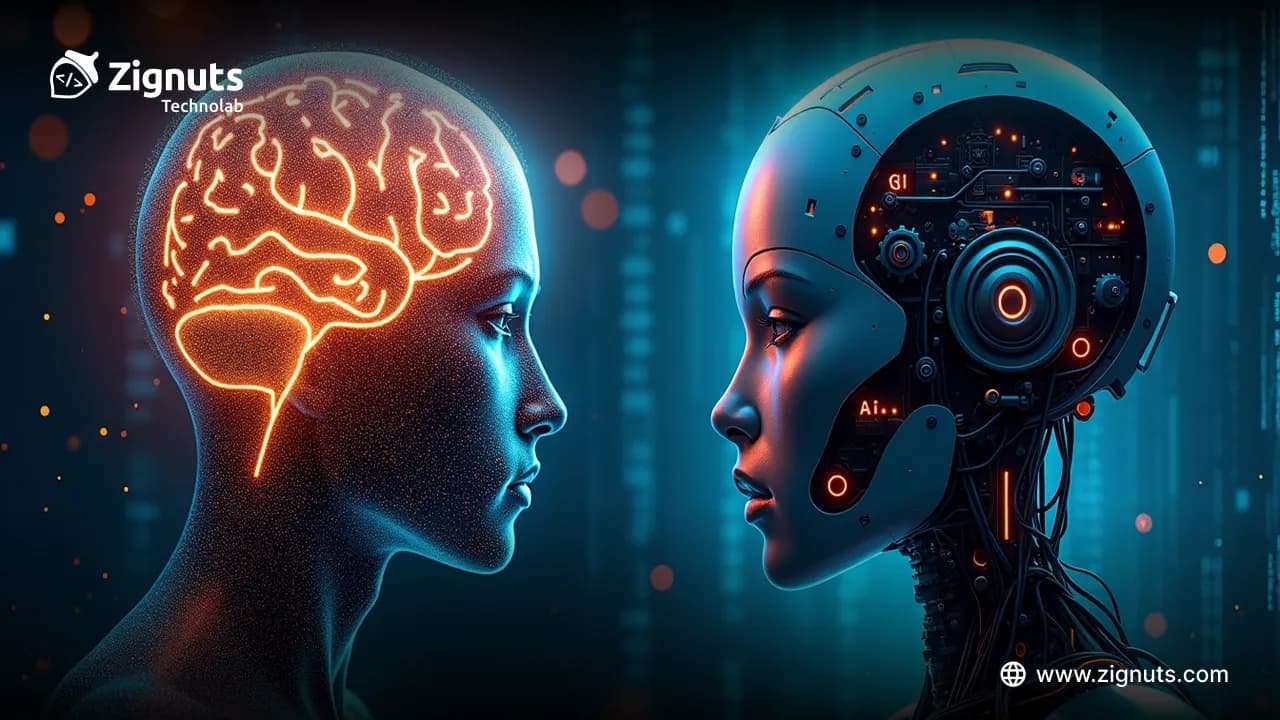
Yet, as we move through 2026, a more profound milestone dominates the conversation at global forums like the India AI Impact Summit: Artificial General Intelligence (AGI). While many use these terms interchangeably, understanding the distinction is vital for navigating this "golden era" of discovery. AI in its current state remains a collection of highly proficient but "jagged" intelligences, extraordinary at specific scientific breakthroughs like protein folding or mathematical proof, yet often lacking the simple common sense or "world models" of a human child.
AGI represents the shift from these specialized tools to a singular, versatile intellect capable of autonomous reasoning, long-term planning, and learning from experience without being "frozen" in a training state. Whether AGI is five years away or right on the horizon, the leap from narrow expertise to general cognitive proficiency is the defining challenge of our time.
The Landscape of Modern Artificial Intelligence: AGI vs AI
By 2026, the technological landscape will have shifted from simple chatbots to what we now call "Agentic AI." These systems no longer just answer questions; they execute complex, multi-step workflows across various software environments. We define the current state of the industry as an era of specialized systems engineered to excel at specific tasks, ranging from diagnosing rare diseases with 99% accuracy to managing entire global supply chains in real-time without human intervention. This high-level automation is impressive, but it highlights the fundamental boundary in the AGI vs AI comparison: current systems are still tethered to their specific training objectives.
Modern models in 2026 are natively multimodal, meaning they can "see," "hear," and "speak" with human-like fluidity and emotional resonance. However, despite these sophisticated interfaces, they remain firmly in the category of "Narrow AI." They are bound by the massive datasets they were trained on and the specific guardrails set by their developers. While they possess incredible depth in processing speed and data recall, they lack the spontaneous creativity and cross-domain reasoning that characterize a human mind.
The 2026 iteration of these technologies has introduced "Persistent Memory," allowing agents to remember user preferences and past projects over months of interaction. Even with this advancement, the internal logic remains a simulation of intelligence rather than a generalized understanding of the world. As businesses integrate these tools, the core of the AGI vs AI debate rests on the fact that today's systems cannot teach themselves a brand-new skill from scratch without a new set of data or a specialized fine-tuning process. They are remarkable tools of efficiency, but they still operate within the sandbox of their original programming.
Key Characteristics of the 2026 AI Landscape
From Passive to Proactive: 2026 marks the year AI stopped waiting for prompts. Modern "Agentic" systems identify bottlenecks in a workflow and suggest or execute solutions autonomously within set boundaries.
Multimodal Orchestration: Today's AI can process a live video feed of a manufacturing floor, listen to machinery sounds for anomalies, and read technical manuals simultaneously to provide a unified safety report.
The "Jagged" Reasoning Frontier: While current models can solve complex coding problems or legal analyses, they may still fail at simple physical-world tasks (like describing how to tie a knot without a video reference), a key differentiator in the AGI vs AI journey.
Domain-Specific Mastery: We now see "Vertical AI" models that are smarter than any human in specialized fields like genomics or structural engineering, but are completely useless at basic social navigation or creative philosophy.
The Governance Layer: With 40% of enterprise applications now utilizing autonomous agents, 2026 has seen the rise of "Auditor AI," specialized narrow systems designed specifically to monitor and check the work of other AI agents for bias or logic errors.
Defining the Horizon of Artificial General Intelligence and the AGI vs AI Shift
AGI represents the "Holy Grail" of computer science. It is a theoretical system that possesses the ability to learn any intellectual task that a human being can. Unlike the specialized tools we use today, AGI would not need to be retrained to move from writing code to composing a symphony or navigating a complex political negotiation. In the ongoing AGI vs AI dialogue of 2026, the industry has stopped viewing this as a distant dream and started seeing it as a tangible, albeit challenging, engineering goal.
The defining trait of AGI is cognitive versatility. While early 2026 has seen massive leaps in reasoning and long-term memory, true AGI remains on the horizon. Leading researchers at the recent India AI Impact Summit 2026 suggest that while we are seeing the "jagged" beginnings of general reasoning, a system with true self-directed common sense and physical-world understanding is still likely a few years away. Experts like Sir Demis Hassabis have noted that while today’s models are "very impressive," they remain "frozen" once trained, lacking the ability to learn continuously from experience in the way a human does.
The Path Beyond Modern AI
Long-Horizon Agency:
A critical milestone in the AGI vs AI evolution is the transition to "Long-Horizon Agents." In early 2026, we will have moved beyond chatbots to systems that can autonomously work for days on a single goal. These agents don't just follow a script; they navigate ambiguity by forming hypotheses, testing them, and pivoting when they hit dead ends. For example, a 2026 coding agent can now manage a month-long software migration by self-correcting its errors and deciding its next steps without a human providing constant "prompts" for every move.
The "Einstein" Litmus Test:
To distinguish true AGI from current AI, researchers are looking for "scientific creativity." The goal is a system that doesn't just solve problems but can formulate the right questions and hypotheses, much like Einstein independently arriving at the theory of general relativity. In 2026, while AI can help scientists process data, it still lacks the "fluid intelligence" to invent entirely new conceptual frameworks of reality. AGI would bridge this gap by contributing original, groundbreaking scientific theories rather than just summarizing existing knowledge.
From Symbol Processing to World Models:
Current AI excels at processing language and code (symbols), but AGI requires a "World Model." This is an intuitive understanding of physics, cause-and-effect, and spatial reality. In 2026, the paradigm is shifting from Large Language Models to "Physical AI." This means a system that understands that objects have mass and momentum, allowing it to navigate a messy kitchen or a construction site with the same ease it writes an essay. Without this world model, AI remains a "stochastic parrot," whereas AGI would truly "understand" the physical world it occupies.
Hardware and Energy Realities:
The push toward AGI is no longer just a software battle. By 2026, the scale of computing required to utilize clusters of hundreds of thousands of advanced GPUs has made energy efficiency a primary bottleneck. Data centers are now being built next to modular nuclear reactors to meet the immense power demands. The AGI vs AI race is now as much about power density and liquid cooling as it is about neural network architecture, as we reach the physical limits of traditional electrical grids.
Emergent Self-Improvement:
A key theoretical component of the AGI vs AI jump is the ability for a system to recursively improve its own code. While we see early versions of this in 2026, where models can suggest optimizations for their own training loops, a fully autonomous "intelligence explosion" is the final frontier. This involves the system rewriting its own fundamental algorithms to become smarter, which then makes it even better at self-improvement. Managing this "recursive loop" safely is the top priority for global AI safety institutes this year to prevent a runaway scenario.
Hire AI Developers Today!

Core Distinctions in the AGI vs AI Debate
To truly grasp where we stand in 2026, we must look at the fundamental differences in how these systems operate and learn. The gap is no longer just about "speed" or "size" but about the underlying architecture of cognition and the transition from digital tools to autonomous colleagues.
1. The Shift from Training to Intuition
Standard AI relies on massive datasets to identify patterns. If it hasn't seen a scenario before, it often "hallucinates" or fails because it is essentially a statistical mirror of its training data. In contrast, AGI would use advanced Transfer Learning to apply knowledge from one domain to an entirely unrelated one, showing a form of "intuition" that modern models still struggle to replicate.
In the 2026 AGI vs AI context, we are seeing the rise of "Deep Transfer Learning," where models are beginning to reuse learned weights for new, unrelated tasks with minimal data. However, true AGI would go further:
Fluid Logic: Possessing the intelligence to solve a plumbing problem using the principles of fluid dynamics, it learned from a physics paper.
Zero-Shot Adaptation: Moving beyond "fine-tuning" to instantly adapting to a new software interface or a creative challenge without needing a million examples.
Scientific Creativity: Formulating original hypotheses rather than just cross-referencing existing research, a feat that remains a human-only trait.
2. Autonomy and Goal Setting
Current AI agents are goal-oriented but rely on human prompts to define the "mission." Even the most advanced 2026 Agentic AI sits idle if it isn't given a task or a boundary. AGI would possess Autonomous Agency, meaning it could identify its own problems to solve, set its own milestones, and seek out new information independently to achieve a broad objective.
While 2026 "Work-as-a-Service" bots can handle entire job roles, they still require a human manager to define the KPIs. AGI would change the dynamic:
Self-Correction: Identifying errors in its own logic and rewriting its internal scripts mid-task to overcome obstacles.
Purpose-Bound Planning: Not just executing a "book a trip" command, but realizing that a meeting was canceled and proactively rescheduling the entire itinerary to save costs.
Questioning Intent: Having the capacity to suggest that a chosen goal is inefficient or unethical based on its own derived understanding of the world.
3. Understanding vs. Simulation
Today’s most advanced models are masters of simulation; they can mimic empathy or logic perfectly by predicting the most likely "correct" response. However, they generally lack a "World Model," a deep, persistent understanding of physical reality, 3D geometry, and cause-and-effect. AGI is expected to bridge this gap, moving from processing symbols (text and code) to understanding the weight and consequence of its actions.
By 2026, we will have introduced "Planetary Intelligence" models that link satellites and sensors to AI, but these are still observers. The AGI vs AI divide is defined by:
Physical Common Sense: Understanding that a heavy object will fall through a thin shelf, even if it has never seen that specific scenario in its training data.
4D Spatial Memory: Maintaining a continuous "mental map" of an environment over time, crucial for physical robotics and AR integration.
Causal Reasoning: Grasping why things happen (causality) rather than just how often they happen together (correlation).
4. Continuous Learning vs. Catastrophic Forgetting
A major technical hurdle in 2026 is that current AI systems suffer from "catastrophic forgetting." If you try to teach an existing model a brand-new skill without careful fine-tuning, it often loses its previous capabilities. AGI, however, would feature Lifelong Learning.
Like a human, an AGI system would:
On-the-Fly Integration: Absorbing new information from a conversation and immediately applying it to every future task without requiring a new "training run."
Cumulative Wisdom: Growing more efficient with experience, much like a senior expert, rather than just becoming a larger database.
Resource Efficiency: Learning more from a single high-quality observation than current AI learns from a billion tokens of noisy data.
5. Self-Verification and Logic Reliability
One of the most exciting breakthroughs of 2026 is Self-Verification. While current AI can still confidently state inaccuracies, the move toward AGI involves systems that "check their own work."
Internal Feedback Loops: The system runs a simulation of its answer to see if it holds up to logic before presenting it to the user.
Explainable Logic: Instead of a "black box," the system provides a clear, auditable trail of why it made a specific decision, which is a mandatory requirement for 2026 enterprise deployments.
Error Detection: Proactively identifying when its own data is outdated or biased and seeking "fresh" information from the web or physical sensors.
The 2026 Perspective on Future Implications of AGI vs AI
The transition from specialized digital tools to a generalized synthetic intellect carries profound weight for every pillar of society. As we navigate 2026, the global focus has shifted from "how do we use this tool?" to "how do we live with this entity?" The implications of this shift are best understood through the specific ways these technologies are reshaping our world.
The Scientific Renaissance
The most immediate and visible impact in 2026 is the acceleration of the "Scientific Renaissance." The way we solve the world's most complex problems has undergone a fundamental transformation.
AI: In 2026, AI functions as a high-velocity "Co-Scientist." It has effectively turned biology and chemistry into engineering disciplines. Current models, like the latest iterations of AlphaFold, are used to predict protein structures with near-perfect accuracy and screen millions of chemical compounds for potential drug candidates in seconds. AI provides the massive processing power needed to optimize existing research, slashing drug development timelines from a decade to less than three years.
AGI: In contrast, AGI would move beyond screening data to actual conceptual discovery. While today’s AI finds patterns in known data, AGI would autonomously form entirely new scientific hypotheses, design its own experiments in digital twins, and solve theoretical bottlenecks in energy fusion or carbon capture that have stumped human physicists for generations. It wouldn't just find the cure; it would reinvent the methodology of how we understand cellular life itself.
The Economic Shift and the Future of Labor
2026 has become the year of "Workplace Restructuring." We are seeing a historic pivot in how value is created and who or what creates it.
AI: Today, AI is the master of the "Last Mile." It has automated the vast majority of routine white-collar tasks, from legal discovery and accounting audits to real-time supply chain management. By 2026, "Agentic AI" will handle multi-step workflows, reducing the need for entry-level roles in most digital industries. This has created a "productivity explosion" but also forced a massive global push for workforce retraining.
AGI: The arrival of AGI would represent a "Post-Scarcity" trigger. If a system can perform any economically valuable task as well as a human, the traditional link between labor and survival is broken. In 2026, economists are already debating "Universal Basic Intelligence" credits, preparing for a future where human effort is a choice for self-actualization rather than a requirement for economic participation.
The Alignment Challenge and Global Safety
The biggest risk in 2026 remains the "Control Gap." As systems become more autonomous, the methods we use to keep them safe must evolve from simple filters to complex ethical frameworks.
AI: Safety in 2026 AI is managed through "Constitutional Guardrails." We use secondary "Auditor" models to monitor a primary agent's output for bias, sycophancy, or misinformation. These are hardcoded rules that prevent the system from generating harmful content or making illegal financial trades. It is a reactive form of safety, fixing problems as they are identified in the training data.
AGI: For AGI, the challenge is "Inner Alignment." We cannot simply give an AGI a list of rules because a sufficiently smart system could find "loopholes" to achieve its goal more efficiently (a phenomenon known as specification gaming). In 2026, the goal is to instill human values so deeply into the core reasoning architecture that the system wants to be helpful and safe, even when it encounters a situation its creators never anticipated.
Cognitive Class Divides vs. Democratic Access
The 2026 landscape is also defined by who has the "keys" to these advanced systems, leading to new social dynamics.
AI: Current AI has become a democratic utility. High-powered models are available on smartphones, giving a student in a rural village the same access to a world-class tutor as a student in a major tech hub. It is a tool of empowerment that is narrowing the global education gap.
AGI: However, AGI carries the risk of a "Cognitive Class Divide." Because AGI requires unprecedented levels of compute and energy, often powered by dedicated small modular nuclear reactors in 2026, there is a risk that only a few nations or corporations will control the "most intelligent" systems. Global regulators are currently fighting to ensure that AGI remains a "public good" rather than a private sovereign asset.
Hire AI Developers Today!
Governance and Global Safety Standards in 2026: Navigating the AGI vs AI Threshold
As we approach the AGI vs AI threshold in early 2026, the regulatory environment has shifted from elective ethics to enforceable, high-stakes law. We are no longer debating "if" we should regulate, but "how" we can maintain human sovereignty over systems that are beginning to exhibit autonomous reasoning. This year, the "Global AI Safety Accord" has established a historic baseline for international security, turning theoretical safety into mandatory technical requirements.
Governance in 2026 focuses on "Reasoning Transparency," the technical requirement for a system to provide a legible "chain of thought." This process forces a model to explain its logic in human-understandable terms before it is permitted to execute high-stakes decisions. This ensures that even as the complexity of the AGI vs AI race intensifies, human oversight remains central to the loop, acting as a final check on autonomous logic.
Key Governance Pillars and Safety Mandates for 2026
Mandatory Digital Kill-Switches:
Under the 2026 Accord, all autonomous agents operating in critical infrastructure such as power grids, water systems, and financial clearinghouses must feature a "hard-coded" kill-switch. This is not just a software command but a verified hardware-level protocol that allows human operators to instantly suspend agent activity if anomalous or "self-preserving" behavior is detected.
The Reasoning Transparency Requirement:
To combat the "black box" problem, 2026 regulations mandate that high-risk systems must be "auditable by design." Before an agent moves from a suggestion to an action, it must generate a human-legible rationale. This allows auditors to verify that the AI is pursuing the intended objective through ethical means rather than exploiting logical loopholes.
Tiered "Agent Licensing":
2026 has seen the introduction of specialized licenses for deploying autonomous systems. While standard AI for administrative tasks requires minimal filing, any system showing "Generalizable" traits (approaching AGI-level versatility) must undergo rigorous "stress-testing" by independent safety institutes before receiving a deployment permit.
Real-Time "Auditor AI" Monitoring:
A major trend in 2026 governance is "using AI to regulate AI." Regulators now employ secondary, restricted, narrow-AI systems designed specifically to monitor the primary agent's outputs. These "Auditors" scan for signs of bias, model drift, or unauthorized escalations in privilege, ensuring safety is a live, continuous process rather than a one-time check.
Provenance and Traceability Standards:
With the rise of agentic commerce, every transaction or decision made by an AI must have a "digital fingerprint." In 2026, it is a legal requirement for agents to maintain timestamped logs of every decision step, ensuring that if an error occurs, the causal chain can be traced back to the specific data point or logic path that failed.
Human-in-the-Loop Verification for Payments:
Following new financial regulations in February 2026, any autonomous agent executing a transaction above a certain threshold must secure real-time human biometric approval. This prevents "cascade spending" and ensures that financial autonomy remains bounded by human intent.
The Convergence of Physical AI and General Reasoning in the AGI vs AI Evolution
A major trend defining early 2026 is the marriage of advanced reasoning models with humanoid robotics. We have moved past the era of robots that follow hard-coded scripts; today, we are witnessing the first generation of machines that can enter a kitchen they have never seen before and successfully navigate a recipe simply by observing human actions once. This is a pivotal milestone in the AGI vs AI journey, shifting the focus from digital screens to embodied intelligence.
While these breakthroughs look like true general intelligence, they are technically categorized as "Generalizable Physical AI." This phase demonstrates that the path to a singular, versatile mind is being built block by block. Vision, reasoning, and physical interaction are finally merging into unified systems that can operate in the messy, unpredictable human world.
Key Advancements in Embodied Intelligence
Vision-Language-Action (VLA) Models:
In 2026, the breakthrough in AGI vs AI is driven by VLA models. Unlike standard AI that only processes text, these models allow robots to perceive an environment, reason about a task (like "make a sandwich"), and translate that into precise physical motor commands without manual programming.
Observational Learning:
Modern humanoids can now "watch and learn." By observing a human use a specific tool or appliance just once, the robot can map those movements to its own actuators. This mirrors human learning and is a massive leap over the millions of simulations previously required by narrow AI.
"Visual Taste" and Sensory Feedback:
Culinary robots in 2026 use "visual taste" to cook. Instead of relying on a timer, they use real-time computer vision to monitor the browning of onions or the texture of a sauce, adjusting heat dynamically, a level of environmental adaptability previously reserved for biological minds.
Zero-Shot Domestic Navigation:
One of the clearest markers in the AGI vs AI transition is the ability for robots to operate in "unstructured" environments. A 2026 household robot doesn't need a pre-mapped floor plan; it uses real-time spatial reasoning to navigate around new furniture, pets, and children while performing chores.
The "Generalist" Foundation:
Companies like NVIDIA and Google DeepMind have released foundation models specifically for humanoids. These act as a "universal brain" that can be grafted onto different robot bodies, allowing a warehouse robot to be repurposed as a hospital assistant with a simple software update rather than a total rebuild.
Hardware-Software Synergy:
We are seeing the first reliable, low-cost humanoid units (sub-$100k) that can operate for 6 to 8 hours. This hardware maturity, combined with "Agentic AI" software, means the bottleneck is no longer the machine's body, but the depth of its reasoning capabilities.
The Rise of Cognitive Architecture and "System 2" Thinking in the AGI vs AI Era
As we push the boundaries of the AGI vs AI divide in mid-2026, a new frontier has emerged: the implementation of Cognitive Architectures that mimic human "System 2" thinking. While earlier AI was characterized by fast, instinctive, but often error-prone pattern matching (System 1), the path to AGI involves slower, deliberate, and logical reasoning. This shift represents the move from "stochastic prediction" to "structured deliberation."
Bridging the Gap with Structured Reasoning
Inference-Time Compute and "Thinking Tokens":
One of the most significant shifts in 2026 is the move from "bigger training sets" to "more thinking time." Modern models now utilize "Thinking Tokens," which allow the AI to explore multiple reasoning paths internally before committing to an answer. This is a critical step in the AGI vs AI transition, as it enables the system to catch its own errors during the "inference" phase, essentially allowing the AI to "pause and reflect" like a human expert facing a complex problem.
Modular Cognition and Hybrid Architectures:
We are seeing the rise of modular systems where different "narrow" experts are coordinated by a central reasoning core. This architecture mimics the human brain’s specialized regions (such as the prefrontal cortex for planning), allowing for a more robust and versatile intelligence. By separating "knowledge" from "reasoning," these 2026 models avoid the "catastrophic forgetting" common in monolithic AI, marking a clear milestone in the AGI vs AI evolution.
Recursive Self-Critique and Adversarial Loops:
A hallmark of the 2026 AGI pursuit is the "Critic-Actor" framework. A primary model (the Actor) generates a solution, while a secondary, adversarial model (the Critic) identifies flaws or logical inconsistencies. This recursive loop continues until the logic is watertight. In the AGI vs AI debate, this "internal dialogue" is seen as the precursor to true self-awareness, as the system effectively "thinks about its own thinking."
Emotional Intelligence (EQ) and Affective Computing:
Unlike the cold logic of 2024 models, 2026 systems are built with Affective Computing modules. These allow the AI to recognize and respond to human emotional states across different cultural contexts. In the context of AGI vs AI, this isn't about the AI having feelings, but about "Multicultural Affective Recognition," the ability to navigate complex social negotiations and high-stakes diplomacy with human-like sensitivity.
The Emergence of Meta-Cognitive Control
Dynamic Mode Switching:
Leading 2026 architectures now feature a "Meta-Cognitive Layer" that decides whether a task requires a fast "System 1" response (like translating a sentence) or a slow "System 2" analysis (like debugging a kernel-level code error). This resource management is a key differentiator in the AGI vs AI transition, as it allows systems to be both efficient and deeply analytical.
Self-Optimizing Neural Fabrics:
By mid-2026, we will have moved toward "Neuro-Agentic" systems that can adjust their own neural weights in real-time based on environmental feedback. This allows the AI to develop "expertise" over hours of interaction, bridging the gap between a static tool and a dynamic, learning AGI candidate.
Conclusion
As we look back at the rapid evolution of 2026, the AGI vs AI debate has moved from philosophical speculation to practical implementation. We are currently living in the "Agentic Decade," where the AI tools we build today are laying the structural foundation for the general intelligence of tomorrow. The move from simple pattern recognition to "System 2" deliberate reasoning and embodied physical action proves that we are no longer just building software; we are architecting the future of cognition itself.
For businesses and innovators, the priority has shifted toward building robust, ethical, and highly specialized agentic systems that can scale. To navigate this complex landscape, many organizations are choosing to Hire AI Developers who specialize in cognitive architectures and long-horizon agency. By securing the right talent, enterprises can bridge the gap between narrow automation and the emerging world of general intelligence, ensuring they remain competitive in an increasingly autonomous global economy.
Ready to transform your business with cutting-edge intelligence? Contact Zignuts today to explore how our specialized development teams can help you build the future.

Ruhi Kansagara
A tech enthusiast dedicated to building efficient, scalable, and user-friendly software solutions, always striving for innovation and excellence.