


.svg)

.svg)


.svg)

.svg)


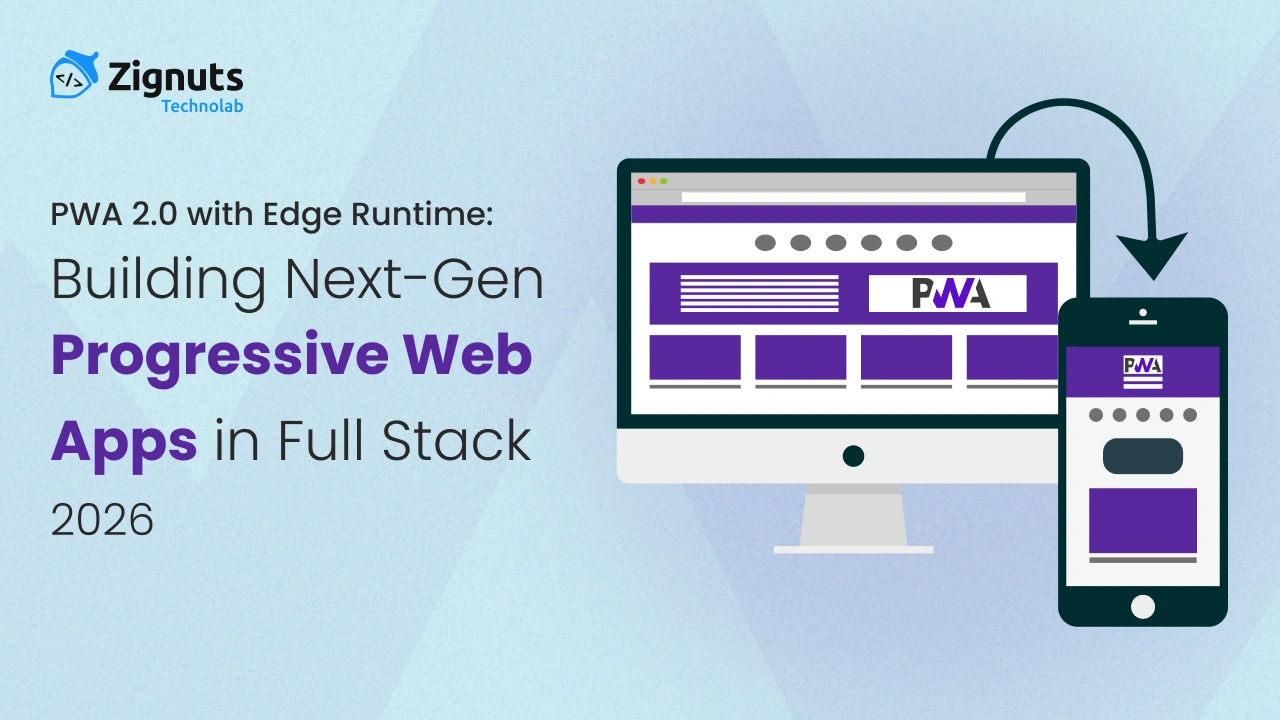
The digital landscape has shifted fundamentally. By 2026, the standard for excellence is no longer just having a functional site; it is about delivering an experience that is indistinguishable from a high-end native application. Users now demand fluid interactions, instant loading regardless of their global location, and the ability to remain productive even when their connection drops. This shift is driven by a "Local-First" movement where data stays close to the user, and computing power is distributed rather than centralized.
This is the era of the PWA 2.0 and Edge Runtime ecosystem. This combination represents a revolutionary change in how we architect the web, moving away from heavy, legacy servers toward a distributed, intelligent, and highly resilient framework. We are seeing the rise of "Edge-Native" applications software designed from the ground up to execute logic at the network's perimeter, milliseconds away from the end user.
In 2026, PWA 2.0 is defined by its deep integration with modern browser APIs like WebGPU for high-performance graphics and AI, and the Origin Private File System (OPFS) for desktop-class storage. When paired with Edge Runtime, these applications gain the ability to stream server-rendered content globally with near-zero latency. It is a full-stack evolution that eliminates the traditional trade-offs between the reach of the web and the power of native software. Companies adopting this stack are not just building websites; they are deploying global, ultra-fast digital products that redefine user engagement.
What Problem Does Progressive Web Apps 2.0 Solve?
In 2026, modern users have zero patience for friction. They expect:
- Interfaces that react at the speed of thought: Near-instant interaction (TTI) even on complex pages. In an era of 120Hz mobile displays, any delay in UI response is immediately jarring. PWA 2.0 ensures that transitions are as fluid as a local system menu, maintaining a "60fps" feel during heavy data operations.
- Full functionality during transit: Reliable performance in "dead zones" like elevators or rural areas. Users no longer accept a "No Internet" screen; they expect to continue their workflows seamlessly, with data automatically synchronizing the moment a 5G or satellite link is restored.
- Immediate access: Skipping the 50MB+ download and the "App Store Tax" of time and storage. By 2026, storage management is a chore users want to avoid. PWA 2.0 allows instant usage via a URL while being 90% smaller than traditional native binaries.
- Highly localized security: Leveraging biometric login (FaceID/Fingerprint) directly in the browser via WebAuthn. This eliminates the "forgot password" cycle, allowing users to authenticate with hardware-level security that remains private to their device.
Despite these expectations, legacy web applications often fail due to:
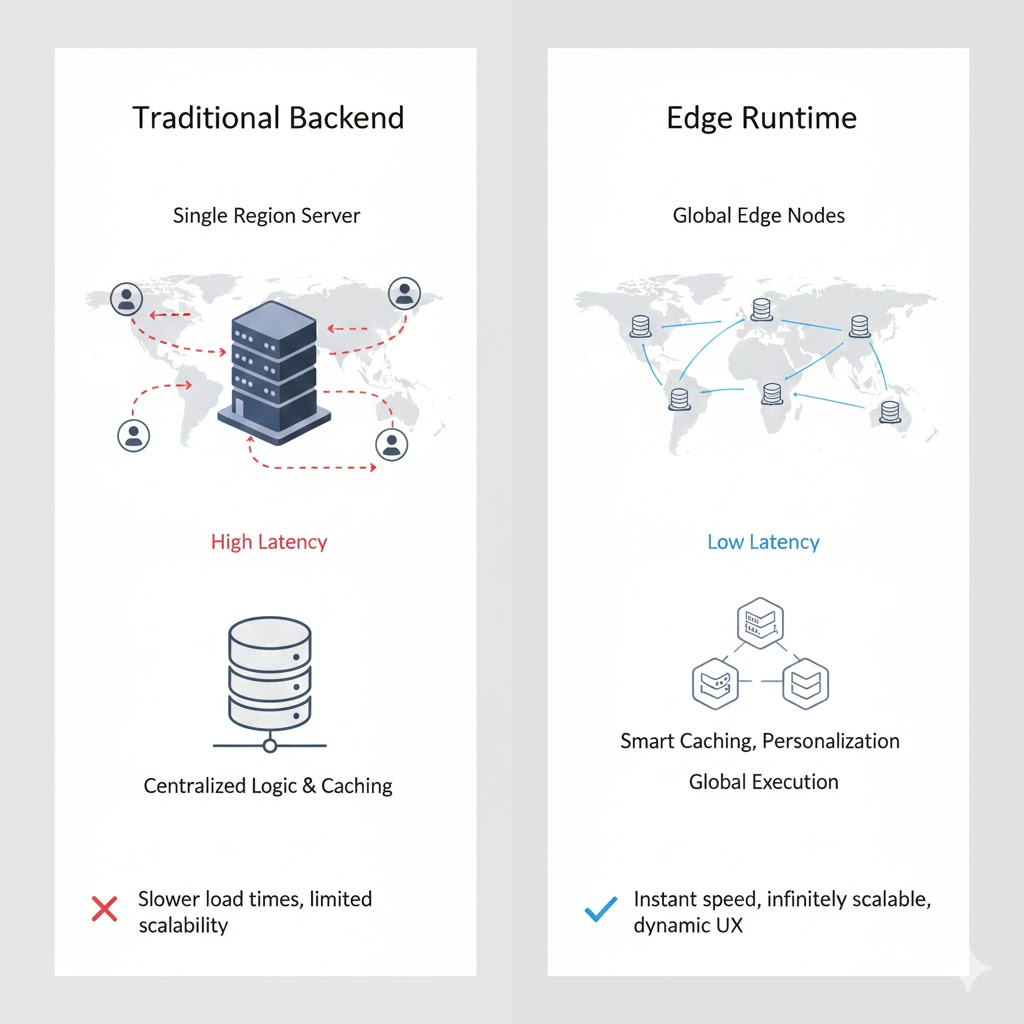
- Latency spikes: Data traveling thousands of miles to a central "origin" server creates a noticeable lag. Even with high-speed internet, the speed of light limits how fast a signal can cross the globe, making centralized apps feel sluggish for international users.
- Bloated codebases: Large JavaScript bundles that choke mid-range devices. Traditional apps often force the browser to download and parse megabytes of code before the user can see a single button, leading to high abandonment rates.
- Brittle offline modes: Basic caching that fails when the user tries to perform a complex action (like a checkout) without a signal. Standard PWAs often "broke" when a user went beyond simple page viewing; PWA 2.0 uses background sync to make complex transactions resilient.
- Over-reliance on "all-or-nothing" responses: If the server is slow, the whole screen stays blank. Legacy apps wait for the entire data packet to arrive before rendering, whereas modern users expect "Skeleton Screens" and incremental content loading.
The PWA 2.0 Solution
The PWA 2.0 framework addresses these pain points by merging advanced browser capabilities with Edge Runtimes. By shifting the "brain" of the application from a distant data center to a global network of "Edge" nodes, we effectively move the server to the user's neighborhood.
Strategic Benefits for Clients
- Fluid User Journeys: By reducing global response times to 10-20ms, the web feels as snappy as a local file. This speed directly correlates to higher conversion rates, as users are significantly more likely to complete a purchase when every click is instantaneous.
- Intelligent Reach: Reach users on any device (iOS, Android, Windows, Linux) with a single codebase, reducing development costs by up to 60%. This "write once, run everywhere" approach ensures brand consistency without the nightmare of managing three separate development pipelines.
- Always-On Availability: PWA 2.0 uses Predictive Prefetching AI-driven logic at the edge that anticipates what a user needs and caches it before they even click. If a user is browsing a product category, the app intelligently prepares the most likely product pages in the background.
- Native Quality, Web Budget: Deliver a premium experience, including splash screens, push notifications, and home-screen icons without the overhead of maintaining multi-platform native teams or paying 30% commissions to app stores.
Empowering the Developer
- Standards-Based Workflow: Use the Web APIs you already know (Fetch, Streams, Web Crypto) without the heavy legacy of Node.js. This simplifies the tech stack, allowing developers to write high-performance logic that runs identically in the browser and on the server.
- Streaming SSR: Send the "shell" of the page instantly from the Edge while the data streams in behind it, eliminating the "white screen of death." This improves Core Web Vitals (specifically LCP) by showing meaningful content within the first few hundred milliseconds.
- Zero-Maintenance Global Scaling: Your code is automatically replicated across hundreds of global PoPs (Points of Presence) without configuring complex clusters. Developers no longer need to worry about "load balancing" across regions; the Edge Runtime handles it natively.
- Secure Execution: Code runs in V8-based isolated sandboxes at the Edge, naturally mitigating many traditional server-side attack vectors like SQL injection or cross-site scripting (XSS) at the infrastructure level.
What Exactly Is a Progressive Web Apps 2.0?
A standard application in this category is built on the pillars of installability and background resilience. However, the 2.0 evolution takes this further by integrating new 2026 browser APIs and hybrid rendering techniques that bridge the final gap between web and hardware.
PWA 2.0 = Modern Web Capabilities + Global Edge Intelligence + Local-First Data
It is no longer just a frontend trick or a mobile-friendly skin. It is a full-stack philosophy where the server logic is as mobile and agile as the client code. In 2026, the definition of a PWA has expanded from "installable websites" to autonomous digital entities that leverage the following:
The Convergence of Edge and Client
Traditional apps rely on a "Request-Response" cycle that often leaves users staring at a spinner. PWA 2.0 uses Hybrid Rendering, where the Edge Runtime generates the initial view in under 50ms, while the Service Worker simultaneously prepares the offline UI. This dual-layer approach ensures that the application is interactive before the user even finishes their first gesture.
Hardware-Level Integration
By 2026, browsers will have unlocked the full potential of the device. PWA 2.0 applications now utilize:
- WebGPU: For console-quality graphics and local AI model execution (LLMs) directly in the browser without server costs.
- WebHID & WebUSB: Connecting seamlessly to specialized hardware like barcode scanners, thermal printers, or industrial controllers.
- Advanced Biometrics: Moving beyond simple logins to secure, encrypted transactions using hardware-backed keys via the WebAuthn L3 standard.
Local-First Persistence
The "2.0" version moves away from transient caching to Durable Storage. Using the Origin Private File System (OPFS), these applications can manage gigabytes of data with the speed of a native disk. This allows for professional-grade tools such as video editors, complex IDEs, and massive CRM databases to run entirely within the PWA framework, syncing with the Edge only when necessary.
Beyond the Mobile Screen
PWA 2.0 is platform-agnostic. The same codebase that lives on an iPhone also powers the desktop experience on Windows 11 and macOS, complete with Window Controls Overlay (for custom title bars) and File Handling APIs that allow the web app to open specific file types directly from the user's desktop. It is a unified ecosystem that follows the user across every device they own.
Ready to build your next website or web app? Start your project with Zignuts' expert web developers.
**Hire now**Hire Now**Hire Now**Hire now**Hire now

What Is an Edge Runtime (Explained Simply)?
For Clients
Imagine if every time you needed a glass of water, you had to wait for it to be piped from a single reservoir thousands of miles away. That is a traditional server; if you are in London and the server is in New York, every "sip" of data takes time to cross the ocean.
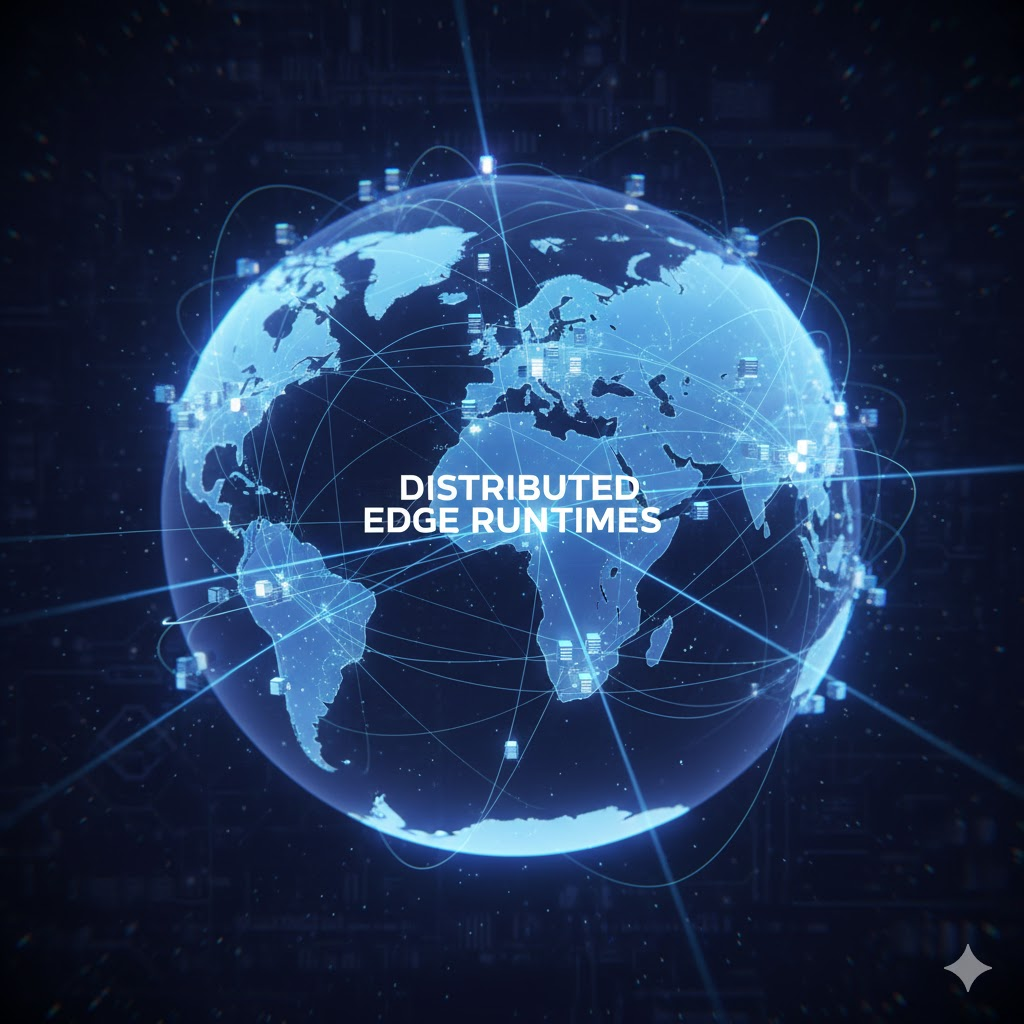
An Edge Runtime is like having a high-tech filtration system in every neighborhood. By 2026, these runtimes will be distributed across over 300 global cities. Because the "logic" of your app happens at a location physically near you, the application responds instantly. Whether you are in a crowded city or a remote area, the app feels like it is running locally on your device because the distance the data travels is reduced from thousands of miles to just a few dozen.
For Developers
Edge runtimes are lightweight execution environments that use Web Standard APIs rather than the heavy, legacy Node.js overhead. In 2026, this architectural shift is powered by V8 Isolates, tiny, secure sandboxes that are 1000x more memory-efficient than traditional containers.
This means:
- No File System Friction: Operations are purely request-based and incredibly lean. By removing the ability to write to a local disk, the runtime avoids the "bloat" and slow startup times associated with traditional backend servers.
- Lightning Execution: Logic starts in under 1ms to 10ms. Traditional serverless functions often suffer from "cold starts," where the code takes seconds to wake up; Edge runtimes are always ready.
- Security by Design: Code runs in isolated sandboxes. Since the runtime lacks access to the underlying operating system or direct file system, it creates a "bulletproof" environment that naturally prevents cross-tenant leaks and common server-side exploits.
- Global Scaling: Your code is not "hosted" in one place. When you deploy, your logic is automatically replicated to hundreds of Points of Presence (PoPs) simultaneously. There is no need for manual load balancing or regional clusters.
- Universal Portability: Because it uses standards like fetch(), Web Streams, and Web Crypto, the code you write for the Edge in 2026 works identically in the user's browser, making "Full-Stack" development truly seamless.
Popular 2026 Implementations:
- Vercel Global Edge: Deeply integrated with Next.js, offering sub-millisecond cold starts and advanced streaming SSR.
- Cloudflare Workers (Advanced Edition): The most extensive global footprint, reaching 95% of the world's population within 50ms, now with native support for SQL databases at the edge.
- Netlify Compute Nodes: Focused on "Composable" architecture, allowing developers to chain edge functions with built-in form handling and identity services.
The Progressive Web Apps 2.0 Architecture
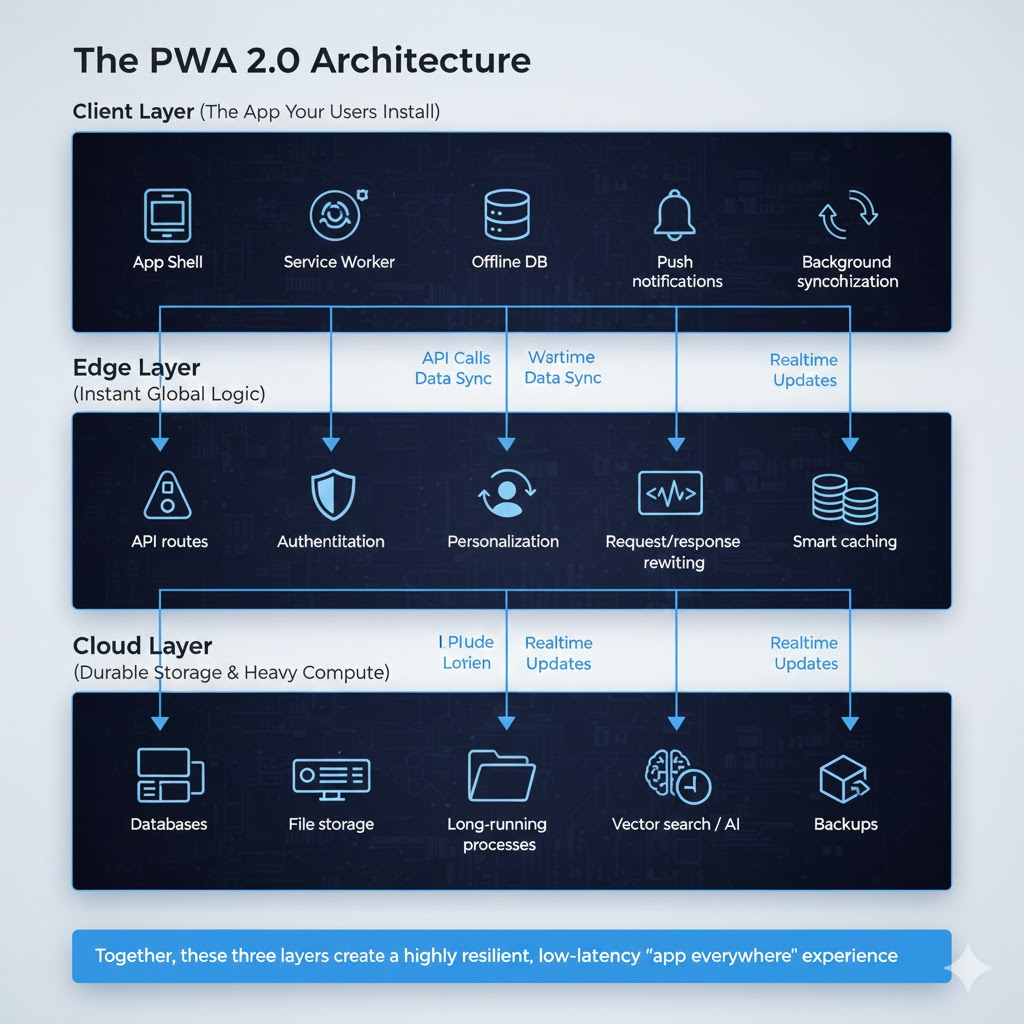
The architecture of a 2026 application is no longer a simple "Client-Server" relationship. It is a sophisticated, three-tier ecosystem designed for resilience, speed, and global intelligence.
Client Layer: The Interaction Hub
This is the part that the user feels is the immediate interface that lives on their device. In PWA 2.0, the client layer does much more than just render HTML; it acts as a local powerhouse.
- App Shell & Service Workers: The Service Worker acts as a programmable network proxy, intercepting requests to serve cached content instantly, even before a network check occurs.
- Origin Private File System (OPFS): Unlike old-school storage, OPFS provides a high-performance, sandboxed file system. It allows the app to perform byte-by-byte file manipulation and high-speed in-place writes, making it possible to run desktop-class software (like video editors or large-scale CRMs) entirely in the browser.
- Background Synchronization: This layer ensures that if a user submits a form while in a subway tunnel, the data is "queued" and sent automatically the second the device detects a signal, ensuring zero data loss.
Edge Layer: The Intelligence Router
Sitting between the user and the central cloud, the Edge Layer is the "brain" distributed across hundreds of global locations. It handles the logic that is used to make apps feel slow.
- Global Authentication: By verifying JWTs or session tokens at the Edge, users are authenticated in under 10ms, regardless of where the main database is located.
- Dynamic Personalization: The Edge can rewrite the incoming HTML on the fly. For example, a user in Tokyo sees Japanese content and local currency, while a user in London sees British English, all served from the nearest local node without touching the central server.
- Streaming SSR: Instead of waiting for a full page to generate, the Edge "streams" the header and critical CSS to the browser immediately, followed by the rest of the data as it becomes available. This virtually eliminates the "white screen" loading phase.
Cloud Layer: The Persistent Core
The deep backend remains the foundation for durable storage and heavy-duty processing. In 2026, the Cloud Layer is reserved for tasks that require massive scale or long-term memory.
- Durable Data & Global Sync: While the Edge handles quick reads, the Cloud Layer ensures that data is backed up, ACID-compliant, and synchronized across every global region.
- Heavy Compute & AI Training: This is where the heavy lifting happens, processing massive datasets, training AI models, and running complex vector searches that are too resource-intensive for the Edge.
- Archival & Backups: The Cloud acts as the "Source of Truth," keeping your historical data secure with multiple layers of redundancy and quantum-resistant encryption.
Why Progressive Web Apps Matter for Businesses in 2026
Native Performance Without the Walls
With edge response times hitting 10 to 20ms, the perceived "lag" of the web is gone. Your software feels like a part of the operating system. In 2026, user patience is measured in milliseconds; research shows that applications loading in under 2 seconds see 50% lower bounce rates than traditional mobile sites. By executing logic at the edge, you eliminate the "white screen" effect, delivering a 4x faster perceived load speed that keeps users focused on your product rather than the loading spinner.
Absolute Reliability for Progressive Web Apps
Thanks to advanced caching and background synchronization, users can complete a checkout, update a task, or edit a document while in an elevator, on a plane, or in a deep-subway tunnel. The sync happens silently in the background, the moment a connection is restored. This "connectivity independence" ensures that your business never misses a transaction due to a poor signal. For retail and service industries, this reliability translates to an average 36% increase in conversion rates by capturing intent the moment it happens, regardless of the network environment.
Zero-Friction Acquisition
The biggest hurdle to mobile growth is the "Download" button. PWA 2.0 removes this barrier entirely. A user clicks a link, and they are instantly inside your full-featured application. One more tap, and your icon is on their home screen. This frictionless onboarding is why global brands are seeing a 20% to 50% boost in monthly active users. You no longer have to pay the "App Store Tax" of time, storage space, or the 15–30% commission on digital sales, allowing you to retain more profit while reaching a wider audience.
Dramatic Cost Efficiency
Building once for Web, iOS, Android, and Desktop with a single codebase reduces initial development costs by 40% to 70%. Maintenance becomes a streamlined process: instead of managing three separate update cycles and waiting for app store approvals, you deploy updates once to the edge. This agility allows your business to iterate on features in weeks rather than months, keeping you ahead of competitors who are still stuck in legacy native development silos.
Enhanced SEO and Discoverability
Unlike native apps that live in the "walled gardens" of app stores, every page of your PWA 2.0 is a searchable URL indexed by Google and Bing. By 2026, search algorithms will prioritize "Edge-Native" sites because of their superior Core Web Vitals. This visibility drives organic traffic directly into your sales funnel, significantly lowering your Customer Acquisition Cost (CAC) compared to paid app store advertisements.
Ready to build your next website or web app? Start your project with Zignuts' expert web developers.
**Hire now**Hire Now**Hire Now**Hire now**Hire now
For Developers: Real-World Use Cases for Progressive Web Apps
By 2026, Progressive Web Apps will have transitioned from simple "mobile-friendly sites" to complex, mission-critical enterprise tools. The ability to run logic at the Edge while maintaining a robust local-first presence has unlocked scenarios that were previously exclusive to high-budget native software.
Financial Dashboards: Real-Time Precision
Modern trading and fintech platforms use PWA 2.0 to deliver real-time data streaming with zero jitter. By utilizing Edge-side pipes and WebSockets terminated at the nearest network node, developers can ensure that market fluctuations are reflected on the user’s screen in under 10ms.
- Key Tech: WebStreams API for incremental data rendering and the Web Locks API to manage high-frequency state updates without UI freezing.
- Developer Win: No more polling central databases; the Edge pushes only the "diffs" to the client, saving bandwidth and battery.
Field Service & Logistics Tools: Offline-First Reliability
Engineers and logistics personnel often work in environments with zero connectivity, such as ship hulls or underground facilities. PWA 2.0 allows for the creation of tools that sync massive datasets via Background Workers and Service Worker Navigation Preloads.
- Key Tech: Origin Private File System (OPFS) for managing multi-gigabyte technical manuals and Background Fetch to download large assets even after the user closes the tab.
- Developer Win: Build a single tool that handles high-resolution offline maps and complex inventory databases with native-disk speeds.
Hyper-Local E-commerce: Dynamic Global Storefronts
Retailers are moving away from generic global sites toward storefronts that change inventory, pricing, and even UI layouts instantly based on the user’s physical city.
- Key Tech: Edge Middleware for geo-fencing and Shared Storage API to handle cross-site personalization while maintaining user privacy.
- Developer Win: Eliminate the "flicker" of client-side translation or currency conversion. The HTML arrives at the device already fully localized by the Edge.
AI-Enhanced Editors: Privacy-Preserving Intelligence
From code editors to graphic design suites, PWA 2.0 enables running local AI inference for privacy, supported by Edge-based vector searches for massive context.
- Key Tech: WebGPU for accelerating Transformer models directly on the user’s graphics card and WebAssembly (WASM) to run high-performance C++ or Rust-based AI logic at near-native speed.
- Developer Win: Keep sensitive user data on-device while providing features like auto-complete, image generation, and semantic search without the cost of high-end GPU servers.
Collaborative Enterprise Suites: Low-Latency Sync
Project management and design tools now use Conflict-free Replicated Data Types (CRDTs) combined with Edge Runtimes to allow hundreds of users to collaborate on a single canvas without a central "controller" causing lag.
- Key Tech: WebRTC for peer-to-peer data channels and Edge-based signaling to manage global connection handshakes in milliseconds.
Security: A Strategic Advantage for Progressive Web Apps
Moving to an Edge Runtime model naturally hardens your application by shifting the security perimeter to the very first point of contact. In 2026, the traditional "centralized" server model is often the weakest link; PWA 2.0 replaces it with a distributed, highly isolated defense strategy.
Reduced Attack Surface
Traditional servers are often broad targets because they expose multiple ports and maintain persistent file systems that hackers can probe for vulnerabilities. Edge Runtimes, however, are essentially ephemeral. They do not have exposed server ports or traditional file systems for hackers to exploit. Because the environment is read-only and exists only for the duration of a request, there is no "landing zone" for a persistent threat to take root.
Isolate Logic and Fault Tolerance
In 2026, security is about containment. Every request in an Edge-powered PWA is handled in a fresh, clean, and isolated V8 sandbox. This means if one request is compromised, the attacker cannot move laterally to access other users' data or the underlying server infrastructure. It’s a "Zero Trust" execution model where every function starts with a blank slate, preventing the data leakage across tenant boundaries that plagued legacy Node.js environments.
Encrypted Transitions and Edge Filtering
Security is enforced at the very edge of the network, stopping threats before they reach your core data. In 2026, Edge Runtimes act as intelligent firewalls that perform deep packet inspection and signature-based blocking in the same 10ms window they use to route traffic. By the time a request hits your Cloud Layer, it has already been scrubbed of SQL injection attempts and malicious bots at a node physically located just a few miles from the source.
Future Trajectory (2026 to 2030)
We are witnessing the final disappearance of the "browser" as a mere document viewer. Over the next five years, Progressive Web Apps will evolve into the primary operating system for both consumer and enterprise computing.
WebGPU Integration: AAA Graphics and Local AI
The web is no longer limited by the CPU. WebGPU allows Progressive Web Apps to deliver AAA-quality graphics and local AI processing directly on the user's device. By 2028, we expect most PWAs to run Small Language Models (SLMs) locally for instant, private AI assistance. This shift reduces server costs for businesses while ensuring that sensitive user data, like voice commands or private documents, never leaves the local hardware.
Biometric Primacy and Passwordless Future
We are entering an era of Biometric Primacy, where the friction of the "Login" screen is replaced by seamless FaceID and fingerprint authentication across all web touchpoints. Using the WebAuthn L3 standard, PWAs in 2026 provide hardware-level security that is more secure than any native app. Passkeys are now the default, making "Account Takeovers" via phished passwords a relic of the past.
Universal Windows and OS Deep-Linking
The boundary between "Web" and "Desktop" is dissolving. Universal Windows technology allows Progressive Web Apps to look and act like native desktop software, featuring multi-window support, custom title bars, and the ability to register as default handlers for specific file types. Whether you are using a foldable phone, a VR headset, or a triple-monitor workstation, the PWA adapts its UI perfectly to the environment, providing a consistent "Pro" experience everywhere.
Local-First Data Sync
By 2030, the "Loading" state will be extinct. Apps will follow a Local-First philosophy where 100% of the application's core functionality exists on the device, with the Edge Runtime acting only as a silent synchronization layer. This ensures that even in the most extreme offline conditions, your professional tools remain as powerful and responsive as if you were sitting in a high-speed data center.
Why You Should Consider Progressive Web Apps 2.0
The shift toward PWA 2.0 with Edge Runtime is not just a passing trend; it is the new baseline for professional software delivery in 2026. This evolution represents a maturation of the web where performance bottlenecks are systematically removed by design rather than by optimization. For businesses, this architecture is about reaching the widest possible audience across every operating system and hardware tier at a fraction of the traditional cost of native development.
By adopting Progressive Web Apps 2.0, organizations can eliminate the high commission fees and strict gatekeeping of app stores while simultaneously offering a product that feels faster and more reliable than traditional software. For developers, it is about moving away from the "legacy bloat" of monolithic servers. It is about building with a modern toolkit that matches the speed of our imaginations, where global scaling happens automatically, and code runs at the speed of light on the edge of the network. In 2026, those who do not adopt this full-stack approach risk falling behind a new standard where "instant" is the only acceptable speed.
Ready to build your next website or web app? Start your project with Zignuts' expert web developers.
**Hire now**Hire Now**Hire Now**Hire now**Hire now
Code Examples for Progressive Web Apps
1. Basic Edge API Route
This example demonstrates how to set up a lightweight endpoint that runs globally on edge nodes. By declaring the runtime as 'edge', you ensure the function executes in a V8 isolate rather than a heavy container, resulting in sub-millisecond cold starts.
2. Streaming SSR from the Edge
In 2026, waiting for a full page to render is obsolete. This code shows how to stream HTML parts to the browser as they become ready, improving the perceived performance and letting users interact with the header while the content is still being generated.
3. Edge fetch() API Example
Leveraging standard web APIs allows for ultra-fast data retrieval from external microservices. This pattern is essential for headless architectures where the edge layer acts as a high-speed data orchestrator.
4. Authentication at the Edge (JWT)
Validating identity at the edge prevents unauthorized requests from ever reaching your primary database. This example uses standard cryptographic libraries to verify tokens locally in the nearest data center.
5. Edge Middleware (Geo Personalization)
Middleware allows you to intercept requests before they even reach your page logic. This is perfect for 2026-style personalization, where you can rewrite URLs based on a user's physical country code without a single layout shift.
6. Service Worker Registration
This client-side logic is the gateway to making your app installable. It ensures that the service worker at the heart of the offline experience is correctly registered when the user first visits your site.
7. Service Worker (Offline Caching)
The service worker acts as a local proxy. This implementation caches the "app shell" and critical views, ensuring that even if the network fails completely, your users are never met with a broken screen.
8. IndexedDB for Local Storage
For professional applications, simple key-value storage isn't enough. IndexedDB provides a structured local database that can store large amounts of data, enabling true "Local-First" development.
9. Ultra-Fast Edge Cache Logic
Modern caching goes beyond simple CDN headers. This code demonstrates "Smart Caching" at the edge, where you can programmatically decide what to cache and for how long, resulting in lightning-fast response times for frequently accessed data.
Conclusion
As we move through 2026, the convergence of PWA 2.0 and Edge Runtimes has irrevocably altered the trajectory of web development. We have transitioned from the era of static pages and sluggish servers to a new reality of "Edge-Native" software applications that live globally, load instantly, and function seamlessly regardless of network conditions. For forward-thinking businesses, this architecture offers a decisive competitive advantage: the ability to deliver a native-grade experience across all devices without the friction of app stores or the cost of maintaining legacy infrastructure.
However, orchestrating V8 isolates, implementing complex background synchronization, and optimizing for WebGPU requires a sophisticated technical approach that goes beyond traditional coding. To truly leverage this full-stack revolution, organizations must Hire Web Developers who possess the foresight and technical mastery to architect these next-generation digital ecosystems.
Ready to replace legacy lag with the instant power of the Edge? Contact Zignuts today to architect your PWA 2.0 strategy, and let our team help you deploy a globally distributed, offline-first solution that defines the future of your business.




.webp)
.webp)
.webp)

.png)
.png)
.png)
.png)
.png)
.png)


