

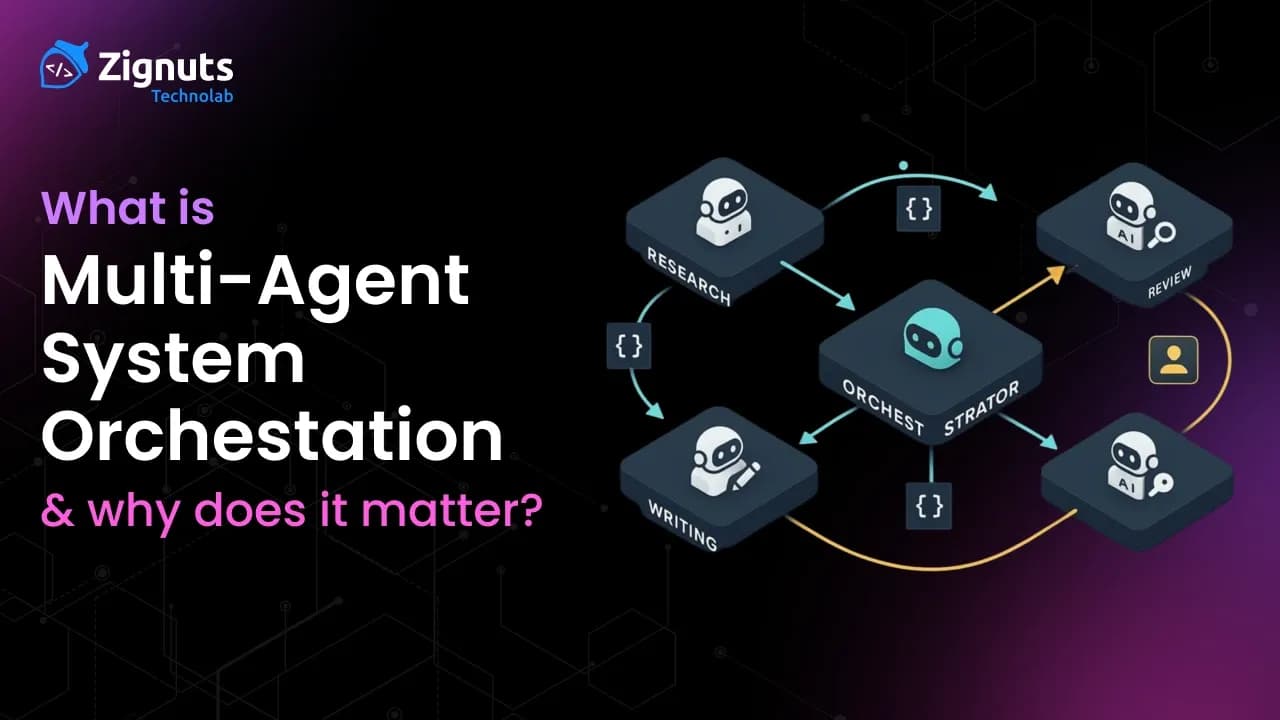
Artificial Intelligence is evolving rapidly, from single-task models to systems capable of solving complex, multi-step problems. One of the most powerful paradigms emerging in this space is the Multi-Agent System (MAS).
But building multiple intelligent agents is only half the story. The real challenge lies in coordinating them effectively. That’s where Multi-Agent System Orchestration comes in.
In this blog, we’ll break down:
- What multi-agent systems are
- What orchestration means in this context
- Why it matters in real-world applications
- How to implement it (with examples and code)
- Tools, patterns, and best practices
What is a Multi-Agent System (MAS)?
A Multi-Agent System is a system composed of multiple independent agents that:
- Perceive their environment
- Make decisions
- Interact with other agents
Each agent typically has a specific role or specialization.
Example
Think of a software development team:
- Developer → writes code
- Tester → tests code
- Manager → assigns tasks
Each works independently but contributes to a shared goal.
Similarly, in AI:
- One agent retrieves data
- Another process it
- Another generates output
What is Orchestration in Multi-Agent Systems?
Orchestration is the process of:
Coordinating multiple agents, managing their interactions, and ensuring they work together efficiently to achieve a goal.
Without orchestration:
- Agents may duplicate work
- Conflict with each other
- Fail to complete tasks
With orchestration:
- Tasks are structured
- Dependencies are managed
- Communication is controlled
1. Solving Complex Problems
Single AI models often struggle with multi-step reasoning, context switching, and handling diverse tasks simultaneously. As problem complexity increases, a single model becomes harder to scale and maintain effectively.
Multi-agent orchestration solves this by:
- Breaking large problems into smaller, manageable sub-tasks
- Assigning each task to a specialized agent
- Enabling parallel and structured execution
- Improving clarity in decision-making pipelines
This approach mimics real-world teams where specialists collaborate instead of relying on a single generalist.
Example:
User query → Research Agent → Analysis Agent → Response Agent
- Research Agent gathers relevant information
- Analysis Agent processes and refines insights
- Response Agent generates the final output
This structured flow significantly improves both efficiency and output quality.
Hire AI Developers Today!

2. Scalability
Traditional systems often require major redesigns when scaling to handle increased load or new features. In contrast, multi-agent orchestration is inherently scalable.
You can:
- Add new agents without redesigning the entire system
- Scale-specific agents are independent based on workload
- Distribute agents across multiple servers or environments
- Handle increasing user demands without degrading performance
For example, if data retrieval becomes a bottleneck, you can scale only the retrieval agents instead of the entire system.
This leads to:
- Better resource utilization
- Improved system performance under load
- Easier horizontal scaling
3. Modularity
One of the biggest advantages of multi-agent systems is modular architecture.
Each agent:
- Has a single, well-defined responsibility
- Operates independently with clear input/output contracts
- Can be developed, tested, and deployed separately
This allows:
- Faster development cycles
- Easier debugging and maintenance
- Independent upgrades without breaking the system
For instance, you can upgrade only the analysis agent’s logic without affecting retrieval or response generation.
This modularity is especially valuable in large-scale production systems.
4. Fault Tolerance
In traditional monolithic systems, a single failure can bring down the entire workflow. Multi-agent orchestration introduces resilience by design.
If one agent fails:
- Other agents can retry the task
- The orchestrator can reroute execution
- Fallback mechanisms can be triggered
- Partial results can still be utilized
Example:
If the Research Agent fails:
- Retry with a different data source
- Use cached data
- Continue with limited context
This ensures:
- System reliability
- Reduced downtime
- Graceful degradation instead of complete failure
5. Better Accuracy
General-purpose models try to do everything, which often leads to suboptimal performance in specialized tasks.
Multi-agent systems improve accuracy by:
- Using domain-specific agents
- Applying task-specific logic and prompts
- Reducing noise in decision-making
Example:
- A retrieval agent optimized for search
- An analysis agent optimized for reasoning
- A generation agent optimized for communication
Each agent performs its role more effectively than a single generalized system.
This results in:
- Higher quality outputs
- Better contextual understanding
- More reliable responses
Real-World Use Cases
1. AI Assistants
- Planner agent
- Tool execution agent
- Memory agent
2. Customer Support Automation
- Intent detection agent
- Knowledge retrieval agent
- Response generation agent
3. Autonomous Systems
- Perception agent
- Decision agent
- Action agent
Key Components of Multi-Agent Orchestration
1. Agents
Agents are independent, task-specific units responsible for performing defined operations within the system.
Each agent:
- Focuses on a single responsibility
- Takes input, processes it, and produces output
- Can operate independently or as part of a workflow
Examples include:
- Retrieval agents (data fetching)
- Processing/analysis agents (logic, reasoning)
- Generation agents (final output creation)
This separation enables specialization and efficiency.
2. Communication Layer
The communication layer defines how agents interact and exchange information with each other.
Common approaches include:
- Message passing → Agents send structured data/messages to one another
- Event-driven communication → Agents react to specific triggers or events
This layer ensures:
- Smooth data flow between agents
- Decoupling of components
- Flexibility in interaction patterns
A well-designed communication layer prevents tight coupling and dependency issues.
3. Orchestrator (Brain)
The orchestrator acts as the central control unit of the system.
It is responsible for:
- Managing the flow of execution
- Deciding the order in which agents run
- Handling failures, retries, and fallbacks
- Coordinating dependencies between agents
In many systems, this is implemented using:
- Workflow engines
- Graph-based execution models
Without an orchestrator, agents would act independently, leading to unstructured and inefficient workflows.
4. State Management
State management handles the shared memory or context that flows across agents during execution.
It ensures:
- Continuity between steps
- Consistent data availability
- Context preservation across the workflow
This can include:
- Intermediate results
- User inputs
- Execution metadata
Proper state management is critical for multi-step reasoning and decision-making.
Multi-Agent System Orchestration Patterns
1. Sequential Flow
Agents run one after another.
Agent A → Agent B → Agent C
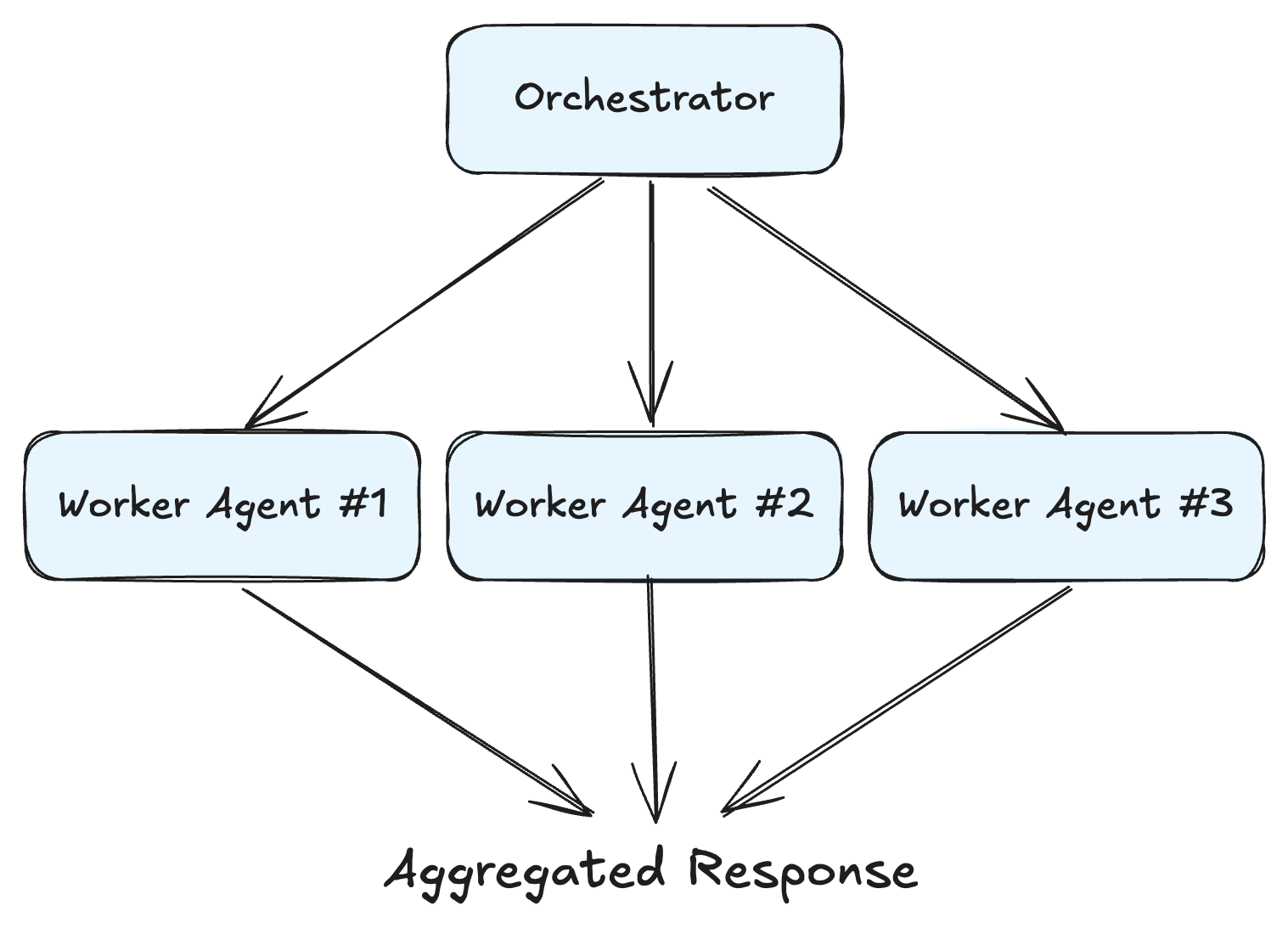
2. Parallel Execution
Agents run simultaneously.
Agent A ─┐
Agent B ─┼→ Aggregator
Agent C ─┘
3. Hierarchical (Manager-Worker)
One agent controls others.
4. Event-Driven
Agents react to events.
Example: Multi-Agent Orchestration in Python
Let’s build a simple orchestrated system.
Scenario
User asks a question → system:
- Retrieves data
- Processes it
- Generates response
Step 1: Define Agents
Step 2: Orchestrator
Step 3: Run System
Output
Advanced Example: Using Graph-Based Orchestration
Libraries like LangGraph enable structured orchestration.
Benefits Over Traditional Systems
| Feature | Traditional System | Multi-Agent Orchestration |
|---|---|---|
| Flexibility | Low | High |
| Scalability | Limited | High |
| Maintainability | Hard | Easy |
| Modularity | Poor | Excellent |
Challenges in Multi-Agent Orchestration
1. Coordination Complexity
Managing multiple agents introduces significant complexity, especially as the number of agents and interactions grows.
Challenges include:
- Defining clear execution flows and dependencies
- Ensuring agents do not conflict or duplicate work
- Handling dynamic decision-making across agents
As workflows become more advanced, maintaining proper coordination requires robust orchestration logic and design patterns.
2. Latency
Since tasks are divided into multiple steps, execution often becomes sequential or partially dependent, which can increase response time.
This happens due to:
- Multiple agent calls in a pipeline
- Waiting for intermediate results
- External API or tool dependencies
While parallel execution can reduce delays, optimizing latency remains a key challenge in real-time systems.
3. Debugging Difficulty
Debugging multi-agent systems is more complex than traditional applications because execution is distributed across multiple components.
Difficulties include:
- Tracing errors across multiple agents
- Identifying which agent caused the failure
- Understanding intermediate states and transitions
Without proper logging and observability, diagnosing issues can become time-consuming and error-prone.
4. Cost
Running multiple agents increases computational and operational costs, especially when using large AI models or external services.
Cost factors include:
- Multiple model/API calls per request
- Increased infrastructure usage
- Scaling agents for high traffic
Efficient orchestration, caching, and selective execution are essential to control and optimize costs.
Best Practices
1. Keep Agents Focused
Each agent should follow the single responsibility principle, handling only one specific task within the system.
This ensures:
- Better specialization and performance
- Easier testing and debugging
- Clear separation of concerns
Avoid building “do-it-all” agents, as they reduce clarity and increase complexity.
2. Use Clear Interfaces
Define well-structured input and output contracts for every agent.
This includes:
- Standardized data formats
- Clearly defined expected inputs
- Predictable outputs
Clear interfaces ensure smooth communication between agents and prevent integration issues.
3. Add Observability
Observability is critical for understanding system behavior and diagnosing issues.
You should:
- Implement logging at each agent level
- Use tracing tools to track execution flow
- Monitor performance and failures
This provides visibility into how data flows through the system and helps in faster debugging and optimization.
4. Implement Retry Logic
Failures are inevitable in distributed systems, so it’s important to handle them gracefully.
Best practices include:
- Adding retry mechanisms for failed agents
- Using fallback strategies when retries fail
- Preventing infinite retry loops
This improves system reliability and resilience without impacting the overall workflow.
5. Optimize Execution
Efficient execution is key to maintaining performance and cost-effectiveness.
You can:
- Use parallel processing where tasks are independent
- Avoid unnecessary agent calls
- Cache intermediate results when possible
Optimization ensures the system remains fast, scalable, and cost-efficient.
Tools & Frameworks
- LangGraph → Workflow orchestration
- Temporal → Durable execution
- OpenTelemetry → Observability
- Nango → Integration handling
When Should You Use Multi-Agent Orchestration?
Use it when:
- Tasks are complex and multi-step
- You need a modular architecture
- Systems require scalability
Avoid it when:
- The problem is simple
- Latency is critical
- Overhead isn’t justified
Future of Multi-Agent Systems
Multi-agent orchestration is becoming foundational in:
- Autonomous AI systems
- Enterprise automation
- AI copilots
It’s a shift from:
“One model does everything.”
to
“Multiple intelligent agents collaborate.”
Conclusion
Multi-Agent System Orchestration is not just a technical concept, it’s a paradigm shift in how we build intelligent systems.
By coordinating multiple specialized agents, we can:
- Build scalable systems
- Solve complex problems
- Create more reliable AI
As AI systems continue to evolve, orchestration will become the backbone of intelligent architectures.

Ekta Trivedi
A Node.js enthusiast focused on building scalable, high-performance applications that power the next generation of web technologies

Meet Shastri
Passionate developer with expertise in building scalable web applications and solving complex problems. Loves exploring new technologies and sharing coding insights.